Equisetum scirpoides
Michx.
iNaturalist· cc-by-nc
(c) Michael Tessler, some rights reserved (CC BY-NC)
iNaturalist· cc-by-nc
(c) Michael Tessler, some rights reserved (CC BY-NC)
iNaturalist· cc-by-nc
(c) Michael Tessler, some rights reserved (CC BY-NC)
Summary
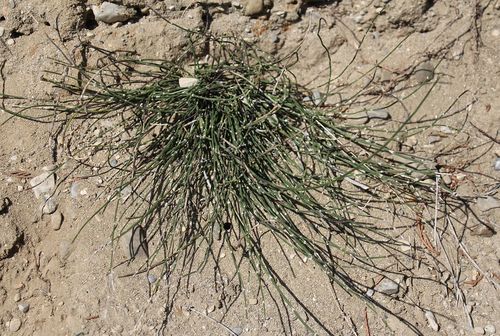
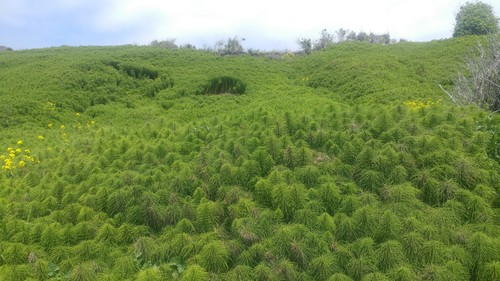
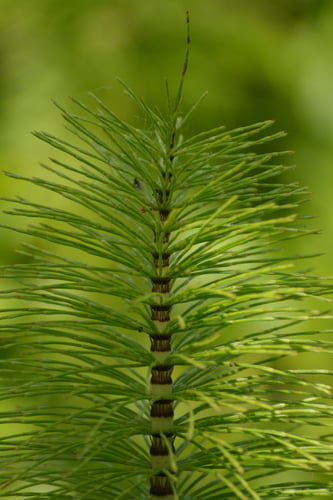
Source: WikipediaEquisetum scirpoides (dwarf scouring rush or dwarf horsetail) Michx., Fl. Bor.-Amer. 2: 281 (1803). 2 n = 216. The smallest of the currently occurring representatives of the genus Equisetum (horsetail). The smallest Equisetum, E. scirpoides has circumpolar distribution. Plants create compact and dense clumps, reaching a maximum height of about 30 cm. The assimilation and generative shoots are identical and grow together. The leaves reduced to a black sheath around the stem. The stems are green, unbranched, thick and about 1 mm with six ribs. The generative shoots with small cones dying after sowing the spores. The nodes occur at approximately 1 – 3 cm. The leaves are very small to about 1 mm, and arranged in around nodes. The corms are thin, yellow and brown. The roots very fine, black and densely surpassing the ground. Species grows best in the mud at the depth zone from 0 to 3 cm. Specimens reproduce primarily by vegetative division. Equisetum scirpoides is hardy and semi-evergreen. This species is quite a popular decorative plant seen in garden ponds, ornamental gardens and assumptions in nearly the whole world. E. scirpoides was discovered and described by French botanist André Michaux. Detailed studies were conducted by the American botanist Oliver Atkins Farwell.
Description
Evergreen perennial reaching 0.2 m tall and wide with slow growth. Hardy to UK zone 2. Tolerates light sandy, medium loamy, and heavy clay soils across mildly acid to very alkaline pH ranges. Grows in full shade, semi-shade, or open conditions, preferring moist or wet soil.
Edible Uses
The root tubercles can be eaten raw. Sterile stems are dried, ground into a powder, and used as a thickener or cooked into a mush; this powder has also been brewed into a tea and is sold in some grocery stores. Underground stems and roots are eaten raw, with or without lard, and are sometimes added to Indigenous ice cream. These underground parts are particularly prized in spring, when they are sweet and juicy — collected near water by some Native American groups as one of the first foods of the season.
Medicinal Uses
No specific reference was found for this species, but horsetails as a group have an unusual chemistry: they contain more than 35% silica, several alkaloids including nicotine, and various minerals. Horsetail is strongly astringent and acts as an effective clotting agent, useful for staunching wounds, stopping nosebleeds, and reducing coughing up of blood. It helps repair damaged connective tissue, improving both strength and elasticity. As a naturally occurring source of organic silica, it addresses conditions caused by poor silica absorption and retention, which can manifest as thin, splitting hair, weak or easily broken nails, hangnails, and lingering nail infections. In homeopathy, silica is called the 'homeopathic scalpel' for its perceived ability to open tissues, release pus and corrupted material, and cleanse and restore flesh, drawing heavy and unneeded materials to the surface.
Distribution
It is a temperate plant. It suits hardiness zones 5-11.
Where It Grows
Asia, China, Greenland, Japan, Korea, Mongolia, North America, Russia, USA,
Cultivation
A Long-lived perennial evergreen with fibrous roots and the smallest living horsetail. Can be used as an aquatic fern. Light requirement: Sun , Part Shade , Shade. Soil moisture: moist or wet (recommended water depth over crown of plant: 0 - 3cm (0 - 1 inch)). Water quality: pH 5.6-6.5. Useful for winter interest in a small pond, barrel, or tub garden, especially in shady areas. Pond Zone: flood plain - Upland. High marsh - saturated. soil spores shed from July through August, or persisting unopened until the following summer. Evergreen. Not a flowering plant. Reproduces by spores contained within sporangia borne on peltate sporophylls.
Propagation
Propagate by rhizome sections. The best rhizomes are harvested in spring, when plants are most vigorous. Sections around 6 inches long with healthy shoots emerging from their joints produce the strongest new plants.
Other Uses
The plant forms a medium-density groundcover of moderate quality. Its coarse green stems are used to scrub pots and clean dishes. Like larger horsetails, it can absorb heavy metals from soil, making it useful in remediation projects targeting heavy metal contamination. It provides wildlife benefits including cover, food, and nesting habitat for amphibians, fish, and waterfowl. It also functions as a dynamic accumulator and is suited to container growing and food forest systems.
Synonyms
Also Known As
Dwarf scouring rush, Dwarf horsetail
References (3)
- Jackes, D. A., Edible Forest Gardens
- Urgamal, M., et al, 2014, Conspectus of the Vascular Plants of Mongolia. Mongolia Academy of Sciences Institute of Botany and National University of Mongolia Department of Biology. p 31
- www.eFloras.org Flora of China