Ephedra vulgaris
Rich.
Teamster’s Tea
wikimedia· cc-by-sa
Wikimedia Commons - Le.Loup.Gris
wikimedia· cc-by-sa
Wikimedia Commons - Le.Loup.Gris
Description
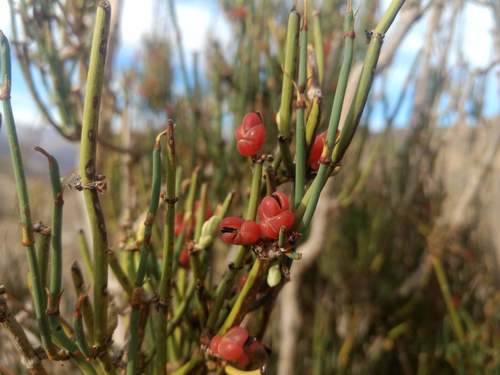
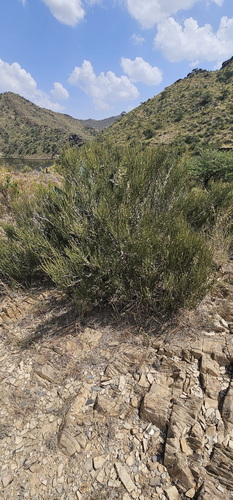
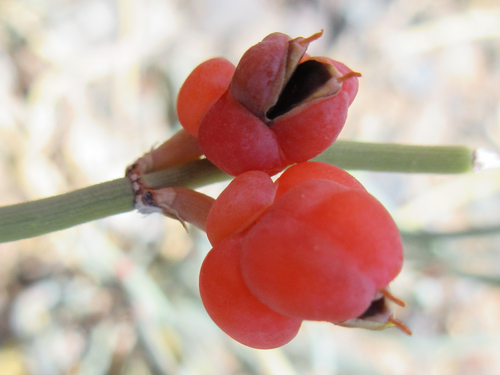
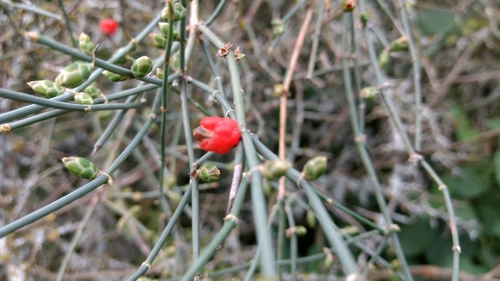
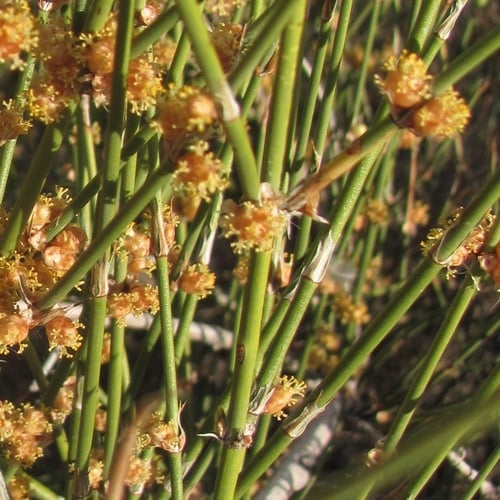
An evergreen shrub. It grows 2 m high and spreads 1.5 m wide. The stem is slender and has grooves. It is green and branches. The leaves are small and like scales. Plants are separately male and female. The male flowers have yellow pollen sacs. The cones are succulent and has 2 sections with a seed in each. The fruit are 1 cm long. They can be pink or red.
Edible Uses
Ephedra distachya is used to relieve acute muscular and rheumatic pains (when it is called teamsters' tea), as a stimulant, and in the cardio tonics in Ayurveda. It is sometimes identified with the legendary drug soma, as described in the Avesta and the Rig Veda, the respective ancient sacred texts of the Zoroastrian and Hindu faiths. Ephedrine, an alkaloid, is obtained from its dried branches and is used as a stimulant, often to control asthma. It was isolated from the plant by Nagayoshi Nagai in 1885. All parts of the plant contain up to 3% ephedrine.
Known Hazards
Although Ephedra has many benefits, it has side effects including insomnia and a fast heart rate.
Distribution
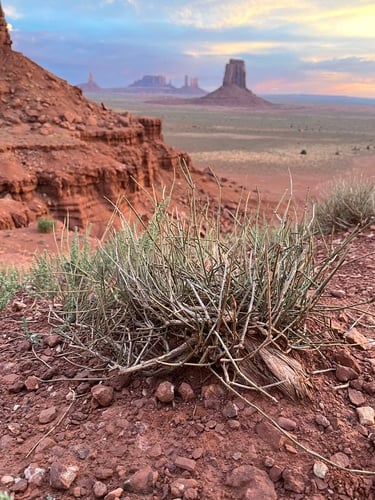
It is a temperate plant. It is best in sandy, arid soils. It suits an open, sunny position. It is resistant to drought or frost. In Pakistan it grows in the Himalayas between 2,300-4,000 m above sea level.
Where It Grows
Australia, China*, Japan, North America, Pakistan, Siberia, USA,
Cultivation
Plants can be grown by seeds.
Notes
There are about 40 Ephedra species.
References (3)
- Anonymous, 2000, Selected edible wild plants of Pakistan north of Lahore, Including Pakistan-held Jammu-Kashmir. Central Intelligence Agency.
- Bodkin, F., 1991, Encyclopedia Botanica. Cornstalk publishing, p 383
- Comm. bot. Conif. Cycad. 46, t. 4, fig. 1. 1826