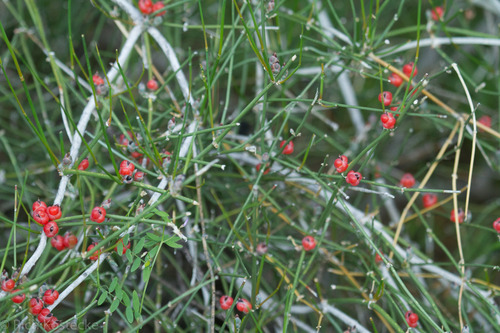
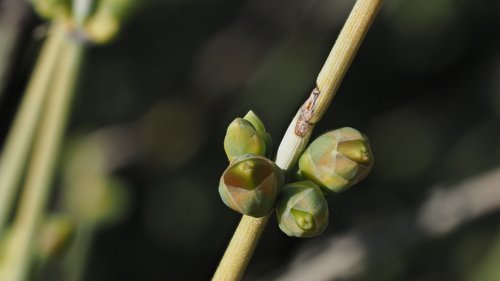
Ephedra distachya
L.
Sea grape, European shrubby horsetail, European joint pine, Ma huang
iNaturalist· cc-by-nc
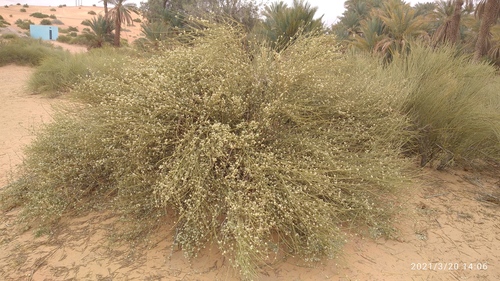
(c) Vadim Prokhorov, some rights reserved (CC BY-NC), uploaded by Vadim Prokhorov
iNaturalist· cc-by-nc
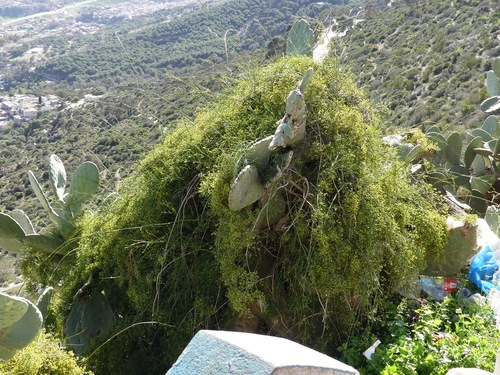
(c) Сергей, some rights reserved (CC BY-NC)
iNaturalist· cc-by-nc
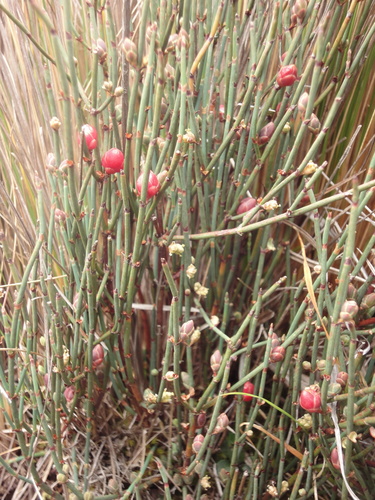
(c) Дмитрий Епихин, some rights reserved (CC BY-NC)
Summary
Source: WikipediaEphedra distachya is a shrub in the family Ephedraceae that stands about 25 cm to 50 cm high. The shrub grows in many parts of the world, including southern and central Europe and western and central Asia. Its local names include somlatha. Ephedra distachya lives on grey dunes which are fixed and stable sand dunes that are covered in continuous vegetation.
Description
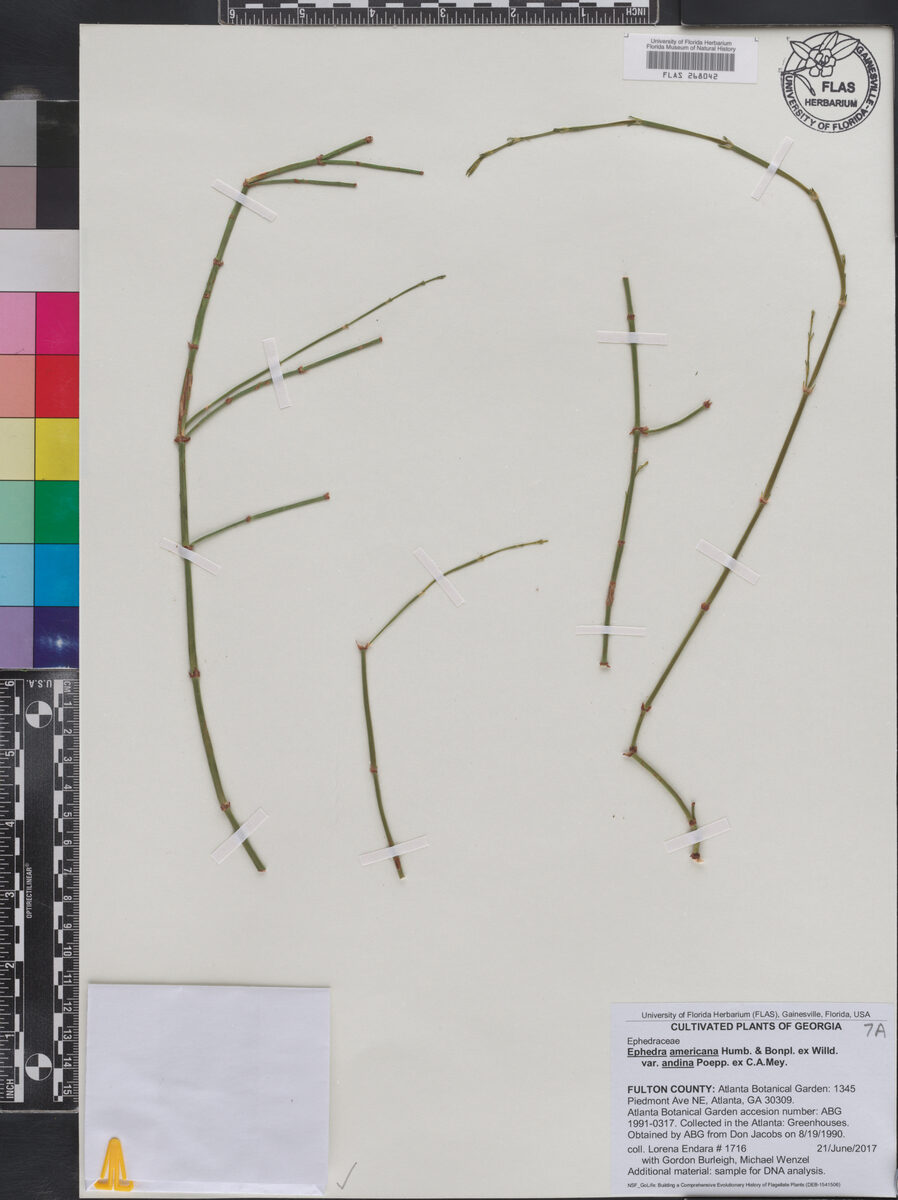
A low, creeping evergreen shrub. It grows about 1 m high. It spreads 90 cm wide. The branches are slender and erect. The leaves are like scales. The fruit is oval and succulent. It is pale or bright red when ripe. Fruit are 6-7 mm across.
Edible Uses
The fruit is eaten raw. It has a sweet but rather insipid flavour and measures about 6mm in diameter.
Traditional Uses
The fruit are eaten fresh. Caution: The stems contain ephedrine which can be addictive.
This uses section is brief — help expand it
Medicinal Uses
Members of this genus contain medicinally active alkaloids, most notably ephedrine, and are widely used in preparations for asthma and catarrh. Using the whole plant at much lower concentrations than the isolated alkaloids rarely gives rise to side-effects. The plant also has antiviral properties, particularly against influenza. The stems are a pungent, bitter, warm herb that dilates the bronchial vessels while stimulating the heart and central nervous system. They are also antitussive, diuretic, diaphoretic, febrifuge, hypertensive, nervine, tonic, and vasoconstrictor. Internally they are used to treat asthma, hay fever, and allergic complaints, and are combined with other herbs for a wide range of conditions. This herb should be used with great caution, preferably under the supervision of a qualified practitioner. It should not be prescribed to patients taking monoamine oxidase inhibitors or those suffering from high blood pressure, hyperthyroidism, or glaucoma. Ephedrine is classified as a performance-boosting substance and is banned in many sporting events. Stems can be harvested at any time of year and dried for later use.
Known Hazards
Although Ephedra has many benefits, it has side effects including insomnia and a fast heart rate.
Distribution
It is a temperate plant. It grows in rocky places, sandy shores and stream banks in Mediterranean countries. It suits hardiness zones 4-9.
Where It Grows
Asia, Australia, Britain, China, Europe, Japan, Mediterranean, Portugal, Russia, Siberia, Spain, Yugoslavia,
Cultivation
Requires a well-drained loamy soil and a sunny position. Established plants are drought resistant and are also lime tolerant. Plants are hardy to at least -15°c. This species does not flower or fruit well in Britain. Dioecious. Male and female plants must be grown if seed is required.
Propagation
Sow seed as soon as it is ripe in autumn in a greenhouse, or in spring in a greenhouse using a sandy compost. Prick out seedlings into individual pots once large enough to handle and grow on for at least their first winter under glass. Plant out in spring or early summer after the last expected frosts, with some protection during their first winter. Can also be propagated by division in spring or autumn, or by layering.
Other Uses
Plants can be used for ground cover, spaced about 60cm apart each way.
Notes
There are about 40 Ephedra species.
References (8)
- Blamey, M and Grey-Wilson, C., 2005, Wild flowers of the Mediterranean. A & C Black London. p 30
- Brown, D., 2002, The Royal Horticultural Society encyclopedia of Herbs and their uses. DK Books. p 201
- Cundall, P., (ed.), 2004, Gardening Australia: flora: the gardener's bible. ABC Books. p 539
- Etherington, K., & Imwold, D., (Eds), 2001, Botanica's Trees & Shrubs. The illustrated A-Z of over 8500 trees and shrubs. Random House, Australia. p 280
- Facciola, S., 1998, Cornucopia 2: a Source Book of Edible Plants. Kampong Publications, p 94
Show all 8 references Hide references
- Hedrick, U.P., 1919, (Ed.), Sturtevant's edible plants of the world. p 291
- Plants for a Future database, The Field, Penpol, Lostwithiel, Cornwall, PL22 0NG, UK. http://www.scs.leeds.ac.uk/pfaf/
- Sp. pl. 2:1040. 1753