Ephedra gerardiana
Wall. ex Stapf.
iNaturalist· cc-by-nc
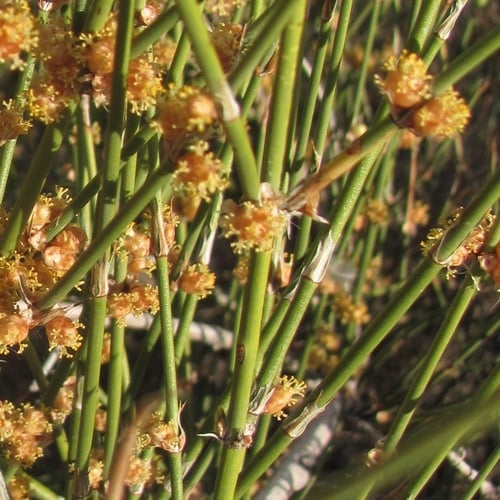
(c) madfox, some rights reserved (CC BY-NC), uploaded by madfox
iNaturalist· cc-by-nc
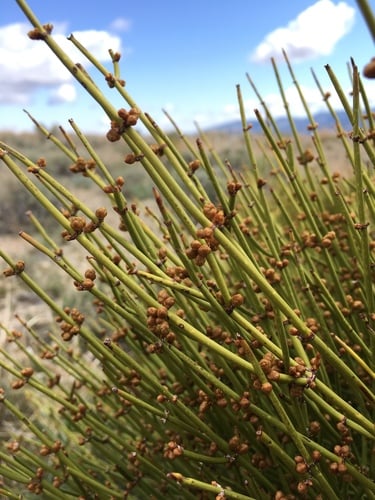
(c) floragastrell, some rights reserved (CC BY-NC)
Summary
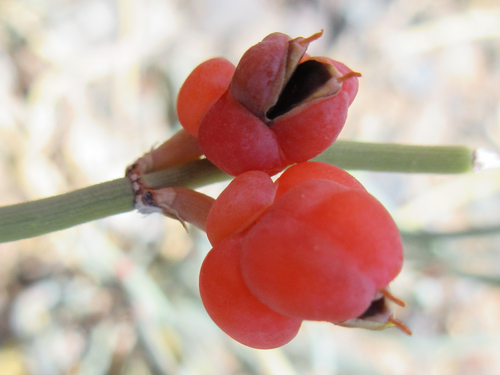
Source: WikipediaEphedra gerardiana (Gerard's jointfir, 山岭麻黄 shan ling ma huang) is a species of Ephedra, endemic to the mountains of Afghanistan, Bhutan, northern India, Nepal, Pakistan, Sikkim, Tajikistan, and Tibet. It is a perennial small shrub composed primarily of fibrous stalks, generally about 8 inches though sometimes growing to 24 inches in height, with small, yellow flowers followed by round, red, edible fruits. It is sometimes used as a stimulant, and in Ayurvedic medicine its tea is used as medicine for colds, coughs, bronchitis, asthma, and arthritis.
Description
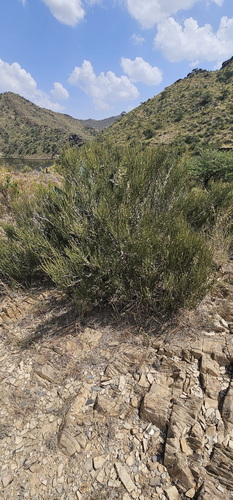
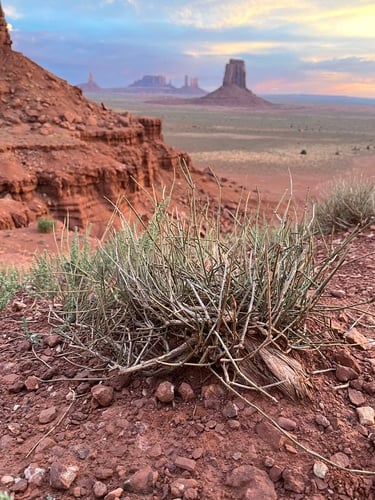
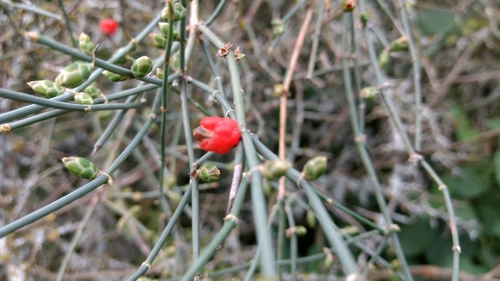
A creeping evergreen shrub. The branches are thin and dark green. It grows 30 cm high. It spreads 1.8 m wide. The leaves are reduced to sheaths at the nodes of the branches. The male flowers are in single spikes. The female flowers occur singly. The fruit are small and purple. They have a sticky juice.
Edible Uses
The fruit is eaten raw and has a sweet flavour. It measures about 7mm in diameter.
Traditional Uses
The ripe fruit are eaten. It contains alkaloids including ephedrine.
This uses section is brief — help expand it
Medicinal Uses
Members of this genus contain medicinally active alkaloids, most notably ephedrine, and are widely used in preparations for asthma and catarrh. Ephedrine acts promptly to reduce swelling of the mucous membranes and has antispasmodic properties, making it valuable for asthma treatment. This species contains between 0.28 and 2.79% alkaloids. Using the whole plant at much lower concentrations than isolated constituents rarely causes side-effects. The plant also has antiviral properties, particularly against influenza. The stems are a pungent, bitter, warm herb that dilates the bronchial vessels while stimulating the heart and central nervous system. They are also diaphoretic, diuretic, and vasodilator, and are used internally for asthma, hay fever, and allergic complaints. They are also combined with other herbs for a wide range of conditions. This herb should be used with great caution, preferably under the supervision of a qualified practitioner. It should not be prescribed to patients taking monoamine oxidase inhibitors or those with high blood pressure, hyperthyroidism, or glaucoma. Ephedrine is banned in many sporting events as a performance-enhancing substance. In Tibetan medicine, the stems are considered to have a bitter taste and cooling potency; they are used as a febrifuge, tonic, and vulnerary in the treatment of severe bleeding and chronic fevers. A decoction of the stems and roots is used in Russia to treat rheumatism and syphilis. The juice of the berries is used to treat respiratory complaints. Stems can be harvested at any time of year and dried for later use.
Known Hazards
Should be used with great caution under qualified supervision. Contraindicated for patients taking monoamine oxidase inhibitors or with high blood pressure, hyperthyroidism, or glaucoma. Ephedrine is a banned performance-enhancing substance in sports.
Distribution
It is a temperate plant. It grows well over rocky banks. It grows in dry and temperate regions between 2,300 - 5,100 m altitude in the Indian Himalayas. It suits hardiness zones 7-10.
Where It Grows
Afghanistan, Asia, Australia, Bhutan, Canada, Central Asia, China, Europe, Himalayas, India, Nepal, Pakistan, Sikkim, Tajikistan, Tibet, Turkey, Türkiye,
Cultivation
Requires a well-drained loamy soil and a sunny position. Established plants are drought resistant and are also lime tolerant. Plants are hardy to about -15°c. Dioecious. Male and female plants must be grown if seed is required.
Propagation
Sow seed as soon as it is ripe in autumn in a greenhouse, or in spring in a greenhouse using a sandy compost. Prick out seedlings into individual pots once large enough to handle and grow on for at least their first winter under glass. Plant out in spring or early summer after the last expected frosts, with some protection during their first winter. Can also be propagated by division in spring or autumn, or by layering.
Other Uses
The wood is very close-grained but too small for commercial use; it is used locally for fuel. The plant also makes good ground cover for dry soils, with plants spaced about 60cm apart each way.
Other Information
The fruit are eaten especially by children.
Notes
There are about 40 Ephedra species. It is used in medicine. It is a source of the alkaloid ephedrine.
Nutrition
| Part | Moisture | kJ | kcal | Protein | Vit A | Vit C | Iron | Zinc |
|---|---|---|---|---|---|---|---|---|
| Fruit - dry | — | — | 8.3 | — | — | — | — | — |
Synonyms
Also Known As
Asmania, Budagur, Butshubr, Charay, Chepat, Chewa, Chhapat, Khanda phag, Lata, Ma Huang, Somlata, Tachi, Teapat, Thayon, Trano, Tse, Tsepat, Tutgantha
References (17)
- Ambasta, S.P. (Ed.), 2000, The Useful Plants of India. CSIR India. p 197
- Ballabh, B., et al, 2007, Raw edible plants of cold desert Ladakh. Indian Journal of Traditional Knowledge. 6(1) pp 182-184
- Cundall, P., (ed.), 2004, Gardening Australia: flora: the gardener's bible. ABC Books. p 539
- Denkschr. Kaiserl. Akad. Wiss. Wien, Math.-Naturwiss. Kl. 56:75. 1889
- Dobriyal, M. J. R. & Dobriyal, R., 2014, Non Wood Forest Produce an Option for Ethnic Food and Nutritional Security in India. Int. J. of Usuf. Mngt. 15(1):17-37
Show all 17 references Hide references
- Dorjey, K., et al, 2012, Ethnobotanical observations in Trans-Himalayan Region of Ladakh. Journal of Plant Development Sciences Vol. 4 (4): 459-464.
- Dorjey, K., 2015, Exploration of Plant based Traditional Knowledge from Sham region of Ladakh (J. & K.), India. Journal of Plant Development Sciences Vol. 7 (5) : 429-433.
- Etherington, K., & Imwold, D., (Eds), 2001, Botanica's Trees & Shrubs. The illustrated A-Z of over 8500 trees and shrubs. Random House, Australia. p 281
- Flora of Pakistan. www.eFloras.org
- Kaul, M.K. et al, 1985, Ethno-botanic studies in North-West and Trans-Himalaya - contribution to the wild food plants of Ladakh. J. Econ. Tax. Bot. Vol. 6 No. 3 pp 523-527
- Negi, P. S. & Subramani, S. P., 2015, Wild Edible Plant Genetic Resources for Sustainable Food Security and Livelihood of Kinnaur District, Himachal Pradesh, India, International Journal of Conservation Science. 6 (4): 657-668
- Plants for a Future database, The Field, Penpol, Lostwithiel, Cornwall, PL22 0NG, UK. http://www.scs.leeds.ac.uk/pfaf/
- Sharma, L. et al, 2018, Diversity, distribution pattern, endemism and indigenous uses of wild edible plants in Cold Desert Biosphere Reserve of Indian Trans Himalaya. Indian Journal of Traditional Knowledge. Vol 17(1) January 2018 pp 122-131
- Singh, H., Saklani, A. & Lal B., 1990, Ethnobotanical Observations on Some Gymnosperms of Garhwal Himalaya, Uttar Pradess, India. Economic Botany. Vol. 44, No. 3, pp. 349-354
- Upreti, K., et al, 2010, Diversity and Distribution of Wild Edible Fruit Plants of Uttarakhand. Bioversity Potentials of the Himalaya. p 168
- Wild edible plants of Himachal Pradesh
- Young, J., (Ed.), 2001, Botanica's Pocket Trees and Shrubs. Random House. p 338