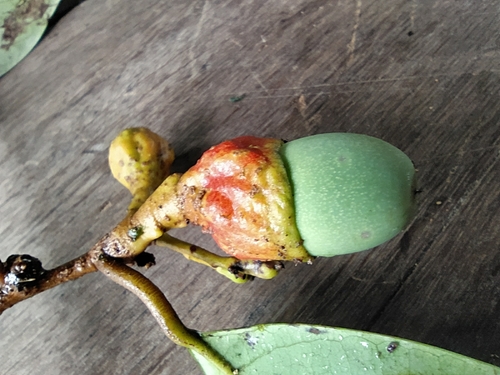
Endiandra pubens
Meisner
Hairy Walnut, Boomban
iNaturalist· cc-by-nc
(c) Pete Woodall, some rights reserved (CC BY-NC), uploaded by Pete Woodall
iNaturalist· cc-by-sa
(c) Greg Tasney, some rights reserved (CC BY-SA)
Summary
Source: WikipediaEndiandra pubens is a rainforest tree growing in eastern Australia. The habitat is subtropical rainforest growing near streams in valleys. The range of natural distribution is from the Bellinger River, New South Wales to Bulburin National Park, south west of Gladstone, Queensland. Common names include rusty walnut, hairy walnut, possum apple, red apple and whitebark walnut. Despite the common names, this tree belongs to the laurel family.
Description
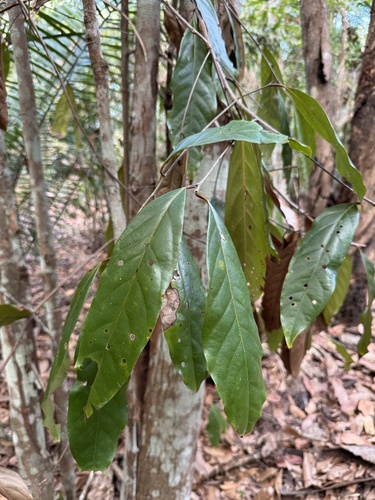
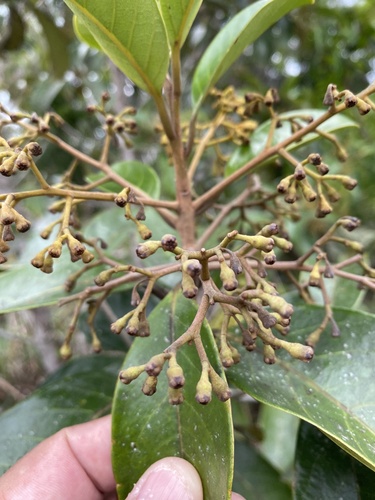
A medium sized tree. It grows 10-25 m high. It spreads 6-12 m across. It has a spreading canopy. The leaves are oval and smooth. They are shiny green above and have rusty hairs underneath. They are 7-20 cm long by 3-8 cm wide. New growth is reddish. The flowers are bell-shaped and white. They are 0.3 cm across. They are in small panicles 2-4 cm long in the axils of the upper leaves. The fruit is round and red. It is 4-8 cm across.
Edible Uses
The fruit are roasted, husked, ground into flour, then leached before eating.
Traditional Uses
The fruit are roasted, husked, ground into flour, then leached before eating.
This uses section is brief — help expand it
Distribution
A tropical plant. It grows in warm temperate to tropical regions. It needs well drained soil. It does best with light shade. It grows in rainforests in Queensland and New South Wales in Australia.
Where It Grows
Australia,
Cultivation
Plants can be grown from fresh seed or cuttings. To grow from seed, remove the flesh and crack the hard seed coat. Seedlings are very slow to germinate. Cuttings are also slow to grow.
Notes
There are about 30-100 Endiandra species.
Synonyms
References (17)
- Cherikoff V. & Isaacs, J., The Bush Food Handbook. How to gather, grow, process and cook Australian Wild Foods. Ti Tree Press, Australia p 199
- Cribb, A.B. & J.W., 1976, Wild Food in Australia, Fontana. p 85
- Cronin, L., 1989, The Concise Australian Flora. Reed. p 150
- Elliot, W.R., & Jones, D.L., 1984, Encyclopedia of Australian Plants suitable for cultivation. Vol 3. Lothian. p 404
- Elliot, W.R., & Jones, D.L., 1984, Encyclopedia of Australian Plants suitable for cultivation. Vol 3. Lothian. p 402
Show all 17 references Hide references
- Hibbert, M., 2002, The Aussie Plant Finder 2002, Florilegium. p 92
- Jackes, B.R., 2001, Plants of the Tropics. Rainforest to Heath. An Identification Guide. James Cook University. p 60 (As Endiandra insignis)
- Jones D, L, 1986, Ornamental Rainforest Plants in Australia, Reed Books, p 167
- Lazarides, M. & Hince, B., 1993, Handbook of Economic Plants of Australia, CSIRO. p 90
- Menninger, E.A., 1977, Edible Nuts of the World. Horticultural Books. Florida p 10 (As Endiandra insignis)
- Molyneux, B & Forrester, S., 1997, The Austraflora A-Z of Australian Plants. Reed. p 76
- Morley, B.D., & Toelken, H.R., (Eds), 1983, Flowering Plants in Australia. Rigby. p 44 (As Endiandra insignis)
- Nicholson, N & H., 1996, Australian Rainforest Plants, Terania Rainforest Publishing. NSW. p 30
- Ratcliffe D & P., 1987, Australian Native Plants for Indoors. Little Hills press. p 86 (As Endiandra pubescens ?)
- Townsend, K., 1994, Across the Top. Gardening with Australian Plants in the tropics. Society for Growing Australian Plants, Townsville Branch Inc. p 181
- Wickens, G.E., 1995, Edible Nuts. FAO Non-wood forest products. FAO, Rome. p 138 (As Endiandra insignis)
- Williams, J.B., Harden, G.J., and McDonald, W.J.F., 1984, Trees and shrubs in rainforests of New South Wales and Southern Queensland. Univ. of New England, Armidale. p 83