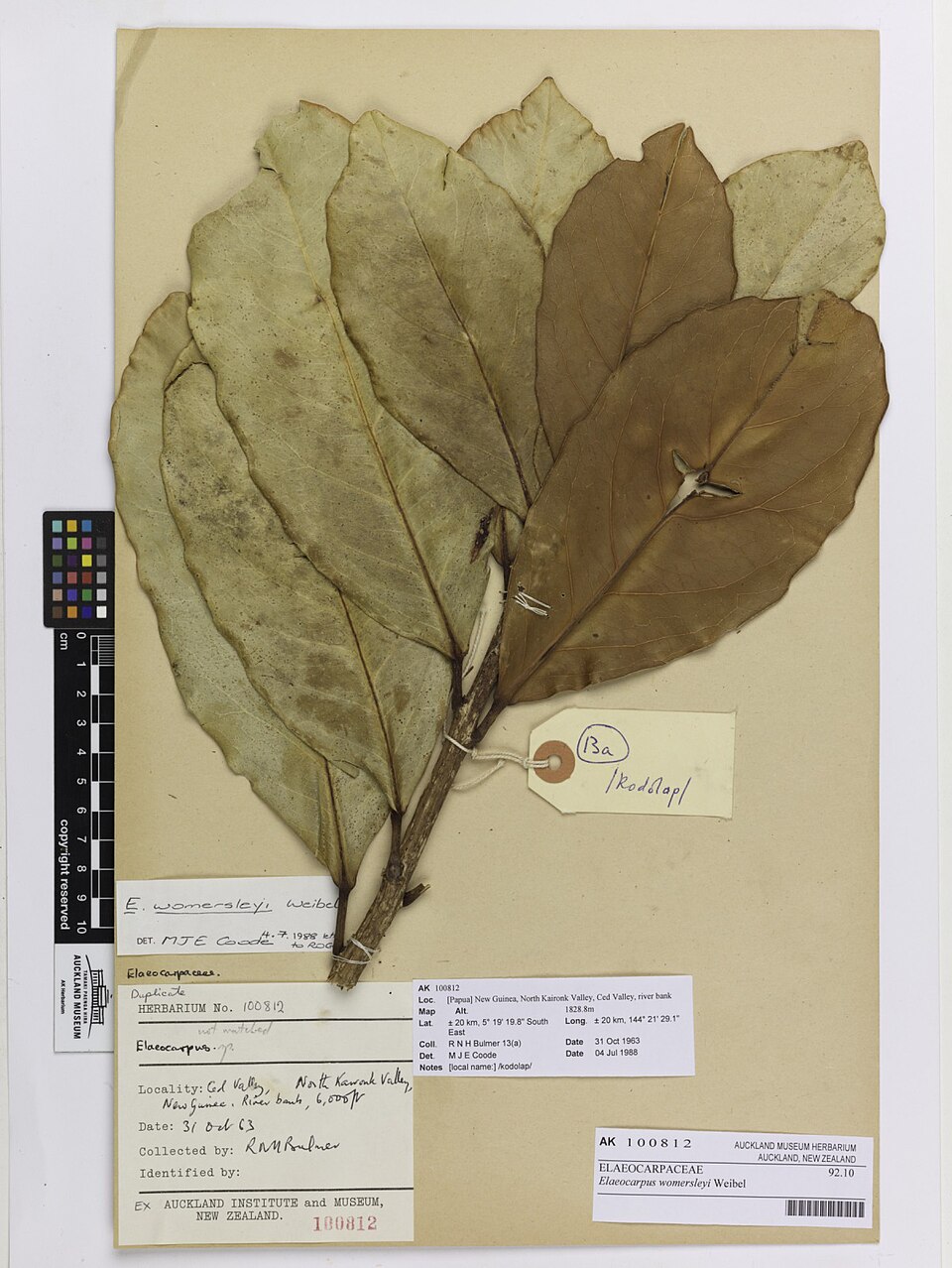
Elaeocarpus culminicola
Warb.
Qandong, Michael's quandong
iNaturalist· cc-by-sa
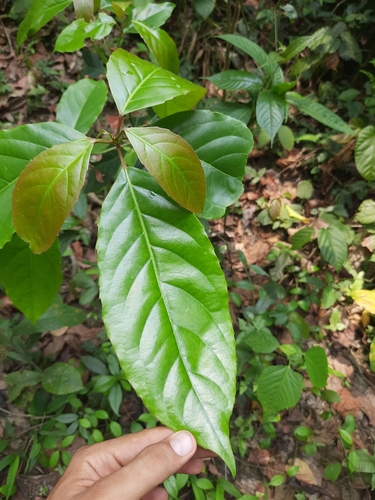
(c) Steve Fitzgerald, some rights reserved (CC BY-SA)
iNaturalist· cc-by-sa
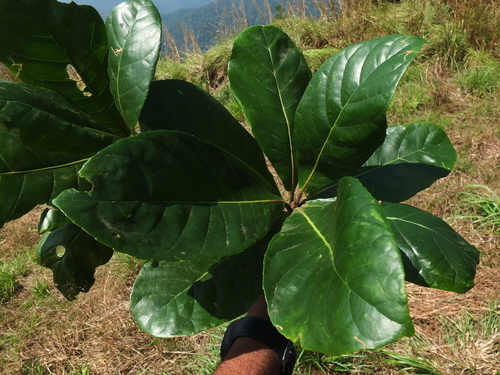
(c) Steve Fitzgerald, some rights reserved (CC BY-SA)
iNaturalist· cc-by-sa
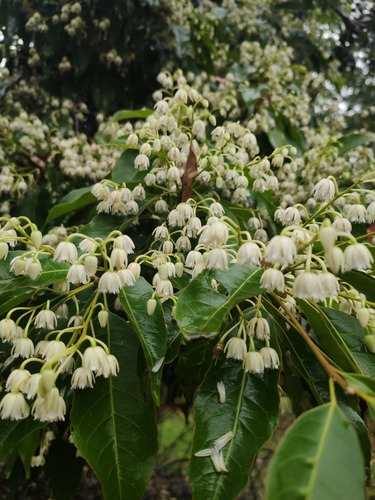
(c) Steve Fitzgerald, some rights reserved (CC BY-SA)
Summary
Source: WikipediaElaeocarpus culminicola, commonly known as Michael's quandong, is a species of flowering plant in the family Elaeocarpaceae and is native to parts of Malesia and Australasia. It is a tree with wavy leaves with wavy or toothed edges, racemes of white, cream-coloured or pink flowers and more or less spherical fruit.
Description
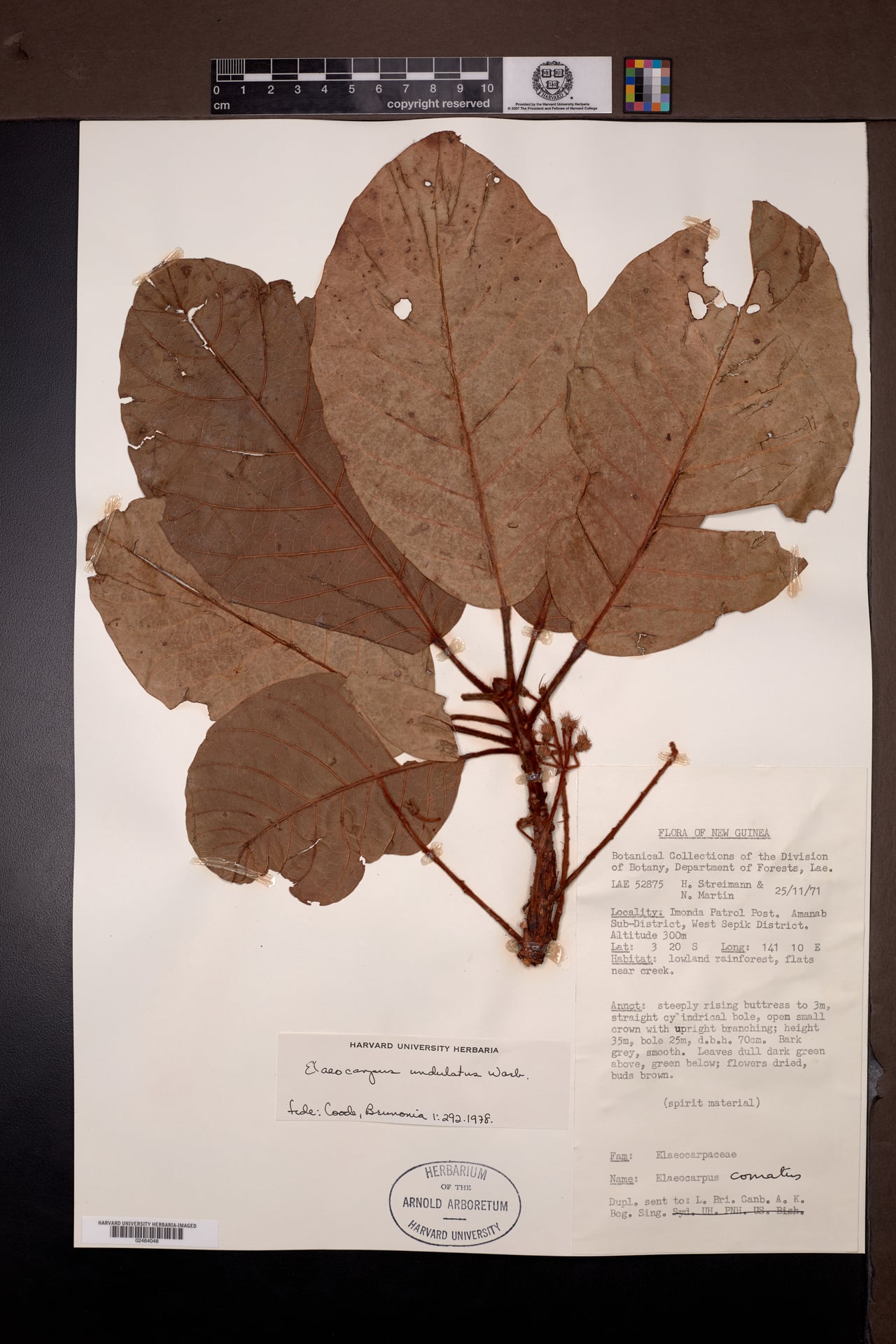
A shrub or bushy tree. It grows up to 10-25 m tall. It can have buttresses. The leaves are glossy and bright green. The are leathery and 12 cm long by 6 cm wide. The edges of the leaf have coarse teeth. The flower racemes are 7 cm long and the flowers 1.5 cm long. The flowers are pink and bell shaped. The fruit are blue, oval and 1.5 cm long.
Edible Uses
The blue oval fruit are eaten.
Distribution
A tropical plant. It needs a sunny sheltered position.
Where It Grows
Australia*, Pacific, Papua New Guinea, PNG,
Cultivation
Plants can be grown from fresh seed. The seed germinates erractically.
Propagation
The seed of most species in this genus is covered by a hard, woody shell and can be very slow and erratic to germinate, sometimes taking 2 years or more. Filing down the shell, or cracking it (being very careful not to damage the seed) in order to allow the ingress of moisture can help to greatly speed up germination. Sow the seed in containers in light shade. When the seedlings are large enough to handle, prick them out into individual pots and grow them on until large enough to plant out, Cuttings of almost ripe shoots, in a sandy soil in a frame. The leaves should be left on the stem.. Many species strike readily from cuttings.
Other Uses
A commercial hardwood. We have no more information on the specific properties of the wood of this species, however the following is a general description of the wood from this genus:- The heartwood is light-yellowish white to pink-brown, it is not distinctly demarcated from the sapwood. The texture is moderately fine and even, with straight to shallowly interlocked grain. The wood is soft to moderately hard; light in weight to moderately heavy; weak; not very durable. It seasons fairly slowly with slight end and surface checking; shrinkage is fairly low. It is easy to resaw and cross-cut; planing is easy and leaves a moderately smooth finish; nailing properties are good. A general purpose wood, it is suitable for purposes such as general planking, shuttering, boxes, crates, wooden pallets, match splints, veneer and plywood.
Production
In Australia, flowering occurs August to Spetember and fruit are ripe February to March.
Notes
There are about 360 Elaeocarpus species mostly in the tropics.
Synonyms
References (4)
- Coode, M.J.E., in Henty, E.E., (Ed.), 1981, Handbooks of the Flora of Papua New Guinea, Melbourne University Press, p 126
- Cooper W & Cooper W T, 1994, Fruits of the Rain Forest. RD Press p 106
- Cooper, W. and Cooper, W., 2004, Fruits of the Australian Tropical Rainforest. Nokomis Editions, Victoria, Australia. p 159
- Jones D, L, 1986, Ornamental Rainforest Plants in Australia, Reed Books, p 141