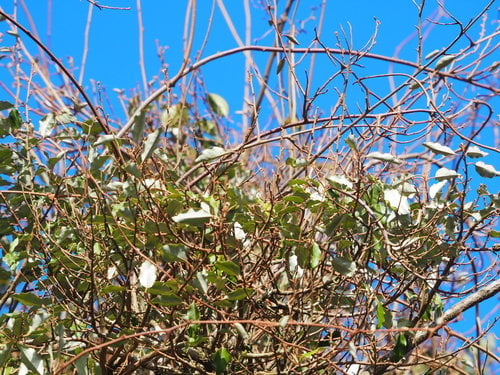
Elaeagnus macrophylla
Thunb.
iNaturalist· cc-by-sa
(c) peganum, some rights reserved (CC BY-SA)
iNaturalist· cc-by-nc
(c) Anton Gjeldum, some rights reserved (CC BY-NC)
iNaturalist· cc-by-nc
(c) Anton Gjeldum, some rights reserved (CC BY-NC)
Summary
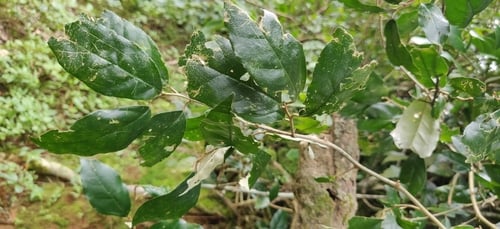
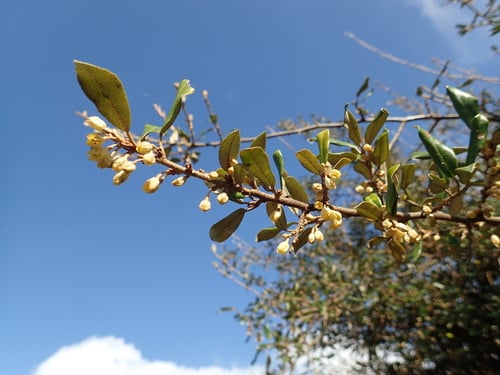
Source: WikipediaElaeagnus macrophylla, the broad-leaved oleaster, is a species of flowering plant native to eastern Asia. Growing to 4 m (13 ft) tall by 8 m (26 ft) broad, it is a substantial spreading evergreen shrub, with round glossy leaves which are silvery when young. Heavily fragrant cream flowers in autumn are followed by red fruit in spring. Elaeagnus × submacrophylla, formerly known as Elaeagnus × ebbingei, is a hybrid between E. macrophylla and E. pungens. The hybrid and its cultivars are grown in gardens as ornamental plants.
Description
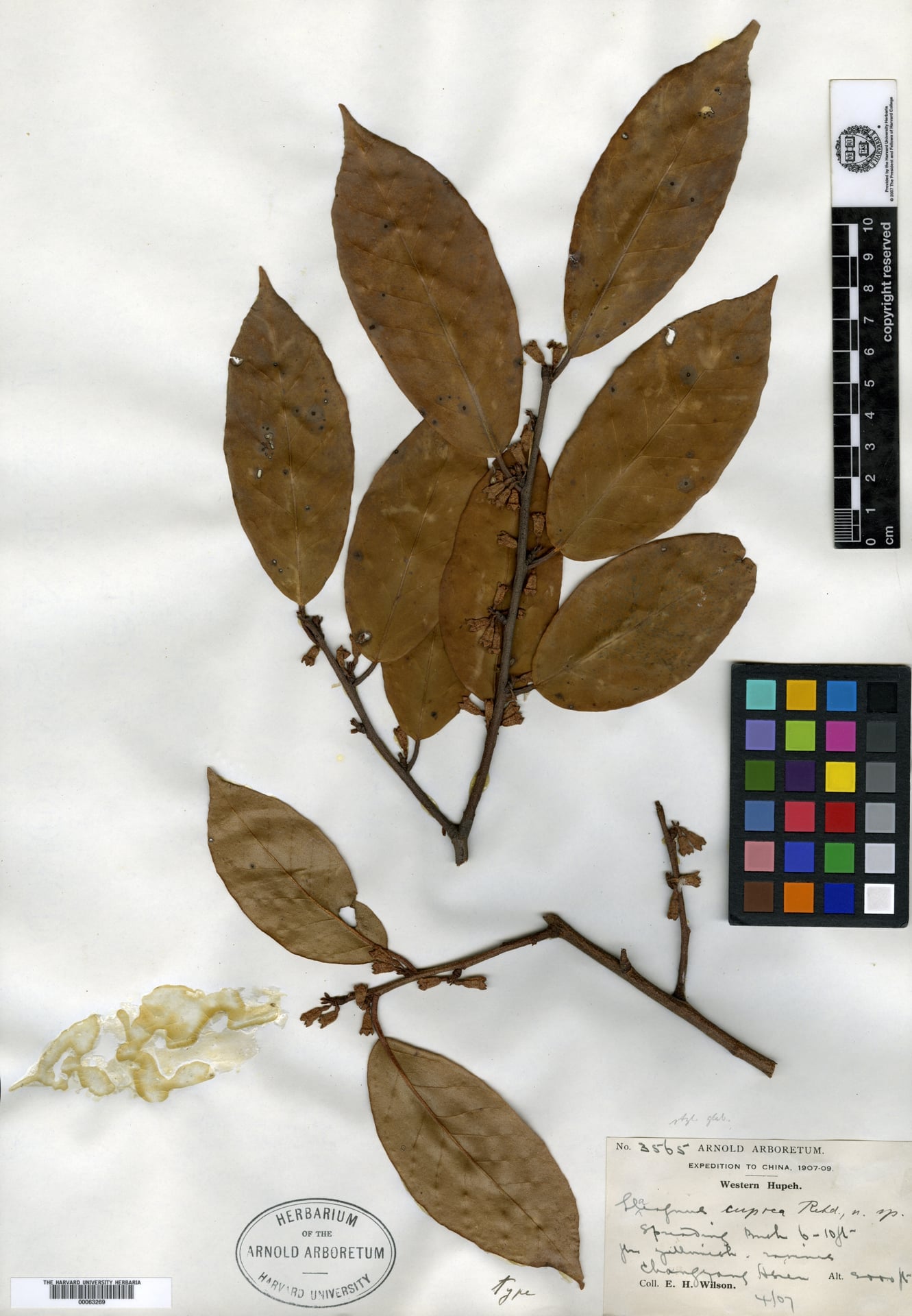
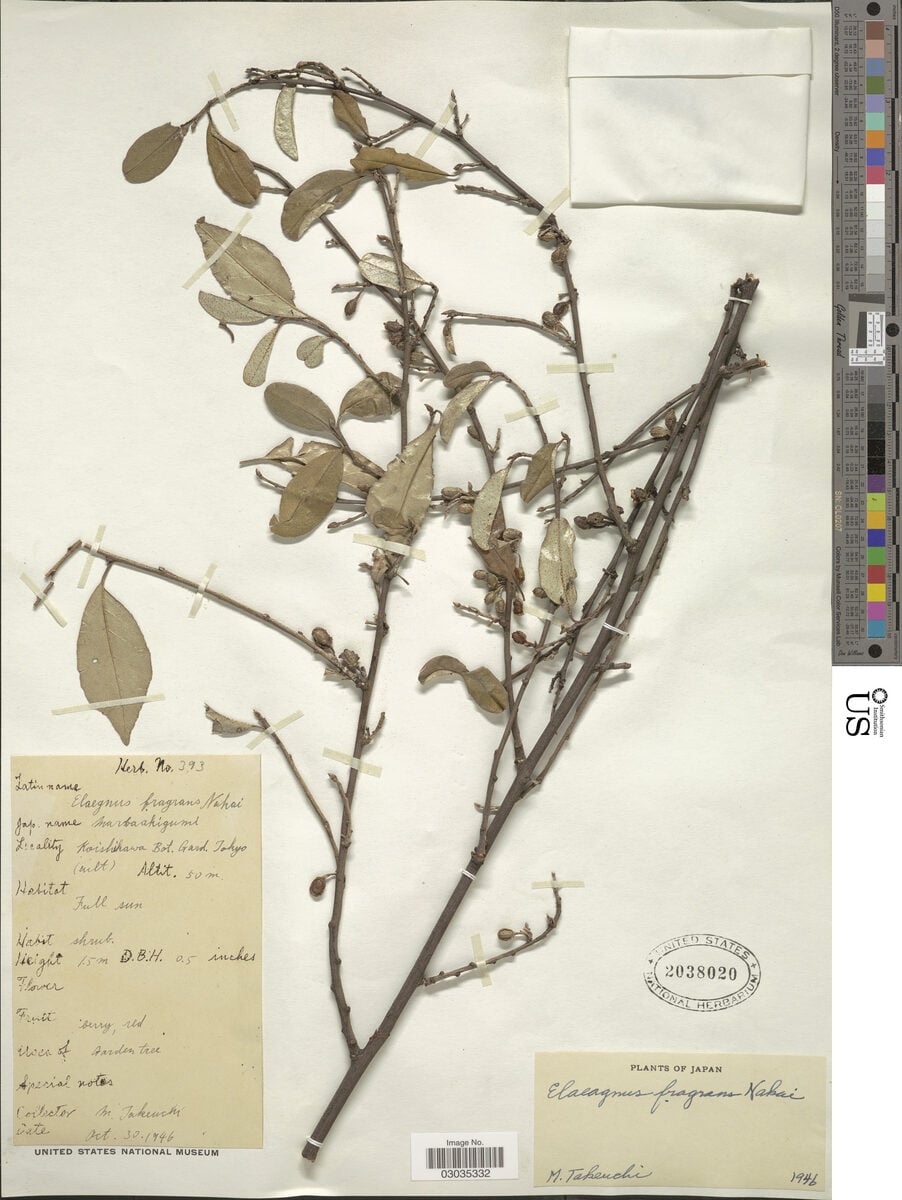
A large spreading shrub. It grows 3 m tall. It spreads 3.5 m wide. The leaves are broadly oval and covered with silvery scales. The upper surface becomes green. The flowers are silvery and fragrant. The fruit are red and scaly. They are 3 cm across. They are edible.
Edible Uses
The fruit can be eaten raw or cooked and has a very acceptable, rich flavour when fully ripe, though it is somewhat astringent before then. It is a potentially valuable crop, ripening in April and May, though cropping reliability varies — some plants bear very heavy crops while others rarely fruit. The fruit grows up to 30mm long and contains a single large seed. The seed has a mild flavour with a hint of peanut, can be eaten in quantity, and is palatable raw or cooked alongside the fruit, though the seed case is rather fibrous.
Traditional Uses
The fruit need to be fully ripe and can then be eaten raw or cooked. The seed can be eaten fresh or cooked. They are often steamed and dried.
This uses section is brief — help expand it
Medicinal Uses
The fruit is a very rich source of vitamins and minerals, particularly vitamins A, C and E, flavanoids and other bio-active compounds. It also provides a fairly good supply of essential fatty acids, which is unusual for a fruit. It is being investigated for its potential to reduce the incidence of cancer and to halt or reverse cancer growth.
Distribution
It is a temperate plant. It grows in full sun or light shade. It grows near seashores. It is tolerant of wind and coastal exposure. It is resistant to frost and drought. It suits hardiness zones 7-10.
Where It Grows
Asia, Australia, Central Asia, China, Japan*, Korea, Taiwan, Tajikistan,
Cultivation
Succeeds in most soils that are well-drained. Prefers a soil that is only moderately fertile, succeeding in poor soils and in dry soils. Succeeds in sun or shade. Plants are very tolerant of maritime exposure. This species is hardy to about -15°c, succeeding in the warmer counties of Britain. This is a plant with a very big potential as a commercial fruit crop. The fruit ripens outdoors in Britain in April, a season where traditionally there is no fresh fruit available. The fruit is of a reasonable size, has a very nice flavour when fully ripe and also has a fairly large edible seed. Some research needs to be carried out in order to find the conditions that are necessary to ensure good crops - some plants fruit very heavily whilst others have very light or no crops. This is the second of the evergreen Elaeagnus species to ripen in the spring, about a week or 10 days later than E. cordifolia. This species is notably resistant to honey fungus. Plants can succumb to wind-rock in very wet seasons. Plants are sometimes damaged by voles. This species has a symbiotic relationship with certain soil bacteria, these bacteria form nodules on the roots and fix atmospheric nitrogen. Some of this nitrogen is utilized by the growing plant but some can also be used by other plants growing nearby. An excellent companion plant, when grown in orchards it can increase yields from the fruit trees by up to 10%. Allied to E. pungens and E. glabra. The flowers are very aromatic, their aroma pervading the garden on calm days.
Propagation
Seed is best sown as soon as it is ripe in a cold frame. It should germinate freely within 4 weeks, though it may take 18 months. Stored seed can be very slow to germinate, often taking more than 18 months; a warm stratification for 4 weeks followed by 12 weeks of cold stratification can help. Prick out seedlings into individual pots as soon as they are large enough to handle and plant out when at least 15cm tall. Cuttings of half-ripe wood, 7–10cm with a heel, taken in July/August in a frame give a good percentage — June is the best time to take them. Cuttings of mature wood from the current year's growth, 10–12cm with a heel, taken in November in a frame give a fair to good percentage; leave for 12 months. Layering in September/October takes 12 months.
Other Uses
Plants can be grown as a hedge in exposed positions and are very tolerant of maritime exposure. They are reasonably fast-growing and provide dense cover, giving very good wind protection. Plants tolerate regular trimming and can also be cut back almost to the ground, resprouting from the base. The plant is also a nitrogen fixer.
Production
It is fast growing. In China plants flower on September and October and fruit March to May.
Notes
There are 45 Elaeagnus species.
Also Known As
Ppoldunamum Ppolttu, Ppolttunamu
References (13)
- Bodkin, F., 1991, Encyclopedia Botanica. Cornstalk publishing, p 376
- Brickell, C. (Ed.), 1999, The Royal Horticultural Society A-Z Encyclopedia of Garden Plants. Convent Garden Books. p 392
- Cundall, P., (ed.), 2004, Gardening Australia: flora: the gardener's bible. ABC Books. p 532
- Etherington, K., & Imwold, D., (Eds), 2001, Botanica's Trees & Shrubs. The illustrated A-Z of over 8500 trees and shrubs. Random House, Australia. p 275
- Fl. jap. 67. 1784
Show all 13 references Hide references
- Hibbert, M., 2002, The Aussie Plant Finder 2002, Florilegium. p 91
- Hwang, H., et al, 2013, A Study on the Flora of 15 Islands in the Western Sea of Jeollanamdo Province, Korea. Journal of Asia-Pacific Biodiversity Vol. 6, No. 2 281-310
- Kuo, W. H. J., (Ed.) Taiwan's Ethnobotanical Database (1900-2000), http://tk.agron.ntu.edu.tw/ethnobot/DB1.htm
- Lord, E.E., & Willis, J.H., 1999, Shrubs and Trees for Australian gardens. Lothian. p 225
- Lyle, S., 2006, Discovering fruit and nuts. Land Links. p 190
- Ong, H. G., et al, 2015, Ethnobotany of the wild edible plants gathered in Ulleung Island, South Korea. Genet Resourc Crop Evol. Springer
- Plants for a Future database, The Field, Penpol, Lostwithiel, Cornwall, PL22 0NG, UK. http://www.scs.leeds.ac.uk/pfaf/
- Ryan, S., 2008, Dicksonia. Rare Plants Manual. Hyland House. p 23