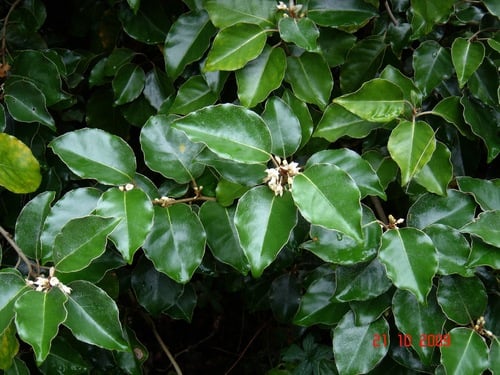
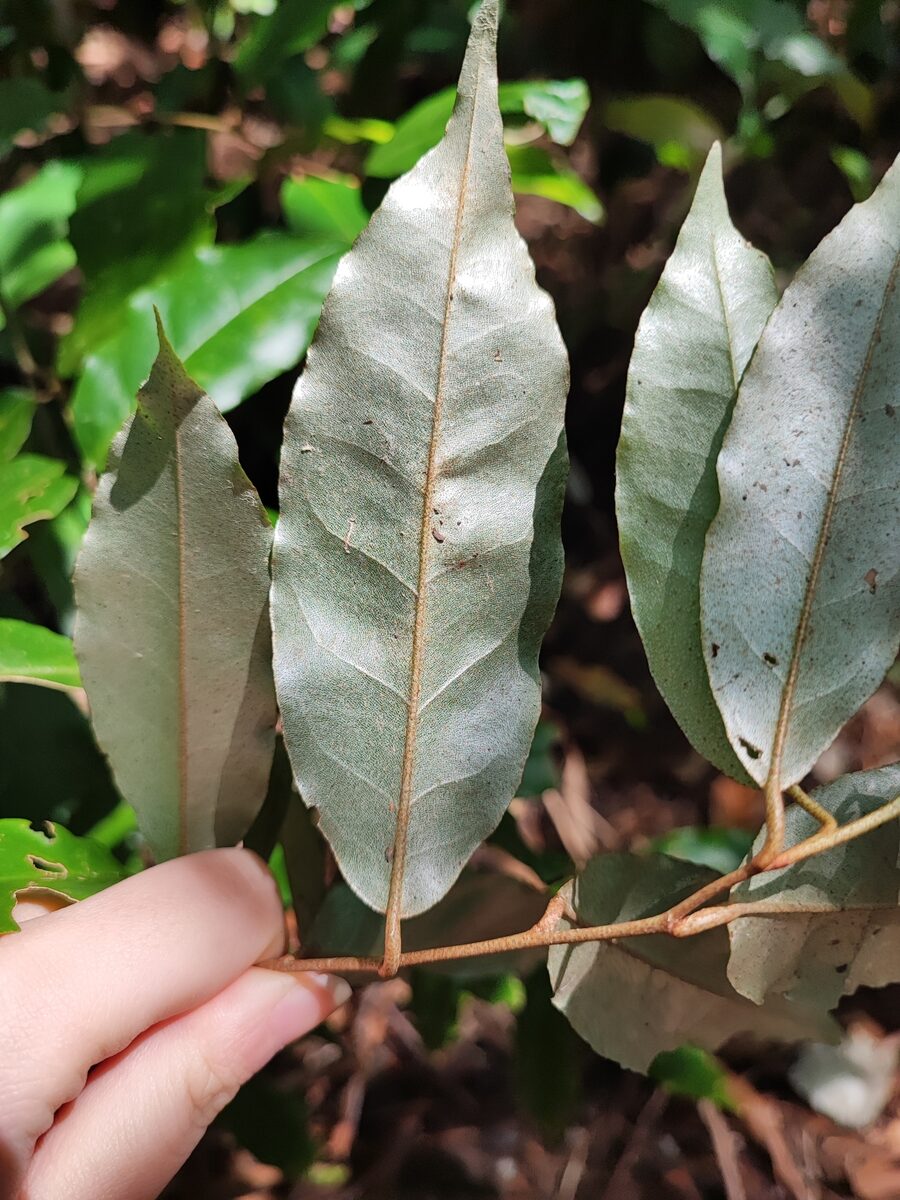
Elaeagnus parvifolia
Wallich ex Royle
Autumn Olive
iNaturalist· cc-by-nc
(c) Michael R Ostrowski, some rights reserved (CC BY-NC)
iNaturalist· cc-by
(c) Senna Bryce Robeson, some rights reserved (CC BY)
iNaturalist· cc-by
(c) Senna Bryce Robeson, some rights reserved (CC BY)
Summary
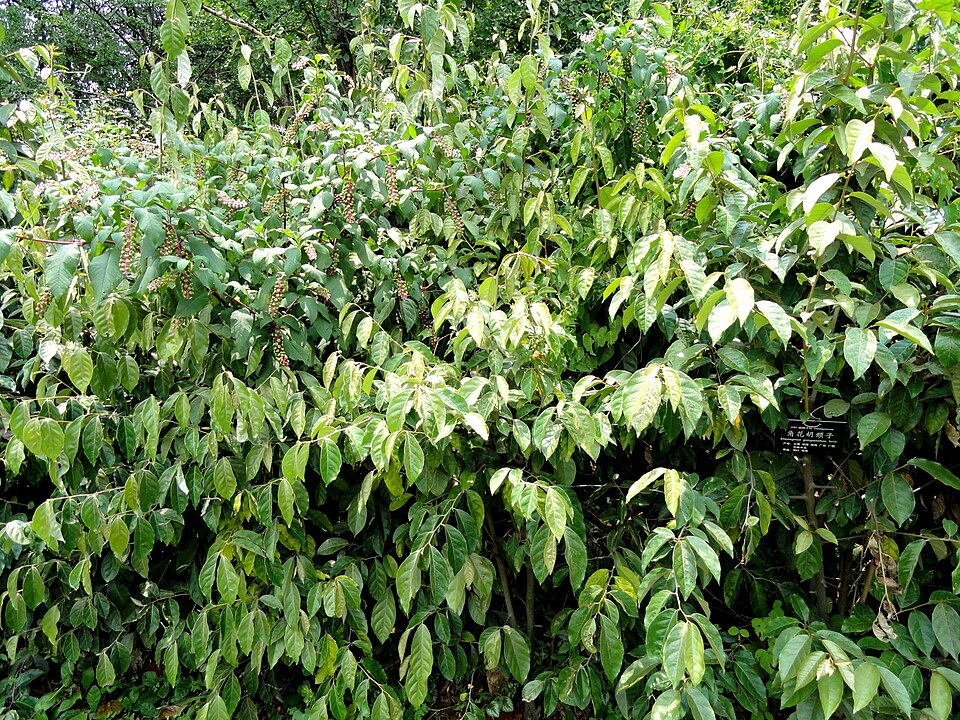
Deciduous shrub reaching 4.5m tall and 3m wide at medium growth rate. Hardy to UK zone 3. Flowers May to June with seeds ripening September to November. Hermaphroditic and bee-pollinated. Grows in light sandy, medium loamy, and heavy clay soils; prefers well-drained conditions and tolerates poor fertility. Adapts to mildly acidic, neutral, and basic soils. Requires full sun and cannot tolerate shade. Tolerates both dry and moist conditions with good drought resistance. Withstands maritime exposure.
Description
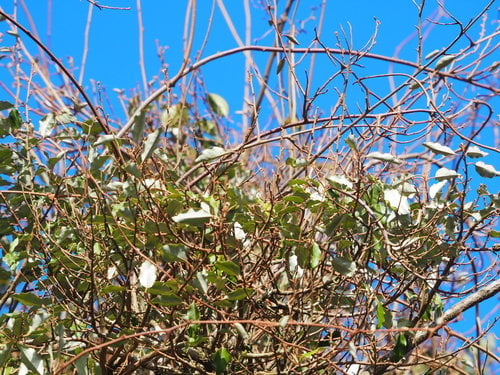
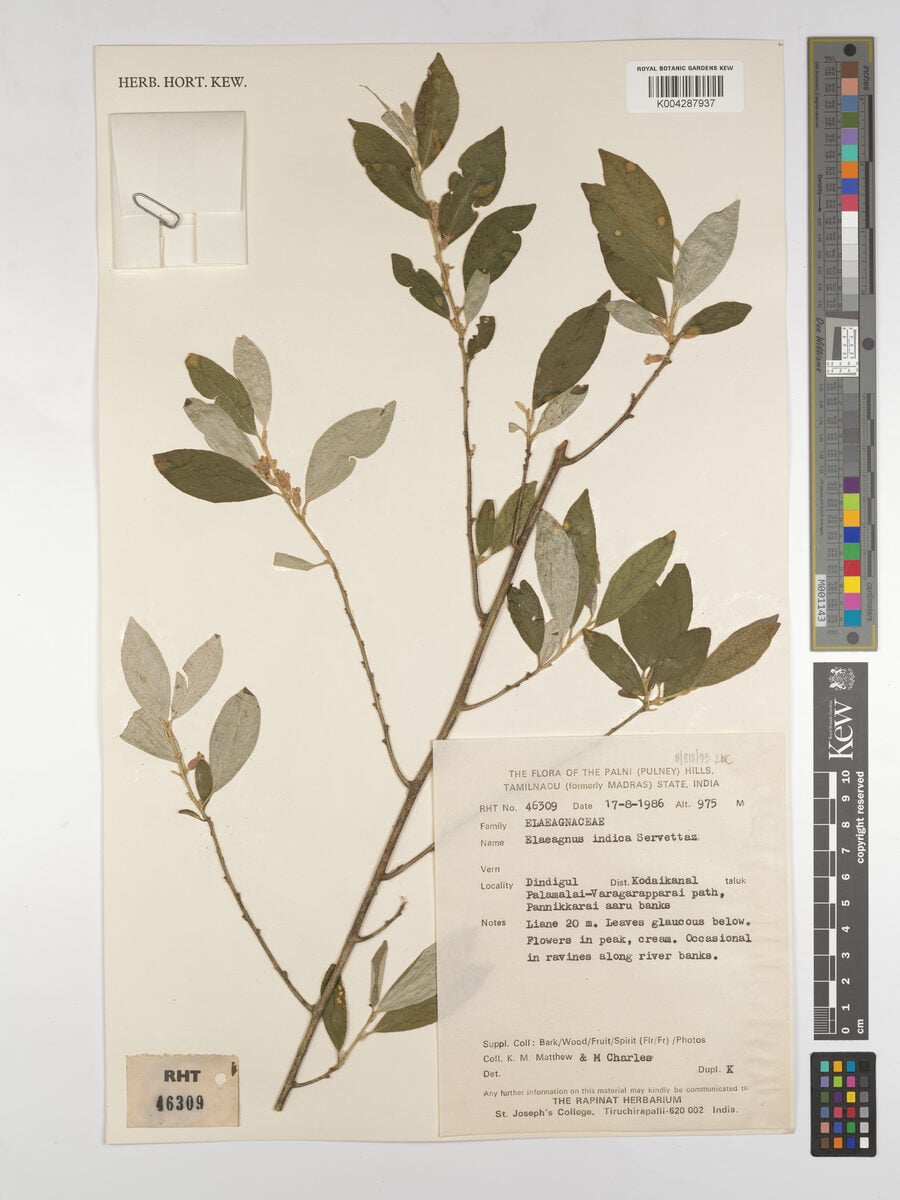
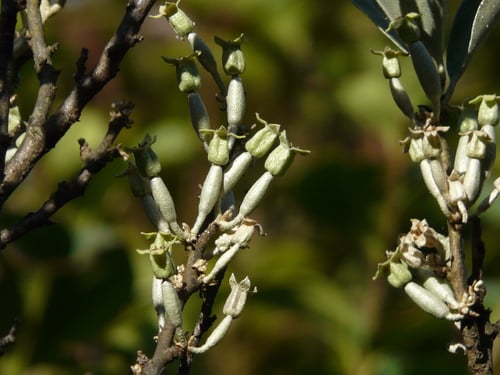
A spiny deciduous shrub. The young branches are covered with silvery hairs. The leaves are alternate and 2.5-5 cm long. They are oblong with silvery scales underneath. The flowers are dull white and have a scent. They occur in clusters in the axils of leaves. The fruit is oval and covered with silvery scales. The fruit is fleshy.
Edible Uses
The fruit can be eaten raw, cooked, or added to curries. It must be fully ripe before eating raw — even slightly underripe fruit is quite astringent, though children seem to enjoy it at that stage. The fruit is about 8mm in diameter and contains a single large seed. The seed can also be eaten raw or cooked alongside the fruit, though its casing is rather fibrous.
Traditional Uses
The ripe fruit are eaten fresh.
This uses section is brief — help expand it
Medicinal Uses
The unripe fruit is astringent and is eaten as a treatment for bloody dysentery. Like many in its genus, the fruit is a very rich source of vitamins and minerals — particularly vitamins A, C and E — along with flavonoids and other bio-active compounds. It is also a fairly good source of essential fatty acids, which is unusual for a fruit. It is being investigated for its potential to reduce the incidence of cancer and to halt or reverse cancer growth.
Distribution
It is a temperate plant. In Nepal it grows between 1300-3000 m altitude.
Where It Grows
Asia, Afghanistan, China, Himalayas, India, Nepal, Northeastern India, NW India, Pakistan,
Cultivation
Succeeds in most soils that are well-drained. Prefers a soil that is only moderately fertile, succeeding in very poor soils and in dry soils. Prefers a light sandy loam and a sunny position. Dislikes shallow chalk soils. Plants are very drought resistant and very tolerant of maritime exposure. A very hardy plant, tolerating temperatures down to at least -40°c. Somewhat similar to E. multiflora, but flowering a few weeks later. The flowers are rich in nectar and very aromatic, they are much visited by bees. This species is notably resistant to honey fungus. Plants can fruit in 6 years from seed. This species has a symbiotic relationship with certain soil bacteria, these bacteria form nodules on the roots and fix atmospheric nitrogen. Some of this nitrogen is utilized by the growing plant but some can also be used by other plants growing nearby. An excellent companion plant, when grown in orchards it can increase yields from the fruit trees by up to 10%.
Propagation
Seed is best sown as soon as it is ripe in a cold frame, where it should germinate in late winter or early spring, though it may take 18 months. Stored seed can be very slow to germinate, often taking more than 18 months. A warm stratification of 4 weeks followed by 12 weeks of cold stratification can help. Prick out seedlings into individual pots as soon as they are large enough to handle and plant out when at least 15cm tall. Cuttings of half-ripe wood, 7–10cm with a heel, taken in July/August in a frame give a good percentage. Cuttings of mature wood from the current year's growth, 10–12cm with a heel, taken in November in a frame and left for 12 months give a fair to good percentage. Layering in September/October takes 12 months.
Other Uses
Very tolerant of maritime exposure, this plant can be grown as an informal hedge in exposed positions. It is also a nitrogen fixer.
Notes
There are 45 Elaeagnus species.
Synonyms
Also Known As
Aarjee, Geai, Ghanum ranga, Ghayai, Ghowein, Ghyeen, Giwain, Guyaalo, Gyam-mrep, Guyeli, Kaain, Kankoli Surch
References (18)
- Amjad, M. S., et al, 2015, Ethnobotanical inventory and folk uses of indigenous plants from Pir Nasoora National Park, Azad Jammu and Kashmir. Asian Pac J Trop Biomed 2015; 5(3): 234-241
- Aryal, K. P., et al, 2018, Diversity and use of wild and non-cultivated edible plants in the Western Himalaya. Journal of Ethnobiology and Ethnomedicine (2018) 14:10
- Bhatia, H., et al, 2018, Traditionally used wild edible plants of district Udhampur, J&K, India. Journal of Ethnobiology and Ethnomedicine (2018) 14:73
- Dobriyal, M. J. R. & Dobriyal, R., 2014, Non Wood Forest Produce an Option for Ethnic Food and Nutritional Security in India. Int. J. of Usuf. Mngt. 15(1):17-37 (As parviflora)
- Ghimire, S. K., et al, 2008, Non-Timber Forest Products of Nepal Himalaya. WWF Nepal p 59
Show all 18 references Hide references
- Hamayun, M., Ethnobotanical Studies of some Useful Shrubs and Trees of District Buner, NWFP, Pakistan
- Ill. bot. Himal. Mts. 1(9):323; 2(9): t. 81, fig. 1. 1836
- Manandhar, N.P., 2002, Plants and People of Nepal. Timber Press. Portland, Oregon. p 214
- Masoodi, H. U. R. & Sundriyal, R. C., 2020, Richness of non-timber forest products in Himalayan communities—diversity, distribution, use pattern and conservation status. Journal of Ethnobiology and Ethnomedicine 16:56
- Negi, P. S. & Subramani, S. P., 2015, Wild Edible Plant Genetic Resources for Sustainable Food Security and Livelihood of Kinnaur District, Himachal Pradesh, India, International Journal of Conservation Science. 6 (4): 657-668
- Plants for a Future database, The Field, Penpol, Lostwithiel, Cornwall, PL22 0NG, UK. http://www.scs.leeds.ac.uk/pfaf/
- Polunin, O., & Stainton, A., 2006, Flowers of the Himalaya, Oxford India Paperbacks. p 357
- Radha, B., et al, 2013, Wild Edible Plant Resources of the Lohba Range of Kedarnath Forest Division (KFD), Garhwal Himalaya, India. Int. Res J. Biological Sci. Vol. 2 (11), 65-73
- Rana, D., et al, 2019, Ethnobotanical knowledge among the semi-pastoral Gujjar tribe in the high altitude (Adhwari’s) of Churah subdivision, district Chamba, Western Himalaya. Journal of Ethnobiology and Ethnomedicine (2019) 15:10
- Rana, D., et al, 2020, Use of medicinal plants for treating different ailments by the indigenous people of Churah subdivision of district Chamba, Himachal Pradesh, India. Environment, Development and Sustainability. Springer. (As parviflora)
- Sharma, P., et al, 2013, Wild edibles of Murari Devi and surrounding areas in Mandi district of Himachal Pradesh, India. International Journal of Biodiversity and Conservation. Vol. 5(9), pp. 580-592, September 2013
- Tsering, J., et al, 2017, Ethnobotanical appraisal on wild edible plants used by the Monpa community of Arunchal Pradesh. Indian Journal of Traditional Knowledge. Vol 16(4), October 2017, pp 626-637
- Upreti, K., et al, 2010, Diversity and Distribution of Wild Edible Fruit Plants of Uttarakhand. Bioversity Potentials of the Himalaya. p 168