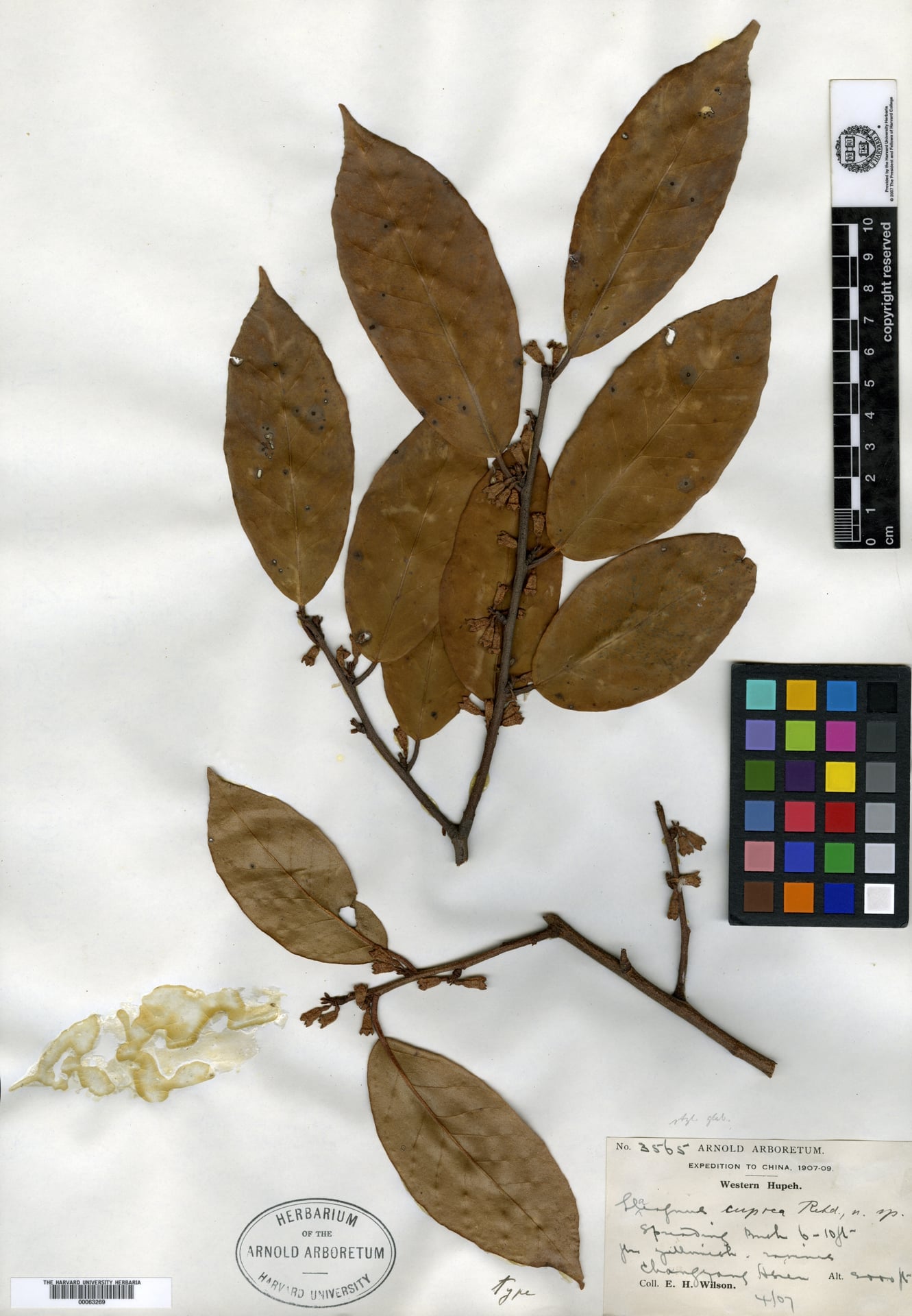
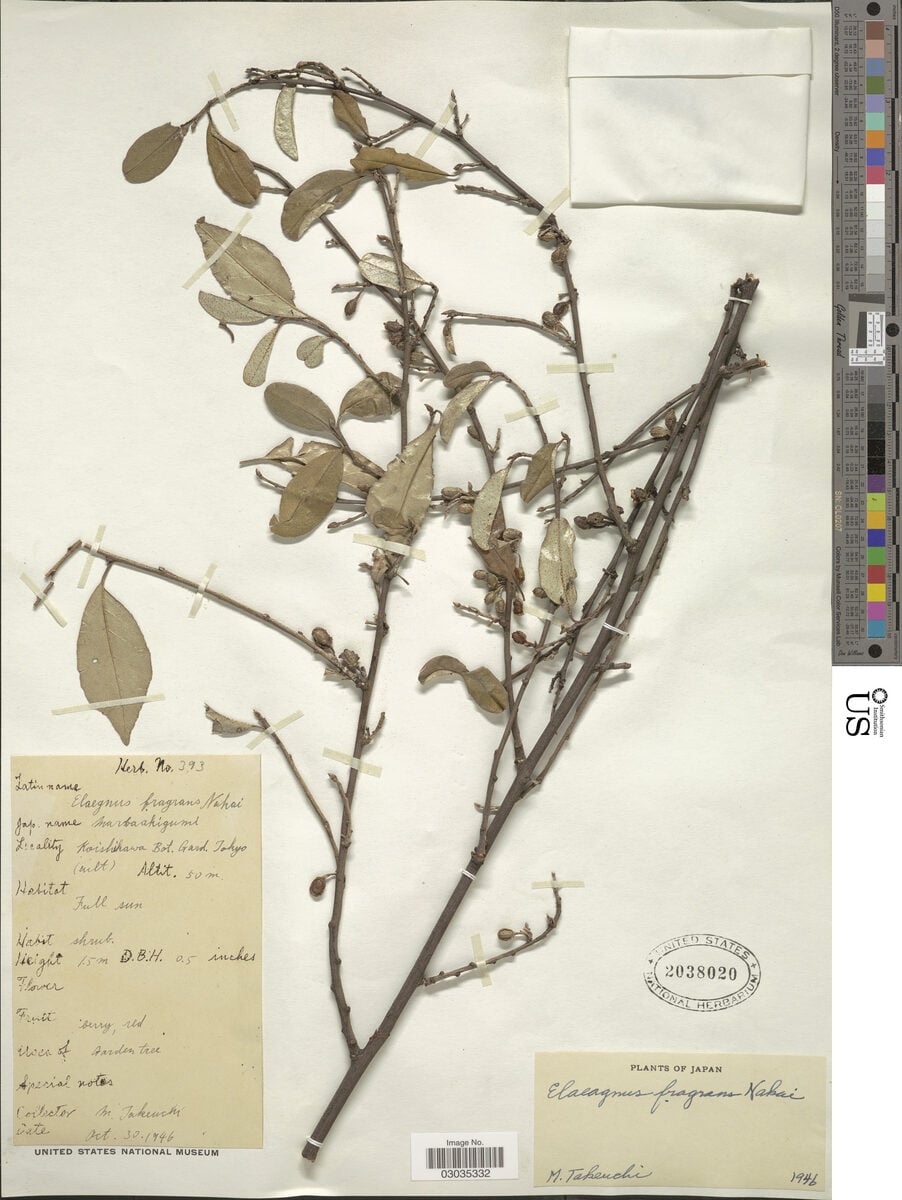
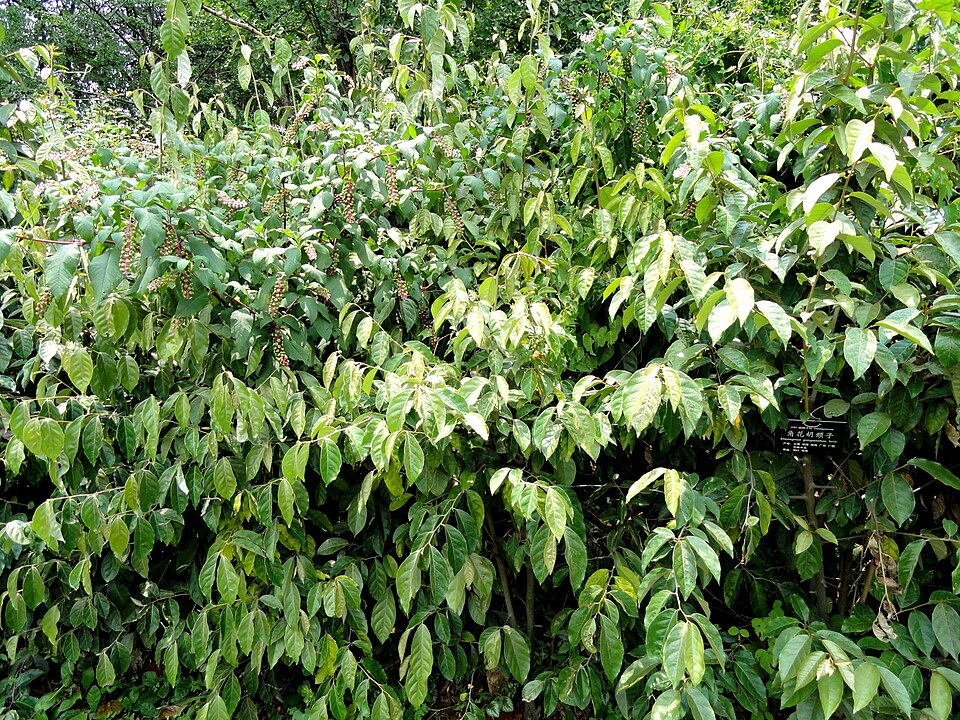
Elaeagnus pungens
Thunb.
Silverthorn, Thorny Elaeagnus, Silverberry
iNaturalist· cc-by-nc
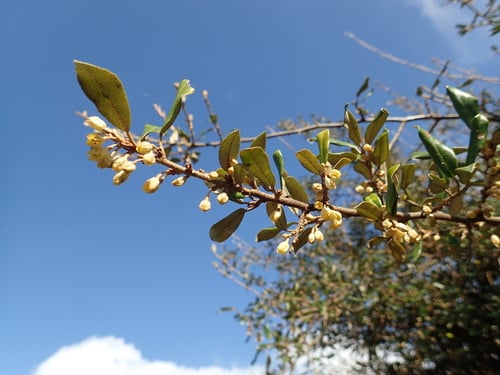
(c) Dave Holland, some rights reserved (CC BY-NC), uploaded by Dave Holland
iNaturalist· cc-by-sa
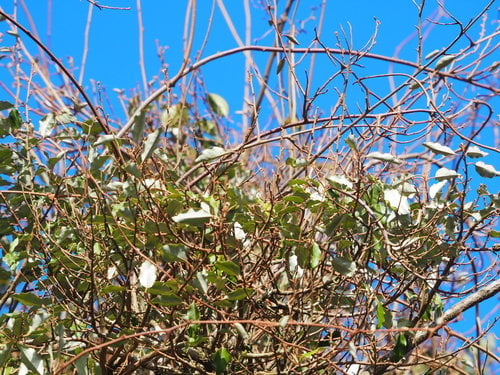
(c) Douglas Goldman, some rights reserved (CC BY-SA), uploaded by Douglas Goldman
iNaturalist· cc-by-sa
(c) Douglas Goldman, some rights reserved (CC BY-SA), uploaded by Douglas Goldman
Summary
Source: WikipediaElaeagnus pungens is a species of flowering plant in the family Elaeagnaceae, known by the common names thorny olive, spiny oleaster and silverthorn; also by the family name "oleaster". It is native to Asia, including China and Japan. It is present in the southeastern United States as an introduced species, a common landscaping and ornamental plant, and sometimes an invasive species.
Description
It is an evergreen shrub or scrambling climber. It grows 3-4.5 m high and wide. The branches are long, horizontal and prickly. The leaves are oval and glossy. They are dark green above and silvery underneath. The flowers are very small. They are cream and bell-shaped. They have a scent. The fruit are red. They are 1 cm across. Some named varieties occur.
Edible Uses
The fruit can be eaten raw or cooked and is roughly the size of a large blackcurrant, though the seed is also quite large. When fully ripe it has a pleasant sub-acid flavour, but is astringent if eaten before then. It can be made into preserves, drinks, and similar preparations. The oval fruit is about 15mm long. The seed can be eaten raw or cooked alongside the fruit, though the casing is rather fibrous and the taste is vaguely reminiscent of peanuts. On a zero moisture basis, the seed contains 42.2% protein and 23.1% fat.
Traditional Uses
The fruit are eaten when fully ripe. They are also used for jam, soft drinks and liqueurs. The seeds are also eaten. It can be eaten fresh or cooked. seed
Medicinal Uses
Like many in its genus, the fruit is a very rich source of vitamins and minerals — particularly vitamins A, C and E — along with flavonoids and other bio-active compounds. It is also a fairly good source of essential fatty acids, which is unusual for a fruit, and is being investigated for its potential to reduce or reverse cancer growth. The leaves and stems are decocted and used in the treatment of asthma, cough, diarrhoea, and haemorrhoids. The seed is used to treat watery diarrhoea. The root is astringent and is applied externally to sores and itchy skin.
Distribution
It is a temperate plant. It is frost hardy. It can grow in a range of soils, including clays. It can grow in shade. It it drought tolerant and tolerates coastal exposure. It often grows near the sea. It suits hardiness zones 7-10.
Where It Grows
Asia, Australia, Central Asia, China, Japan*, North America, Slovenia, Tajikistan, USA,
Cultivation
Succeeds in most soils that are well-drained. Dislikes very alkaline soils. Prefers a soil that is only moderately fertile, succeeding in poor soils and in dry soils. Grows well in heavy clay soils. Very drought and shade resistant. Tolerates maritime exposure. Plants are hardy to about -15°c. The foliage can be damaged in severe wind-chill conditions. This is a potentially valuable fruit crop, fruiting as it does in April and May. There are a number of named varieties and so there is plenty of scope for improving size and quality of fruit by selective breeding. Most cultivars are variegated and therefore slower-growing than the species. This species is notably resistant to honey fungus. The small flowers have a sweet but pungent aroma. They pervade the garden for some distance on sunny days. Closely related to E. glabra. This species has a symbiotic relationship with certain soil bacteria, these bacteria form nodules on the roots and fix atmospheric nitrogen. Some of this nitrogen is utilized by the growing plant but some can also be used by other plants growing nearby. An excellent companion plant, when grown in orchards it can increase yields from the fruit trees by up to 10%. . Fruits from Elaeagnus species are usually harvested in late summer to early autumn, depending on the species and local climate. Elaeagnus species generally flower in late spring to early summer depending on the specific species and environmental conditions. Many Elaeagnus species are self-fertile, meaning they can produce fruit without needing another plant for cross-pollination. Elaeagnus species are relatively fast-growing shrubs or small trees, typically reaching maturity in 3 to 5 years. They can grow to heights of 1 to 5 meters (3 to 16 feet) depending on the species and growing conditions.
Propagation
Seed is best sown as soon as it is ripe in a cold frame, where it should germinate freely within 4 weeks, though it may take 18 months. Stored seed can be very slow to germinate, often taking more than 18 months. A warm stratification of 4 weeks followed by 12 weeks of cold stratification can help. Prick out seedlings into individual pots as soon as they are large enough to handle and plant out when at least 15cm tall. Cuttings of half-ripe wood, 7–10cm with a heel, are best taken in June and placed in a frame in July/August for a good percentage. Cuttings of mature wood from the current year's growth, 10–12cm with a heel, taken in November in a frame and left for 12 months give a fair to good percentage. Layering in September/October takes 12 months.
Other Uses
Plants can be grown as a hedge in exposed positions and tolerate maritime exposure well. They can also be planted under trees that have become bare at the base, where they will in time scramble up and fill in the lower growth. The flowers are rich in nectar and pollen, attracting bees, butterflies, and other pollinators. The fruit is favoured by birds and small mammals, and the dense branches provide shelter, nesting, and roosting sites. Leaf litter and dense growth offer overwintering habitat for invertebrates. As a nitrogen fixer, it improves soil fertility and benefits neighbouring plants.
Production
In China plants flower in September to December and fruit April to June.
Other Information
It is cultivated.
Notes
There are 45 Elaeagnus species.
Also Known As
Bodičasta oljčica, Nawashiro-gumi
References (17)
- Arora, R. K., 2014, Diversity in Underutilized Plant Species - An Asia-Pacific Perspective. Bioversity International. p 69
- Bodkin, F., 1991, Encyclopedia Botanica. Cornstalk publishing, p 376
- Brickell, C. (Ed.), 1999, The Royal Horticultural Society A-Z Encyclopedia of Garden Plants. Convent Garden Books. p 392
- Cundall, P., (ed.), 2004, Gardening Australia: flora: the gardener's bible. ABC Books. p 532
- Etherington, K., & Imwold, D., (Eds), 2001, Botanica's Trees & Shrubs. The illustrated A-Z of over 8500 trees and shrubs. Random House, Australia. p 276
Show all 17 references Hide references
- Fl. jap. 68. 1784
- Hibbert, M., 2002, The Aussie Plant Finder 2002, Florilegium. p 91
- Jackes, D. A., Edible Forest Gardens
- Kiple, K.F. & Ornelas, K.C., (eds), 2000, The Cambridge World History of Food. CUP p 1770
- Kremer, B.P., 1995, Shrubs in the Wild and in Gardens. Barrons. p 103.
- Lord, E.E., & Willis, J.H., 1999, Shrubs and Trees for Australian gardens. Lothian. p 225
- Lyle, S., 2006, Discovering fruit and nuts. Land Links. p 190
- Plants for a Future database, The Field, Penpol, Lostwithiel, Cornwall, PL22 0NG, UK. http://www.scs.leeds.ac.uk/pfaf/
- Tanaka,
- Wang, J., et al, 2020, An ethnobotanical survey of wild edible plants used by the Yi people of Liangshan Prefecture, Sichuan Province, China. Journal of Ethnobiology and Ethnomedicine 16:10 p 7
- Young, J., (Ed.), 2001, Botanica's Pocket Trees and Shrubs. Random House. p 336
- Zeven, A. C. & de West, J. M. J., 1982, Dictionary of cultivated plants and their regions of diversity. Wageningen. p 36