Elaeagnus oldhamii
Maximowicz
Little persimmon
iNaturalist· cc0
no rights reserved, uploaded by 葉子
iNaturalist· cc-by-nc
(c) Han-Ting Liu, some rights reserved (CC BY-NC), uploaded by Han-Ting Liu
iNaturalist· cc0
no rights reserved, uploaded by 葉子
Summary
Evergreen shrub reaching 4m tall. Not frost tender. In leaf year-round, flowering September to December with seeds ripening April to June. Hermaphroditic, insect-pollinated, nitrogen-fixing. Tolerates light sandy, medium loamy, and heavy clay soils with good drainage and poor soil; acidic to alkaline pH. Grows in semi-shade or full sun. Handles both dry and moist soil conditions.
Description
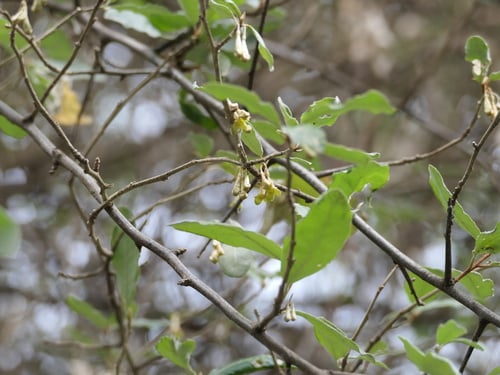
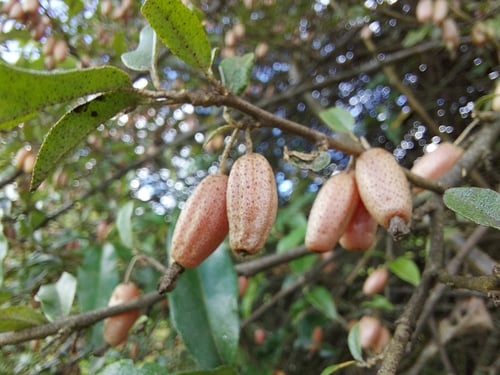
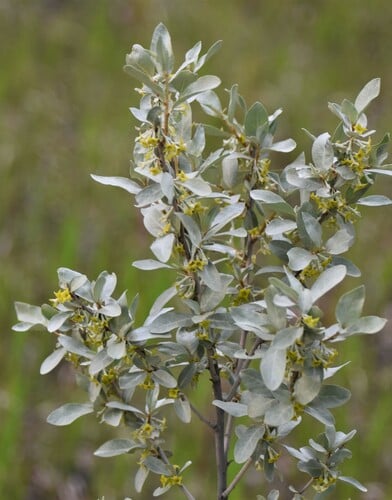
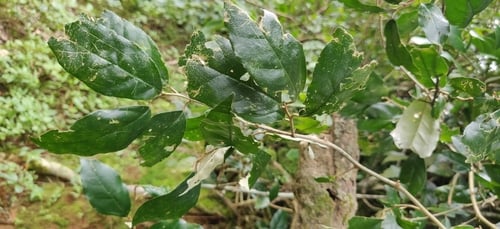
An evergreen shrub or small tree. There are silver scales on young branches. The leaves are papery and a fattened oval shape. They are 3-6 cm long by 2-3 cm wide. There are 4-6 pairs of side veins. The flowers are white and in groups. The fruit are almost round and 7-9 mm long. They are red. The seeds are 7-8 mm long.
Edible Uses
The fruit can be eaten raw or cooked, but must be fully ripe before it can be enjoyed raw — if even slightly under-ripe it will be quite astringent. The globose fruit is about 9mm wide and contains a single large seed up to 8mm long. The seed can also be eaten raw or cooked alongside the fruit, though the seed case is rather fibrous.
Traditional Uses
The fruit are eaten fresh.
This uses section is brief — help expand it
Medicinal Uses
The fruit is a very rich source of vitamins and minerals, particularly vitamins A, C and E, flavanoids and other bio-active compounds. It also provides a fairly good supply of essential fatty acids, which is unusual for a fruit. It is being investigated for its potential to reduce the incidence of cancer and to halt or reverse cancer growth.
Distribution
A tropical plant. In Taiwan it grows below 500 m altitude.
Where It Grows
Asia, China, Taiwan,
Cultivation
We have very little information on this species and do not know if it will be hardy in Britain. The following notes are based on the general needs of the genus. Succeeds in most soils that are well-drained. Prefers a soil that is only moderately fertile, succeeding in poor soils and in dry soils. This species is notably resistant to honey fungus. This species has a symbiotic relationship with certain soil bacteria, these bacteria form nodules on the roots and fix atmospheric nitrogen. Some of this nitrogen is utilized by the growing plant but some can also be used by other plants growing nearby. An excellent companion plant, when grown in orchards it can increase yields from the fruit trees by up to 10%.
Propagation
Seed is best sown as soon as it is ripe in a cold frame. It should germinate in late winter or early spring, though it may take 18 months. Stored seed can be very slow to germinate, often taking more than 18 months; a warm stratification for 4 weeks followed by 12 weeks of cold stratification can help. Prick out seedlings into individual pots as soon as they are large enough to handle and plant out when at least 15cm tall. Cuttings of half-ripe wood, 7–10cm with a heel, taken in July/August in a frame. Cuttings of mature wood from the current year's growth, 10–12cm with a heel, taken in October/November in a frame — the cuttings are rather slow and difficult to root, so leave them for 12 months. Layering in September/October takes 12 months.
Other Uses
No other uses are known. The plant is a nitrogen fixer.
Production
In China plants flower in November and December and fruit is February and March.
Notes
There are 45 Elaeagnus species.
References (4)
- Flora of Taiwan Vol 3:787
- Hu, Shiu-ying, 2005, Food Plants of China. The Chinese University Press. p 571
- Kuo, W. H. J., (Ed.) Taiwan's Ethnobotanical Database (1900-2000), http://tk.agron.ntu.edu.tw/ethnobot/DB1.htm
- Plants for a Future database, The Field, Penpol, Lostwithiel, Cornwall, PL22 0NG, UK. http://www.scs.leeds.ac.uk/pfaf/