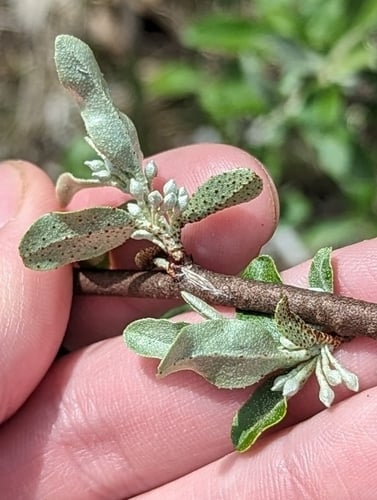
Elaeagnus orientalis
L.
Trebizond Date
No photos yet for Elaeagnus orientalis
Sign in to contribute a photoDescription
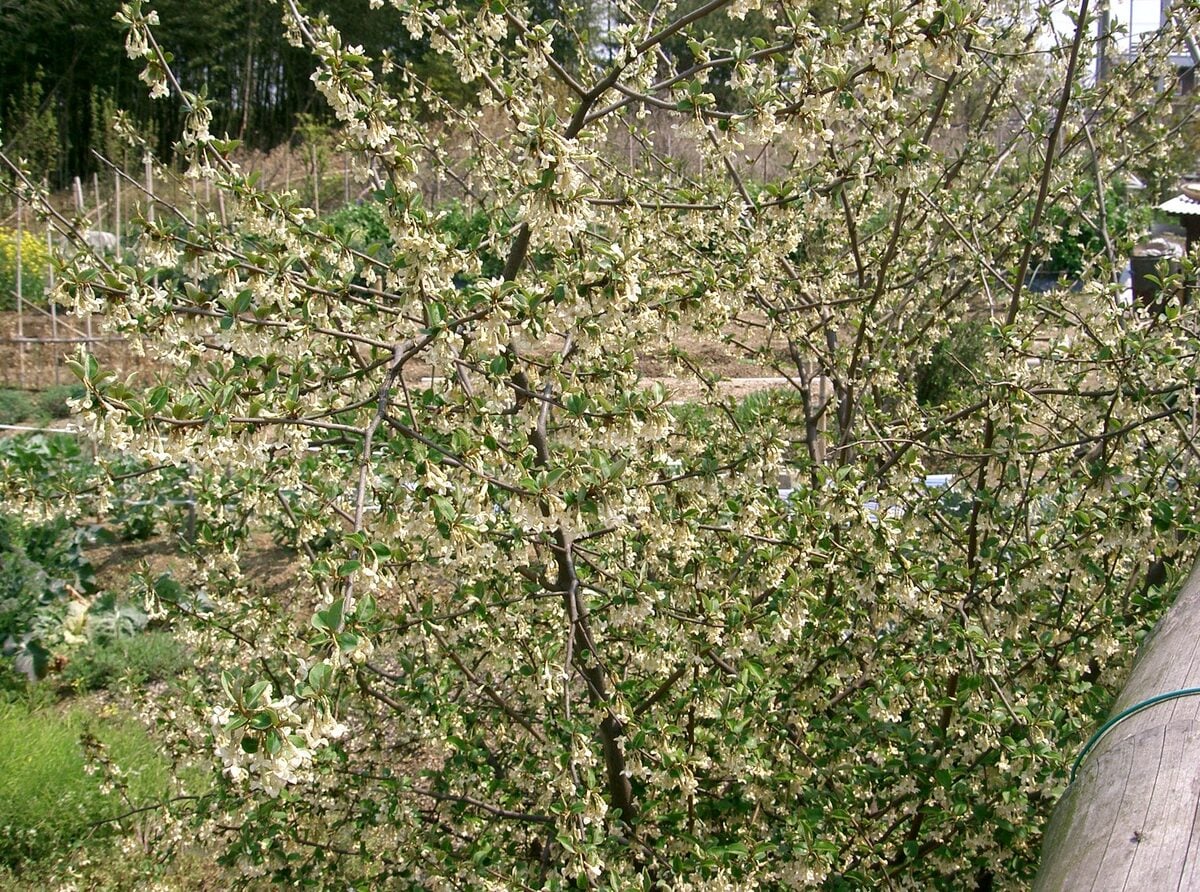
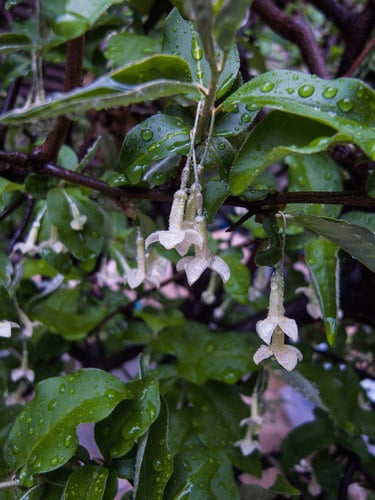
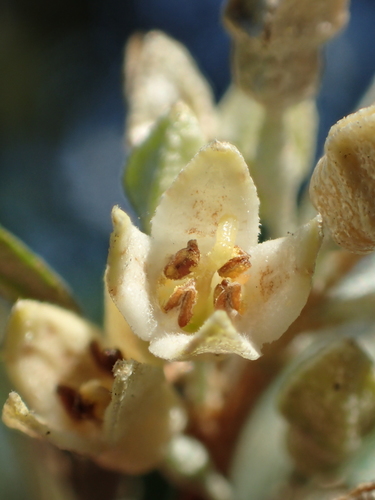
Elaeagnus orientalis is a deciduous Shrub growing to 12 m (39ft) by 6 m (19ft) at a medium rate. See above for USDA hardiness. It is hardy to UK zone 4 and is not frost tender. It is in flower in June. The species is hermaphrodite (has both male and female organs) and is pollinated by Bees. It can fix Nitrogen. It is noted for attracting wildlife. Suitable for: light (sandy), medium (loamy) and heavy (clay) soils, prefers well-drained soil and can grow in nutritionally poor soil. Suitable pH: mildly acid, neutral and basic (mildly alkaline) soils. It cannot grow in the shade. It prefers dry or moist soil and can tolerate drought. The plant can tolerate maritime exposure.
Edible Uses
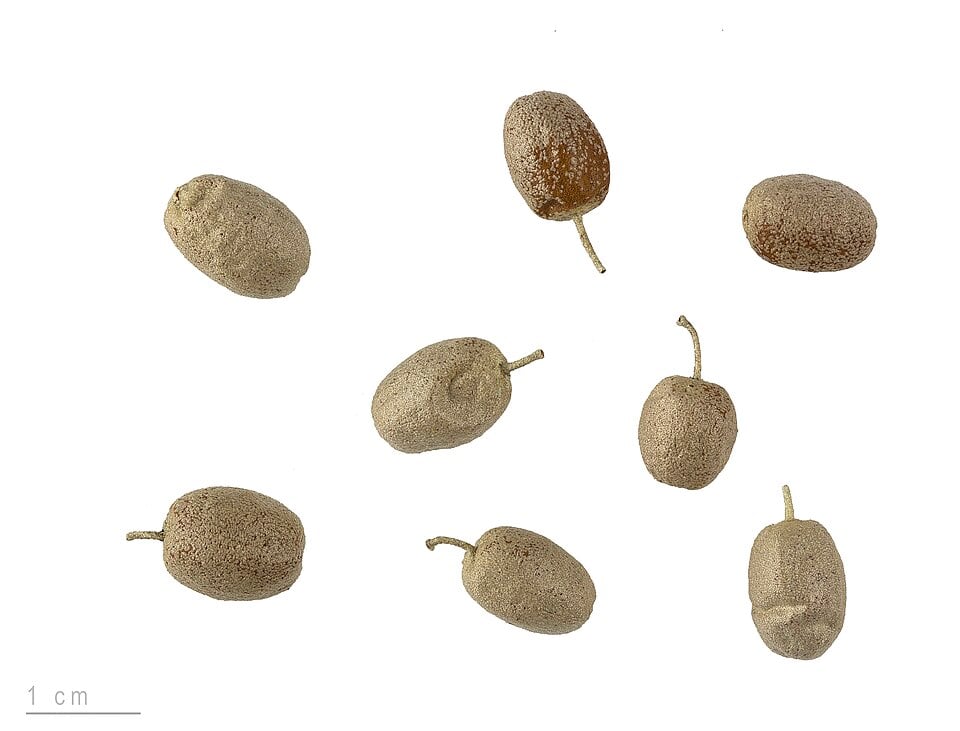
Fruit - raw or cooked. Sweet and mealy but of better quality than the closely related E. angustifolia. Eaten fresh or made into sherbet and preserves. The fruit must be fully ripe before it can be enjoyed raw, if even slightly under-ripe it will be quite astringent. The oval fruit is about 10mm long and contains a single large seed. Seed - raw or cooked. It can be eaten with the fruit though the seed case is rather fibrous.
Medicinal Uses
Cancer. The fruit of many members of this genus is a very rich source of vitamins and minerals, especially in vitamins A, C and E, flavanoids and other bio-active compounds. It is also a fairly good source of essential fatty acids, which is fairly unusual for a fruit. It is being investigated as a food that is capable of reducing the incidence of cancer and also as a means of halting or reversing the growth of cancers.
Distribution
W. Asia.
Where It Grows
TEMPERATE ASIA: Afghanistan, Iran, Turkey, Russian Federation-Ciscaucasia (Ciscaucasia), Armenia, Azerbaijan, Georgia, Russian Federation (Dagestan), Russian Federation-Western Siberia (Western Siberia), Russian Federation (Altay), Kazakhstan, Tajikistan, Turkmenistan, Uzbekistan, Mongolia, China (Gansu Sheng, Hebei Sheng, Henan Sheng, Liaoning Sheng, Nei Mongol Zizhiqu, Ningxia Huizi Zizhiqu, Qinghai Sheng, Shaanxi Sheng, Shanxi Sheng, Xinjiang Uygur Zizhiqu) TROPICAL ASIA: India (northwest), Pakistan (northeast) EUROPE: Russian Federation (European part), Belarus, Moldova
Cultivation
Succeeds in most soils that are well-drained. Prefers a soil that is only moderately fertile, succeeding in very poor soils and in dry soils. Established plants are very drought resistant. Prefers a light sandy loam and a sunny position. Dislikes shallow chalk soils. Very closely related to E. angustifolia and often considered to be no more than a sub-species of it, it does not flower so freely in Britain as that species. This species is notably resistant to honey fungus. This species has a symbiotic relationship with certain soil bacteria, these bacteria form nodules on the roots and fix atmospheric nitrogen. Some of this nitrogen is utilized by the growing plant but some can also be used by other plants growing nearby. An excellent companion plant, when grown in orchards it can increase yields from the fruit trees by up to 10%. The flowers are very fragrant and are rich in nectar, they are much visited by bees. Occasionally cultivated for its edible fruit, there are some named varieties. The fruit used to be commonly sold in the markets of Iran and Turkey but is rarely found there nowadays.
Propagation
Seed - best sown as soon as it is ripe in a cold frame. It should germinate in late winter or early spring, though it may take 18 months. Stored seed can be very slow to germinate, often taking more than 18 months. A warm stratification for 4 weeks followed by 12 weeks cold stratification can help. The seed usually (eventually) germinates quite well. Prick out the seedlings into individual pot as soon as they are large enough to handle and plant out when they are at least 15cm tall. Cuttings of half-ripe wood, 7 - 10cm with a heel, July/August in a frame. Cuttings of mature wood of the current year's growth, 10 - 12cm with a heel, October/November in a frame. The cuttings are rather slow and difficult to root, leave them for 12 months. Layering in September/October. Takes 12 months.
Other Uses
Hedge Hedge. Plants can be grown as a hedge in exposed positions, tolerating maritime exposure.