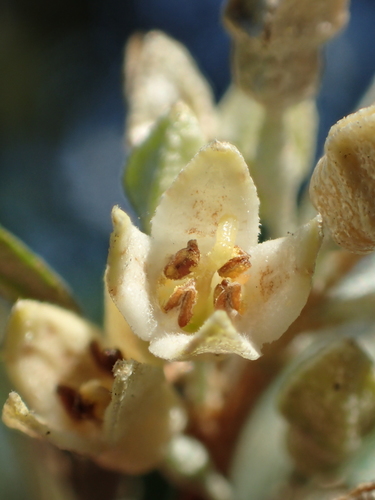
Elaeagnus latifolia
Linn.
Millaa Millaa, Bastard oleaster
iNaturalist· cc-by-sa
(c) Dinesh Valke, some rights reserved (CC BY-SA)
iNaturalist· cc-by
(c) Eugene Popov, some rights reserved (CC BY)
Summary
Source: WikipediaElaeagnus latifolia, known as the bastard oleaster, or soh-shang, is a species of Elaeagnus native to India and Southeast Asia.
Description
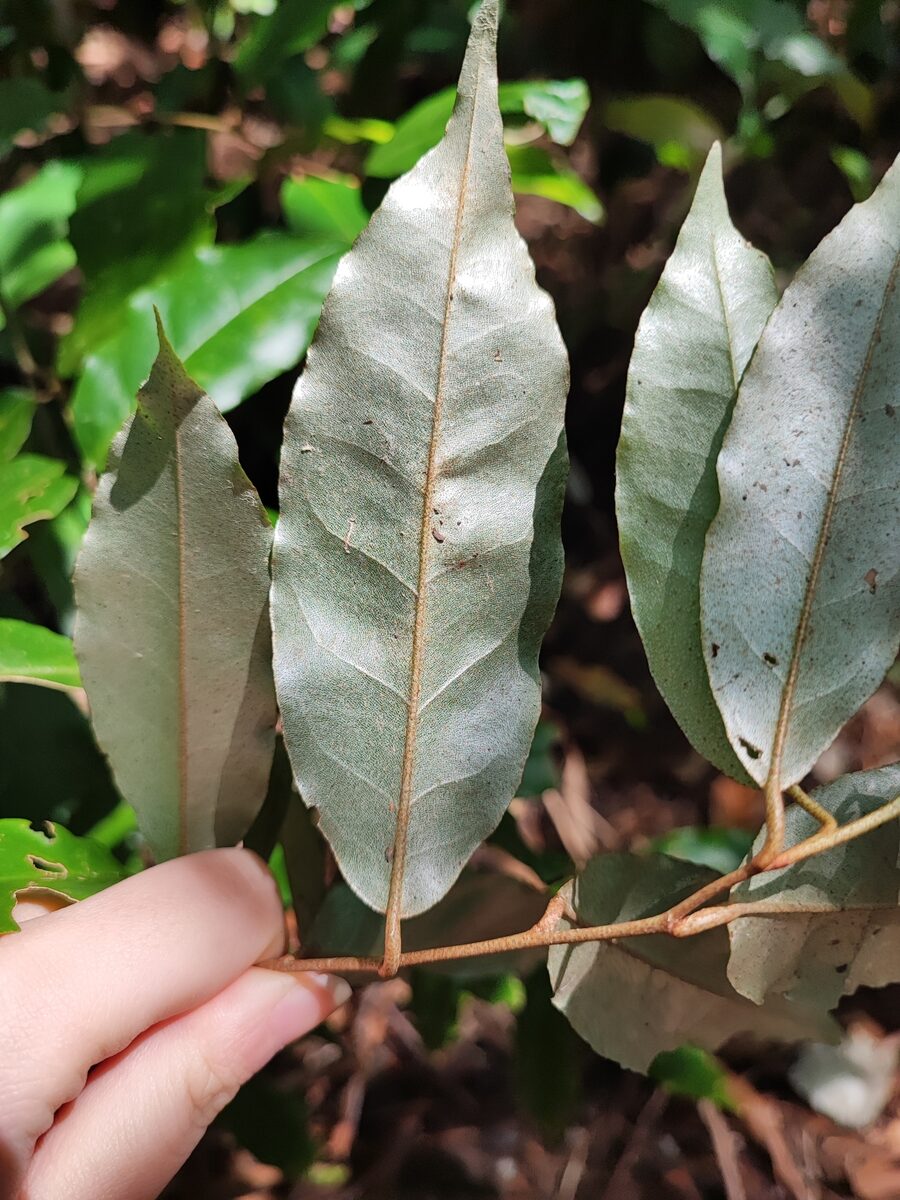
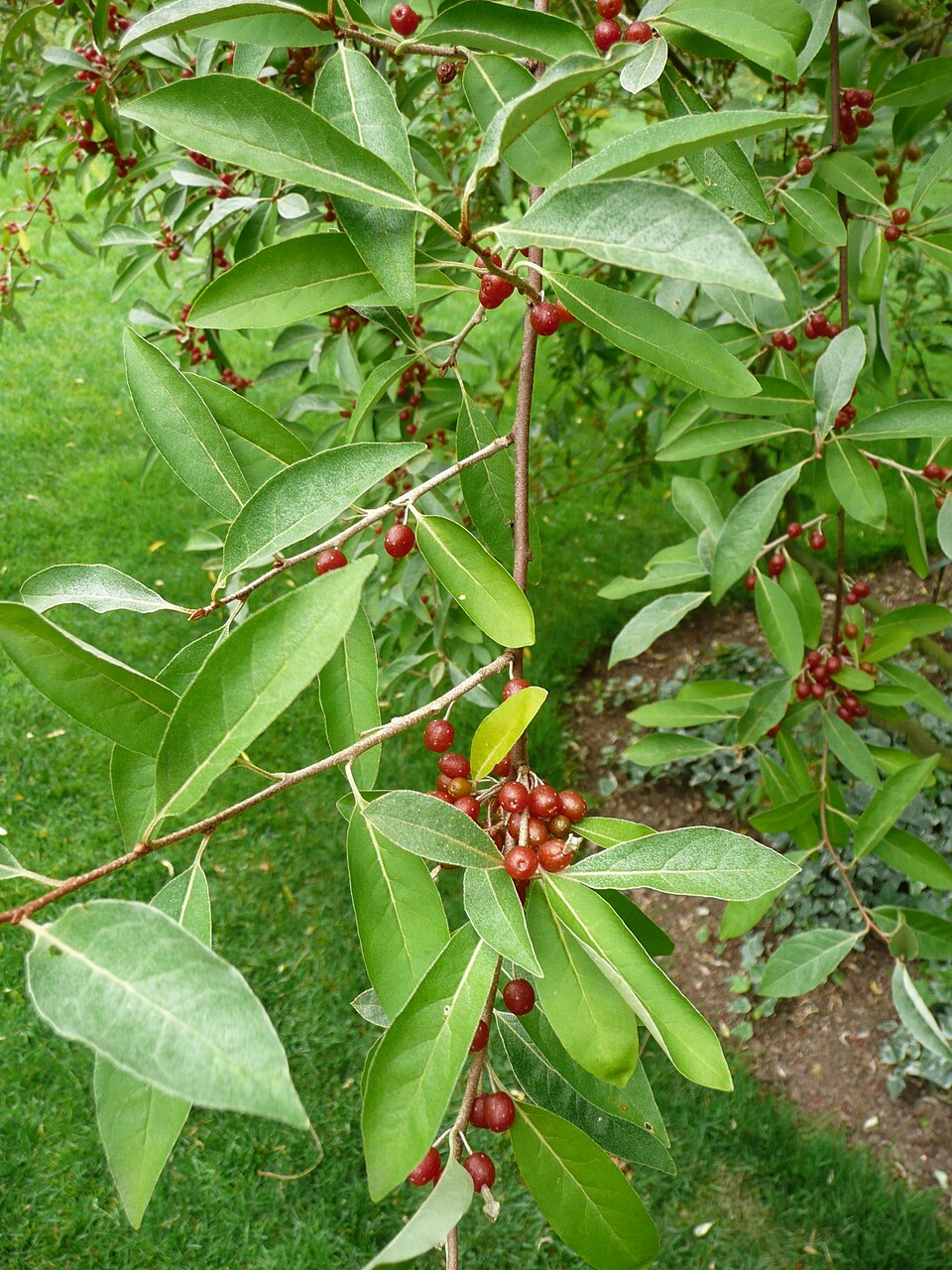
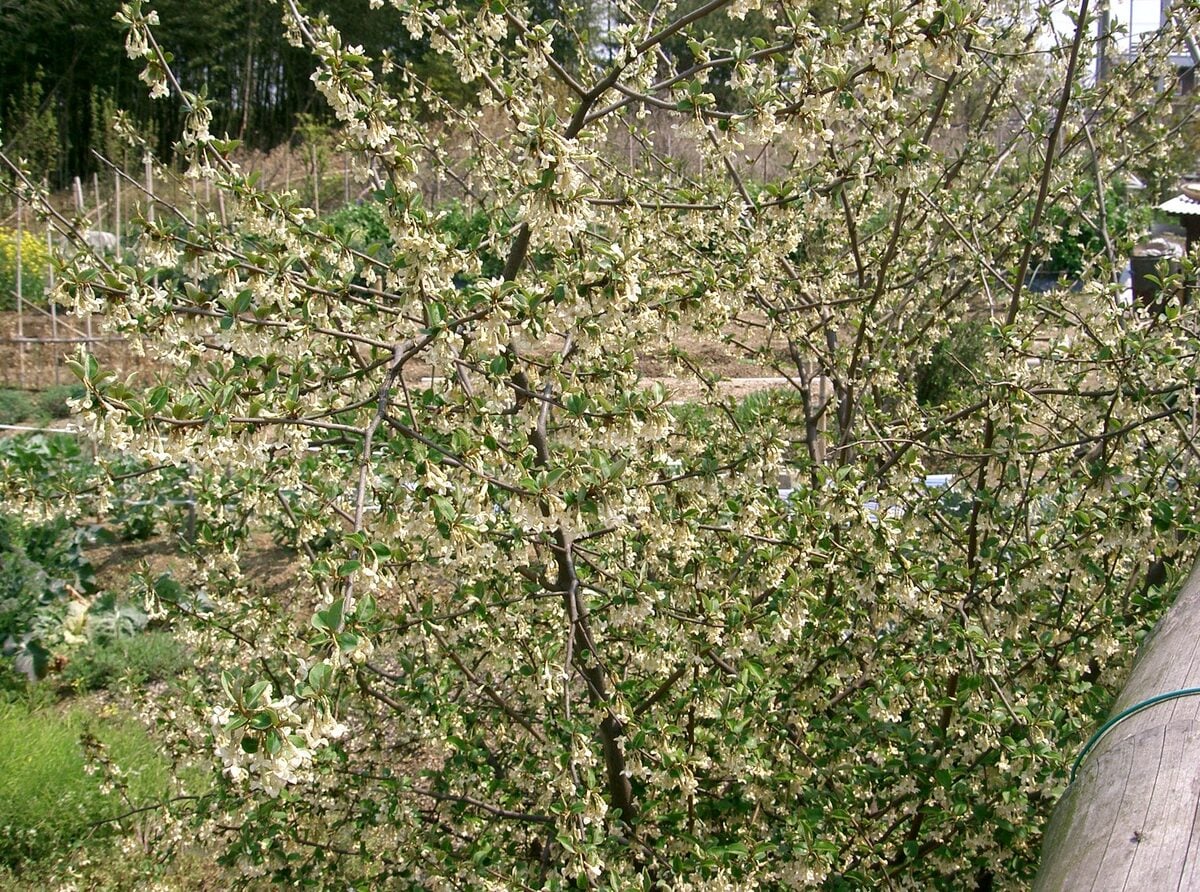
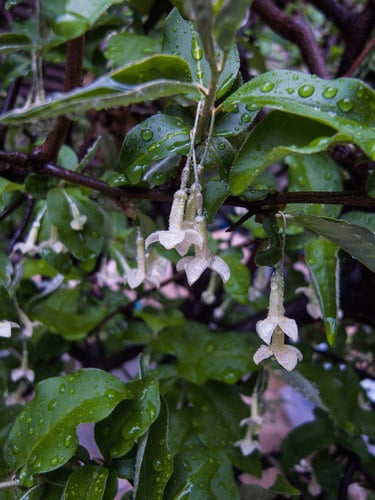
A woody climber. It can be 3-4 m long. It can be a shrub. It has long straggling stems. The leaves are alternate. The young leaves have a silvery covering of white hairs. The leaves have rusty scales which show up in older leaves. The flowers have small white petals. The fruit are 2 cm long and red when ripe. They have one seed.
Edible Uses
The fruit can be eaten raw or cooked. It is acid and somewhat astringent, and is mainly used in preserves, pies and similar preparations, though one account describes it as acid and pleasantly refreshing when eaten fresh. It must be fully ripe before it can be enjoyed raw — if even slightly under-ripe it will be quite astringent. The fruit contains a single large seed, which can also be eaten raw or cooked alongside the fruit, though the seed case is rather fibrous.
Traditional Uses
The ripe fruit are eaten. They are sweet and sour in taste. They are used for tarts and jellies. They are also used for pickles. They can be cooked and sweetened with sugar.
Medicinal Uses
The flowers are astringent and cardiac. The fruit is also astringent. The fruit is additionally a very rich source of vitamins and minerals, particularly vitamins A, C and E, flavanoids and other bio-active compounds, and provides a fairly good supply of essential fatty acids, which is unusual for a fruit. It is being investigated for its potential to reduce the incidence of cancer and to halt or reverse cancer growth.
Known Hazards
Fruit becomes quite astringent if not fully ripe before consumption.
Distribution
It is a tropical plant. It grows in subtropical and temperate regions in the Himalayas. It grows between 700-2,300 m altitude. It grows in swampy regions. It can grow to hardiness zone 9. Melbourne Botanical gardens.
Where It Grows
Andamans, Australia, Bangladesh, Bhutan, China, Cuba, Himalayas, India, Indochina, Indonesia, Malaysia, Myanmar, Nepal, Northeastern India, Pakistan, Philippines, SE Asia, Sikkim, Sri Lanka, Thailand, Vietnam, West Indies,
Cultivation
Succeeds in most soils that are well-drained. Prefers a soil that is only moderately fertile, succeeding in poor soils and in dry soils. Requires a sunny position. This species is not very hardy in Britain and is unlikely to succeed outdoors even in the milder areas of the country. This species is notably resistant to honey fungus. This species has a symbiotic relationship with certain soil bacteria, these bacteria form nodules on the roots and fix atmospheric nitrogen. Some of this nitrogen is utilized by the growing plant but some can also be used by other plants growing nearby. An excellent companion plant, when grown in orchards it can increase yields from the fruit trees by up to 10%.
Propagation
Seed is best sown as soon as it is ripe in a cold frame. It should germinate in late winter or early spring, though it may take 18 months. Stored seed can be very slow to germinate, often taking more than 18 months. A warm stratification for 4 weeks followed by 12 weeks of cold stratification can help, though this stratification information is probably not appropriate to this species as it does not experience much frost in its native habitat. Prick out seedlings into individual pots as soon as they are large enough to handle and plant out when at least 15cm tall. Cuttings of half-ripe wood, 7–10cm with a heel, taken in July/August in a frame. Cuttings of mature wood from the current year's growth, 10–12cm with a heel, taken in October/November in a frame — the cuttings are rather slow and difficult to root, so leave them for 12 months. Layering in September/October takes 12 months.
Other Uses
The wood makes a good fuel. The plant is a nitrogen fixer.
Production
A fruit can weigh 9 g. The yields can be 9-155 kg per plant. In NE India plants flower and fruit November to May. In Sikkim March to May.
Other Information
The fruit are sold in markets. It is cultivated.
Notes
There are 45 Elaeagnus species. Fruit are quite high in Vitamin C.
Nutrition
| Part | Moisture | kJ | kcal | Protein | Vit A | Vit C | Iron | Zinc |
|---|---|---|---|---|---|---|---|---|
| Fruit | — | — | 7.8 | — | — | 18 | — | — |
| Fruit | — | — | — | — | — | — | — | — |
Synonyms
Also Known As
Ambgul, Bhadrasey, Bonjara, Buiehthei, Chishoshikajii, Chhokhua, Durenan besar, Ghiwan, Goeli, Guara, Hari, Hittele, Hmangu, Hunaseballi, Kayalampuvalli, Kolungai, Kulari, Loharu, Malindo, Maloh, Matau, Muslendi, Nildook, Nurgi, Pechuchudi, Saring, Shoushi-ajii, Sibsagar, Sohlyngi, Soh-shang, Sokua, Ta-htu-moo, Thong-za
References (53)
- Ambasta, S.P. (Ed.), 2000, The Useful Plants of India. CSIR India. p 191
- Angami, A., et al, 2006, Status and potential of wild edible plants of Arunachal Pradesh. Indian Journal of Traditional Knowledge 5(4) October 2006, pp 541-550
- Arora, K., Indigenous Forest Management in the Andaman and Nicobar Islands, India.
- Arora, R. K., 2014, Diversity in Underutilized Plant Species - An Asia-Pacific Perspective. Bioversity International. p 70
- Bailey, F. M., 1913, Comprehensive Catalogue of Queensland Plants. Queensland Government. p 459
Show all 53 references Hide references
- Chase, P. & Singh, O. P., 2016, Bioresources of Nagaland: A Case of Wild 4 Edible Fruits in Khonoma Village Forest. in J. Purkayastha (ed.), Bioprospecting of Indigenous Bioresources of North-East India. p 50
- Cribb, A. B. & J. W., 1976, Wild Food in Australia, Fontana. p 75
- Dobriyal, M. J. R. & Dobriyal, R., 2014, Non Wood Forest Produce an Option for Ethnic Food and Nutritional Security in India. Int. J. of Usuf. Mngt. 15(1):17-37
- Facciola, S., 1998, Cornucopia 2: a Source Book of Edible Plants. Kampong Publications, p 93
- Flora Malesiana Series 1 Vol 10 (2) p152,
- Flora of Pakistan www.eFloras.org
- Hedrick, U.P., 1919, (Ed.), Sturtevant's edible plants of the world. p 286
- Hibbert, M., 2002, The Aussie Plant Finder 2002, Florilegium. p 91
- Jeeva, S., 2009, Horticultural potential of wild edible fruits used by the Khasi tribes of Meghalaya. Journal or Horticulture and Forestry Vol. 1(9) pp. 182-192
- Jones, D.L. & Gray, B., 1977, Australian Climbing Plants. Reed. p 101
- Khan, D. & Shaukat, S.S., 2006, The Fruits of Pakistan: Diversity, Distribution, Trends of Production and Use. Int. J. Biol. Biotech., 3(3):463-499
- Kuhnlein, H. V., et al, 2009, Indigenous Peoples' food systems. FAO Rome p 175
- Maikhuri, R, K, and Gangwar, A. K., 1993, Ethnobiological Notes on the Khasi and Garo Tribes of Meghalaya, Northeast India, Economic Botany, Vol. 47, No. 4, pp. 345-357
- Manju, S., and Sundriyal, R. C., 2001, Wild Edible Plants of the Sikkim Humalaya: Nutritive Values of Selected Species. Economic Botany 55(3): 377-390
- Medhi, P. & Borthakur, S. K., 2012, Phytoresources from North Cachur Hills of Assam -3: Edible plants sold at Hflong market. Indian Journal of Natural Products and Resources. 3(1) pp 84-109
- Medhi, P., Sarma, A and Borthakur, S. K., 2014, Wild edible plants from the Dima Hasao district of Assam, India. Pleione 8(1): 133-148
- Miguel, E., et al, 1989, A checklist of the cultivated plants of Cuba. Kulturpflanze 37. 1989, 211-357
- Morley, B.D., & Toelken, H.R., (Eds), 1983, Flowering Plants in Australia. Rigby. p 237, 238
- Murtem, G. & Chaudhrey, P., 2016, An ethnobotanical note on wild edible plants of Upper Eastern Himalaya, India. Brazilian Journal of Biological Sciences, 2016, v. 3, no. 5, p. 63-81
- Pandey, Y., Upadhyay, S. & Bhatt, S. S., 2018, Phyto-chemical constituent os some wild edible fruits of Sikkim Himalaya. Journal of Pharmacognosy and Phytochemistry 2018; 7(3): 1045-1047
- Panja, S., et al, 2014, In vitro assessment of phytochemicals, antioxidant and DNA protective potential of wild edible fruit of Elaeagnus latifolia L. Fruits, Vol. 69, p. 303-314
- Pasha, M. K. & Uddin, S. B., 2019, Minor Edible Fruits of Bangladesh. Bangladesh J. Plant Taxon. 26(2): 299–313
- Pfoze, N. L., et al, 2012, Survey and assessment of floral diversity on wild edible plants from Senapati district of Manipur, Northeast India. Journal of Biodiversity and Environmental Sciences. 1(6):50-52
- Phawa, G. M., Dkhar, E. K. & Marbaniang, D., 2019, Indigenous Wild Edible Plants of Bataw Village, East Jaintia Hills District, Meghalaya. International Journal of Arts, Science and Humanities. 7(2)
- Plants for a Future database, The Field, Penpol, Lostwithiel, Cornwall, PL22 0NG, UK. http://www.scs.leeds.ac.uk/pfaf/
- Ray, A., et al, 2020, How many Wild Edible Plants do we Use. Frontiers in Sustainable Food Systems. 4:56 p 12
- Recher, P, 2001, Fruit Spirit Botanical Gardens Plant Index. www.nrg.com.au/~recher/ seedlist.html p 2
- Rymbai, H., et al, 2016, Analysis study on potential underutilized edible fruit genetic resources of the foothills track of Eastern Himalayas, India. Genetic. Resourc. Crop Evol. (2016) 63:125-139
- Sadhale, A., et al, 1991, Ethnobotanical studies of sacred grove at Ajiwali, Pune district. J. Econ. Tax. Bot. Vol. 15 No. 1 pp 167-172
- Salvi, J. et al, 2016, A review: Underutilized wild edible plants as a potential source of alternative nutrition. International Journal of Botany Studies. Volume 1; Issue 4; May 2016; Page No. 32-36
- Sangma, A. j. T., 2018, Non-timber forest products (NTFPs) used by Garo tribe of Rongram block in West Garo Hills, Meghalaya. Indian Journal of Traditional Knowledge Vol 18 (1), pp 151-161
- Sarma, H., et al, 2010, Updated Estimates of Wild Edible and Threatened Plants of Assam: A Meta-analysis. International Journal of Botany 6(4): 414-423
- Sawian, J. T., et al, 2007, Wild edible plants of Meghalaya, North-east India. Natural Product Radiance Vol. 6(5): p 415
- Seal, T., 2012, Evaluation of Nutritional Potential of Wild Edible Plants, Traditionally Used by the Tribal People of Meghalaya. American Journal of Plant Nutrition and FertilizationTechnology 2(1): 19-26
- Singh, H.B., Arora R.K.,1978, Wild edible Plants of India. Indian Council of Agricultural Research, New Delhi. p 56
- Singh, K.K., Singh, M. & Joshi, S. C., 2014, Phenolic content and Antioxidant Activity of some Underutilized Wild Edible Fruits of the Sikkim Himalaya. SMU Medical Journal. Vol. 1, No. 2 July 2014
- Sp. pl. 1:121. 1753
- Srivastava, R. C., et al, 2010, Indigenous biodiversity of Apatani plateau: Learning on biolcultural knowledge of Apani tribe of Qrunachal Pradesh for sustainable livelihoods. Indian Journal of Traditional Knowledge 9(3): 432-442
- Sukarya, D. G., (Ed.) 2013, 3,500 Plant Species of the Botanic Gardens of Indonesia. LIPI p 922
- Sundriyal, M., et al, 1998, Wild edibles and other useful plants from the Sikkim Himalaya, India. Oecologia Montana 7:43-54
- Sundriyal, Manju and Sundriyal R. C., 2001, Seed Germination and Response of Stem-cuttings to Hormonal Treatment in Six Priority Wild Edible Fruit Species in Sikkim Himalaya. Indian Forester Vol. 127 No. 6 June 2001. pp 695-717
- Sundriyal, Manju and R. C. Sundriyal, Wild Edible Plants of the Sikkim Himalaya: Marketing, Value Addition and Implications for Management. Economic Botany: Vol. 58, No. 2, pp. 300–315.
- Sundriyal, Manju and R. C. Sundriyal, 2003, Underutilized edible plants of the Sikkim Himalaya: Need for domestication. Current Science, Vol. 85, No. 6, p 731
- Sundriyal, M., et al, 2004, Dietary Use of Wild Plant Resources in the Sikkim Himalaya, India. Economic Botany 58(4) pp 626-638
- Sundriyal, M. & Sundriyal, R. C., 2004, Structure, Phenology, Fruit Yield, and Future Prospects of some Prominent Wild Edible Plant Species of the Sikkim Himalaya, India. Journal of Ethnobiology 24(1): 113-138
- Tanaka,
- Uprety, Y., et al, 2016, Traditional use and management of NTFPs in Kangchenjunga Landscape: implications for conservation and livelihoods. Journal of Ethnobiology and Ethnomedicine (2016) 12:19
- Wild edible plants of Himachal Pradesh