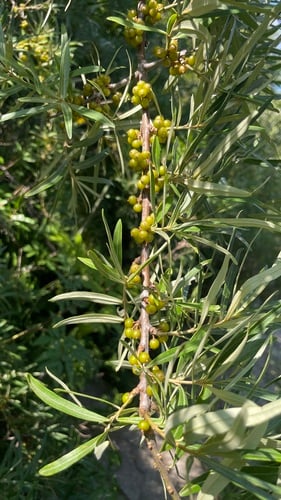
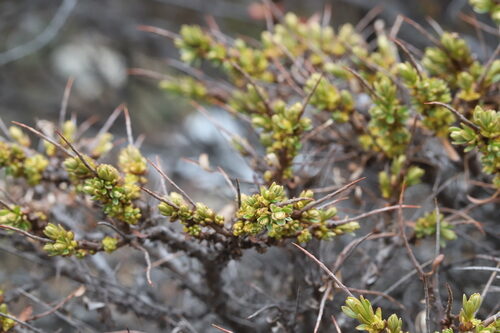
Hippophae rhamnoides subsp. turkestanica
Rousi
Seabuckthorn
gbif· cc-by-sa
swmplf
gbif· cc-by-nc-sa
MBG
gbif· cc-by-nc
Alex
Description
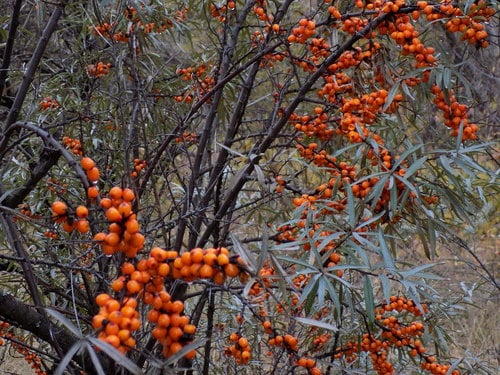
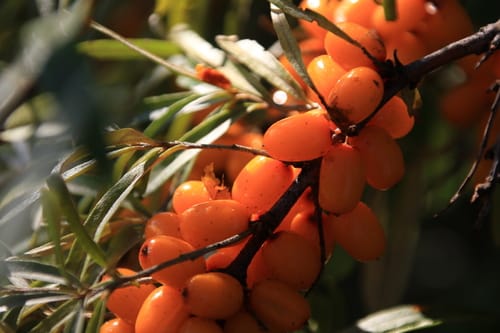
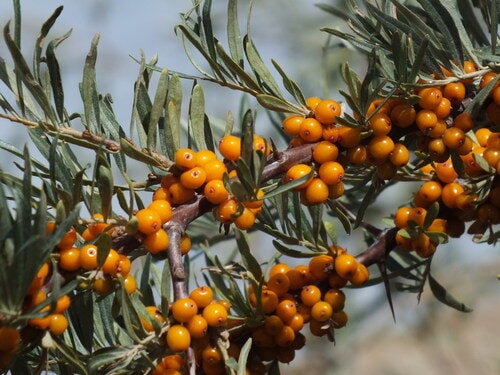
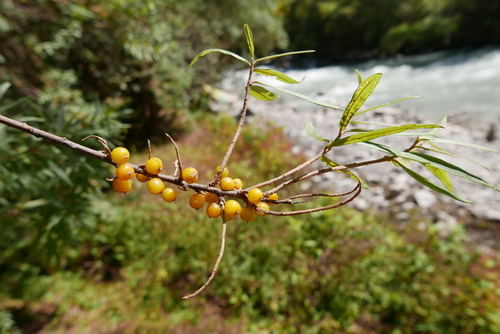
A climbing shrub. It grows 2 m tall. The shoots are often modified into spines. The leaves are 2-6 cm long and 3-6 mm wide. They are narrow. The male flowers are in clusters at the base of the shoots. The female flowers are in clusters of 2-4 and are slender. The fruit is almost round and 6-7 mm across. It is succulent and orange. There is one seed. The seed is 4 mm long. It is black and shiny with unequal lobes.
Edible Uses
The acidic fruits are boiled with sugar and eaten, used for juice, and used in curries. The fruit is also eaten fresh by children.
Traditional Uses
The fruit are boiled with sugar and eaten. They are acidic. They are used for juice. The juice is also used for curries.
This uses section is brief — help expand it
Medicinal Uses
The plant is being studied for its health benefits.
Distribution
It is a cool temperate plant. It grows in cold desert in north India. In the Himalayas it grows between 1,800-3,600 m altitude.
Where It Grows
Afghanistan, Asia, Central Asia, China, Himalayas, India, Kazakhstan, Kyrgyzstan, Mongolia, Pakistan, Tajikistan, Tibet, Turkmenistan, Uzbekistan,
Other Information
The fruit are acidic and are eaten by children.
Notes
There are about 8 Hippophae species. The plant is being studied for its health benefits.
Synonyms
Also Known As
Charma, Cherker, Dhurchuk, Kalabisa, Sastalulu, Sermang, sTar-bu, Tsermang
References (6)
- Ballabh, B., et al, 2007, Raw edible plants of cold desert Ladakh. Indian Journal of Traditional Knowledge. 6(1) pp 182-184
- Khan, D. & Shaukat, S.S., 2006, The Fruits of Pakistan: Diversity, Distribution, Trends of Production and Use. Int. J. Biol. Biotech., 3(3):463-499
- Murugan, Pal M., et al, 2010, Phytofoods of Nubra valley, Ladakh - The cold desert. Indian Journal of Traditional Knowledge. Vol. 9(2): 303-308
- Negi, P. S. & Subramani, S. P., 2015, Wild Edible Plant Genetic Resources for Sustainable Food Security and Livelihood of Kinnaur District, Himachal Pradesh, India, International Journal of Conservation Science. 6 (4): 657-668
- Plants for a Future database, The Field, Penpol, Lostwithiel, Cornwall, PL22 0NG, UK. http://www.scs.leeds.ac.uk/pfaf/
Show all 6 references Hide references
- Sharma, L. et al, 2018, Diversity, distribution pattern, endemism and indigenous uses of wild edible plants in Cold Desert Biosphere Reserve of Indian Trans Himalaya. Indian Journal of Traditional Knowledge. Vol 17(1) January 2018 pp 122-131