Ehretia rigida
(Thunb.) Druce
Cape lilac, Puzzle bush
iNaturalist· cc-by-nc
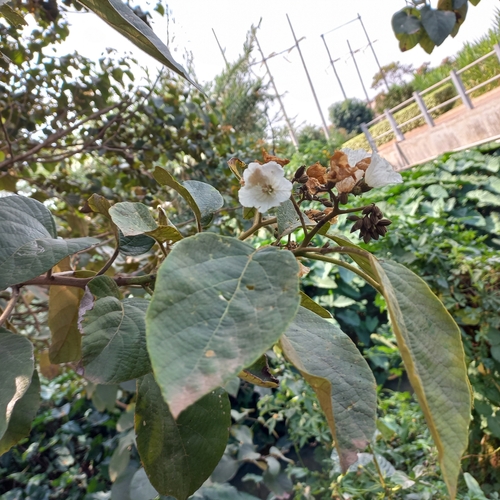
(c) Marie Delport, some rights reserved (CC BY-NC), uploaded by Marie Delport
iNaturalist· cc-by-nc
(c) Troos van der Merwe, some rights reserved (CC BY-NC), uploaded by Troos van der Merwe
iNaturalist· cc-by-nc
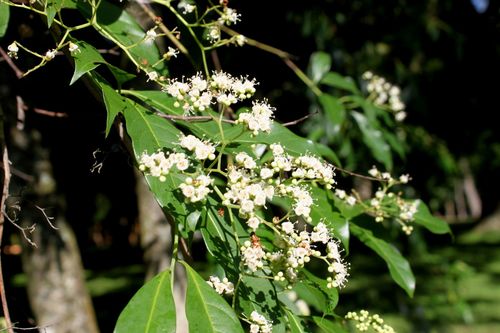
(c) Grant Egen, some rights reserved (CC BY-NC), uploaded by Grant Egen
Summary
Source: WikipediaEhretia rigida (puzzle bush, also deurmekaarbos in Afrikaans = "confused/tangled bush"), is a small, multi-stemmed tree with a tangled growth habit belonging to the family Ehretiaceae. It occurs over a wide range of habitat throughout the eastern part of South Africa, and in Namibia, Botswana, Zimbabwe and Mozambique. The species is deciduous, hardy and normally grows to about 5 meters tall. Branches are quite rigid, hence its specific name. Leaves are in tufts, leathery and rough with adpressed minute barbs along the margins. Almost invariably there are small pockets of hairs or acarodomatia, providing a refuge for mites in the axils of veins on the underside of the leaves. Bark is smooth and uniformly ash-grey, becoming rough on older stems. Fragrant lilac-coloured to white flowers are produced in early spring and are followed by small 8mm diameter fruits bearing a persistent style, green at first, turning orange, red and finally black. Seeds are some 3 millimeters in length, reniform and sculpted on the abaxial surface. Each fruit contains 4 seeds. The genus honours the botanist Georg Dionysius Ehret, a celebrated botanist and botanical illustrator of the 18th century.
Description
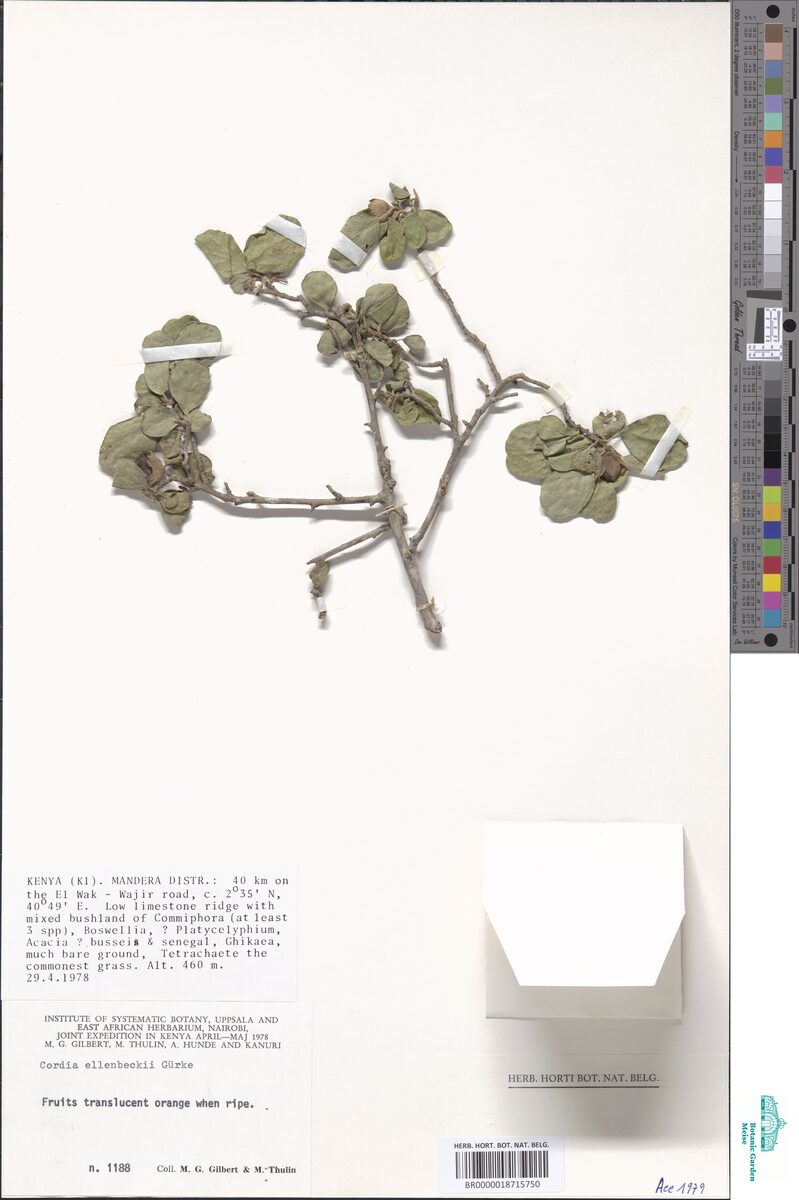
A small straggly tree which loses its leaves during the year. It grows 2-5 m tall. It has a short stem and spreading crown. The bark is smooth and grey. The leaves are simple and alternate. The leaves are broadly oval and 2.5 cm long. They are leathery and borne close together near the ends of twigs. The flowers are pale pink. They are 7 mm across. The occur in clusters in branches. The fruit are round and orange to red. They are small and cherry like and in clusters. The seed are oval, brown, hard and fibrous. The fruit are edible.
Edible Uses
The ripe fruit are eaten raw and are very sweet; they can also be prepared with water to make a gravy. The leaves are used as a drink.
Traditional Uses
The fruit are eaten raw when ripe. They are very sweet. They are also prepared with water and used as a gravy.
This uses section is brief — help expand it
Distribution
A tropical plant. It grows from 800 m to 1200 m altitude. It occurs from the edges of evergreen forest to open woodland. It is drought and frost resistant. It can grow in arid places. It grows in Miombo woodland in Africa. In Brisbane Botanical gardens.
Where It Grows
Africa, Australia, Botswana, East Africa, Eswatini, Lesotho, Mozambique, Namibia, South Africa, Southern Africa, Swaziland, Zambia, Zimbabwe,
Cultivation
Plants can be grown from seeds or cuttings. Seeds germinate in 10-20 days. Seedlings can be transplant at the 2 leaf stage.
Production
It is fast growing.
Other Information
The fruit are eaten especially by children.
Notes
There are about 50 Ehretia species. They have also been put in the family Ehretiaceae.
Synonyms
Also Known As
Bhungela, Bhungele, Deurmekaarbos, Iklele, Morobe, Morobo, Muhambe, Nyakashemveri, Swartbos, Umbotshane, Umcele, Umhlele, Umhloli, Umkele, Umklele, Umqxele, Umthele, Umxele
References (32)
- Arnold, T.H., Wells, M.J. & Wehmeyer, A.S., Khoisan food plants: taxa with potential for future economic exploitation, in Wickens, G.E., Goodin, J.R., and Field, D.V.,(Eds.) 1985, Plants for Arid Lands. Unwin Hyman, London, p 73
- Bot. Soc. Exch. Club Brit. Isles 4:620. 1917
- Cunningham, 1985,
- FAO, 1988, Traditional Food Plants, FAO Food and Nutrition Paper 42. FAO Rome p 261
- Fox, F. W. & Young, M. E. N., 1982, Food from the Veld. Delta Books. p 132
Show all 32 references Hide references
- Grivetti, 1979,
- Grivetti, L. E., 1980, Agricultural development: present and potential role of edible wild plants. Part 2: Sub-Saharan Africa, Report to the Department of State Agency for International Development. p 79
- HELY-HUTCHINSON (As Ehretia hottentotica)
- https://growwild.co.za Edible Indigenous plants
- http://aflora.africa.kyoto-u.ac.jp
- INFOODS:FAO/INFOODS Databases
- Joffe, P., 2007, Creative Gardening with Indigenous Plants. A South African Guide. Briza. p 224
- Long, C., 2005, Swaziland's Flora - siSwati names and Uses http://www.sntc.org.sz/flora/ (As subsp. nervifolia)
- Magwede, K., van Wyk, B.-E., & van Wyk, A. E., 2019, An inventory of Vhavenḓa useful plants. South African Journal of Botany 122 (2019) 57–89
- Mason, 1971,
- Ogle & Grivetti, 1985,
- Palgrave, K.C., 1996, Trees of Southern Africa. Struik Publishers. p 803
- Palmer, E and Pitman, N., 1972, Trees of Southern Africa. Vol. 2. A.A. Balkema, Cape Town p 1843
- Peters, C. R., O'Brien, E. M., and Drummond, R.B., 1992, Edible Wild plants of Sub-saharan Africa. Kew. p 71
- Plowes, N. J. & Taylor, F. W., 1997, The Processing of Indigenous Fruits and other Wildfoods of Southern Africa. in Smartt, L. & Haq. (Eds) Domestication, Production and Utilization of New Crops. ICUC p 190
- Roodt, V., 1998, Trees & Shrubs of the Okavango Delta. Medicinal Uses and Nutritional value. The Shell Field Guide Series: Part 1. Shell Botswana. p 193
- Royal Botanic Gardens, Kew (1999). Survey of Economic Plants for Arid and Semi-Arid Lands (SEPASAL) database. Published on the Internet; http://www.rbgkew.org.uk/ceb/sepasal/internet [Accessed 4th April 2011]
- Ruiters-Welcome, A. K., 2019, Food plants of southern Africa. Ph.D. thesis. Univ. of Johannesburg p 38
- Schmidt, E., Lotter, M., & McCleland, W., 2007, Trees and shrubs of Mpumalanga and Kruger National Park. Jacana Media p 574
- Shava, S., 2000, The Use of Indigenous Plants as Food by a Rural Community in the Eastern Cape: an Educational Exploration. Masters Thesis Rhodes University. p 65
- Story, 1958,
- Swaziland's Flora Database http://www.sntc.org.sz/flora
- van Wyk, B, van Wyk, P, and van Wyk B., 2000, Photographic guide to Trees of Southern Africa. Briza. p 125
- Venter, F & J., 2009, Making the most of Indigenous Trees. Briza. p 140
- Wehmeyer, A. S, 1986, Edible Wild Plants of Southern Africa. Data on the Nutrient Contents of over 300 species
- Welcome, A. K. & Van Wyk, B.-E., 2019, An inventory and analysis of the food plants of southern Africa. South African Journal of Botany 122 (2019) 136–179
- World Checklist of Useful Plant Species 2020. Royal Botanic Gardens, Kew