Dovyalis caffra
(Hook. f. et Harv.) Warb.
Key apple
iNaturalist· cc-by-nc
(c) D. Waters, some rights reserved (CC BY-NC)
iNaturalist· cc-by-nc
(c) D. Waters, some rights reserved (CC BY-NC)
iNaturalist· cc-by-nc
(c) MG Dlamini, some rights reserved (CC BY-NC)
Description
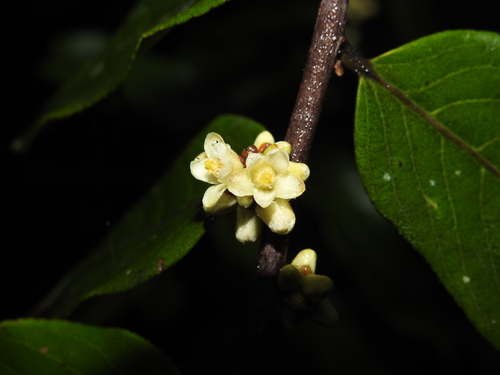
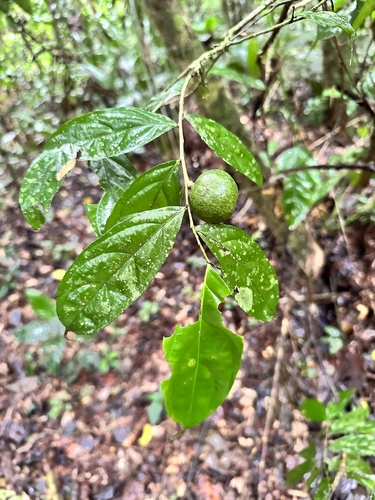
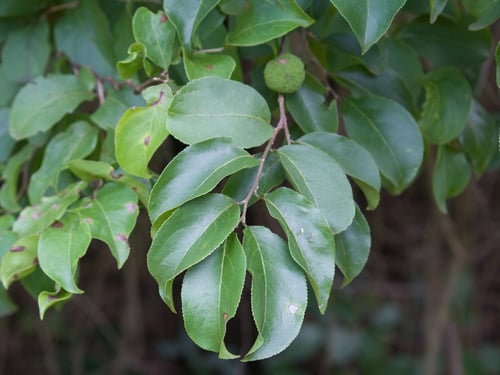
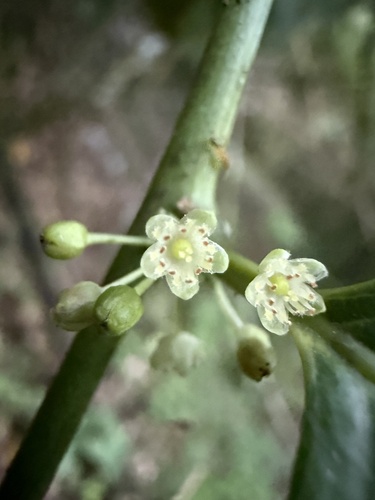
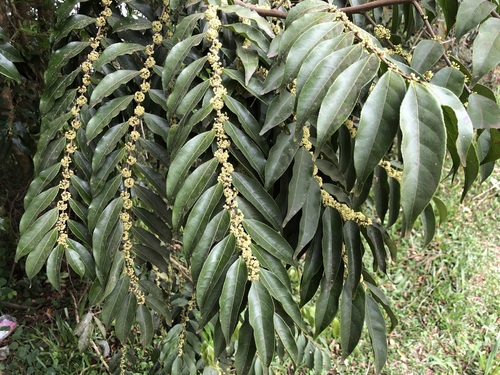
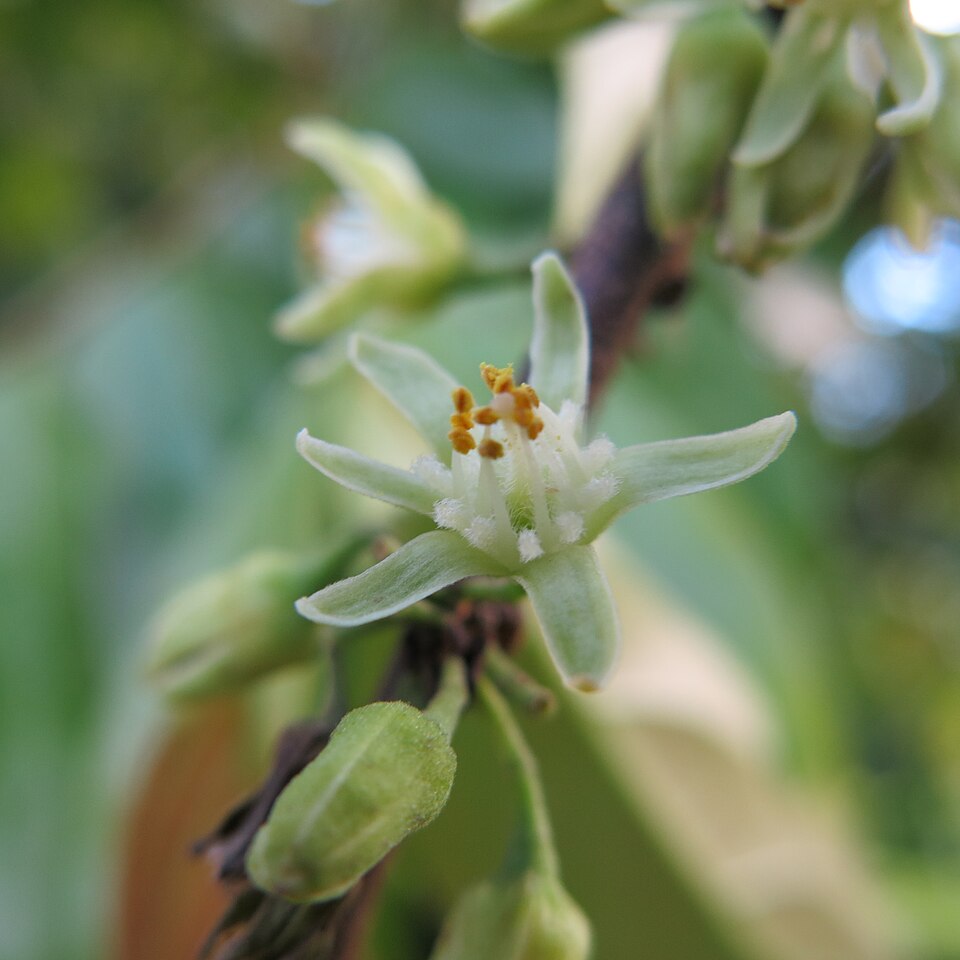
A spiny shrub. It grows up to 6-9 m tall. It has long straight spines on the trunk and branches. They are about 3 cm long. The bark is white when young. The leaves are simple and carried one after another along the stem. The edges of the leaves roll back slightly. The leaves are dark green and glossy. Plants are separately male and female. The female flowers are 3 mm long and light green. They occur as 1-3 together in the axils of leaves. The male flowers are in dense short clusters in the axils of leaves. The fruit are medium sized and yellow. They are round and 2.5-4 cm across. The skin is tough. The fruit are edible.
Edible Uses
The fruit are eaten fresh, used in jams and desserts, and pickled when green. The acidic fruit are high in pectin and can be added in small amounts to help jams set.
Traditional Uses
The fruit are eaten fresh and used in jams and desserts. The fruit are acidic. Because the fruit are high in pectins they can be added in small amounts to help jams to jell and set. The green fruit are also pickled.
Medicinal Uses
The fruit are rich in Vitamin C.
Distribution
It is native to S and E Africa. It is subtropical. It can withstand drought but cannot tolerate frosts. They grow naturally in areas with temperatures in the range 14-22°C. Often they grow between 800 and 1200 m altitude but grow up to 2450 m altitude in Kenya. The rainfall where it grows naturally is 1000-1700 mm per year. It needs well drained soils. It is often on termite mounds. It can grow in arid places. It suits hardiness zones 9-10.
Where It Grows
Africa, Albania, Asia, Australia, Balkans, Botswana, Brazil, Britain, Central America, Cuba, Djibouti, East Africa, Egypt, Eritrea, Eswatini, Ethiopia, Europe, Greece, India, Indonesia, Iran, Iraq, Israel, Italy, Kenya, Lesotho, Malawi, Malta, Mediterranean, Middle East, Mozambique, Namibia, North Africa, North America, Pacific, Philippines, Portugal, SE Asia, Slovenia, South Africa, Southern Africa*, South America, Spain, St Helena, Sudan, Swaziland, Tanzania, Uganda, USA, West Indies, Zambia, Zimbabwe,
Cultivation
Plants are grown from seed. Seed are collected from fruit. The ripe fruit are cracked and allowed to rot for one week before removing the seed. There are about 20 seeds in each fruit. The seeds should be sown immediately in a nursery bed. Seedlings come through the soil in 12 days. When bushes are established they need to have their crown thinned out to allow more fruit to be produced. The trees can be used as a fence or hedge. Trees can be grown from cuttings, air layering and grafting. It can be grown as a hedge.
Propagation
Seed - no pre-treatment is required. If dried carefully and stored at 3°c, the seed can remain viable for several years. Seeds are sown in flat seedling trays and covered with a layer of fine sand and kept moist. Under ideal conditions, germination occurs within 18 - 20 days. Seedlings transplant well Layering. Graft or shield-bud desirable varieties on to seedling rootstocks. Hardwood cuttings. The cut tips should be treated with root-stimulating hormones before planting out into river sand
Other Uses
If the fruit is soaked in water and allowed to ferment, the liquid drained off has herbicidal properties. The wood is white, dense and heavy; usually too small to be of general use. The plants have dense spiny shoots that make an impenetrable barrier. They are well suited to making hedges so long as they are trimmed regularly. Trees exhibit allelopathy and will inhibit the growth of other plants nearby.
Production
Trees produce fruit in 5-6 years from seed and 2-3 years from cuttings. Fruit need to be fully ripe when harvested. Fruit can be harvested after they fall. Fruit mature in 90 days.
Other Information
A popular fruit.
Notes
The fruit are rich in Vitamin C. There are about 22 Dovyalis species. Also put in the Flacourtiaceae family.
Nutrition
| Part | Moisture | kJ | kcal | Protein | Vit A | Vit C | Iron | Zinc |
|---|---|---|---|---|---|---|---|---|
| Fruit | 85.9 | 238 | 57 | 0.4 | — | 117 | 0.1 | — |
References (67)
- Ambasta, S.P. (Ed.), 2000, The Useful Plants of India. CSIR India. p 182
- Arora, R. K., 2014, Diversity in Underutilized Plant Species - An Asia-Pacific Perspective. Bioversity International. p 68
- Awodoyin, R.O., Olubode, O.S., Ogbu, J.U., Balogun, R.B., Nwawuisi, J.U. and Orji, K.O., 2015, Indigenous Fruit Trees of Tropical Africa: Status, Opportunity for Development and Biodiversity Management. Agricultural Sciences, 6, 31-41
- Barwick, M., 2004, Tropical and Subtropical Trees. A Worldwide Encyclopedic Guide. Thames and Hudson p 156
- Bodkin, F., 1991, Encyclopedia Botanica. Cornstalk publishing, p 357
Show all 67 references Hide references
- Burkill, I.H., 1966, A Dictionary of the Economic Products of the Malay Peninsula. Ministry of Agriculture and Cooperatives, Kuala Lumpur, Malaysia. Vol 1 (A-H) p 870
- Cundall, P., (ed.), 2004, Gardening Australia: flora: the gardener's bible. ABC Books. p 511
- Cunningham, 1985,
- Darley, J.J., 1993, Know and Enjoy Tropical Fruit. P & S Publishers. p 131
- Dharani, N., 2002, Field Guide to common Trees & Shrubs of East Africa. Struik. p 224
- H. G. A. Engler & K. A. E. Prantl, Nat. Pflanzenfam. 3(6a):44. 1893
- Etherington, K., & Imwold, D., (Eds), 2001, Botanica's Trees & Shrubs. The illustrated A-Z of over 8500 trees and shrubs. Random House, Australia. p 267
- Facciola, S., 1998, Cornucopia 2: a Source Book of Edible Plants. Kampong Publications, p 116
- FAO, 1988, Traditional Food Plants, FAO Food and Nutrition Paper 42. FAO Rome p 257
- Flowerdew, B., 2000, Complete Fruit Book. Kyle Cathie Ltd., London. p 162
- Fox, F. W. & Young, M. E. N., 1982, Food from the Veld. Delta Books. p 228
- Hardwick, G., 2001, Economically Useful Plants for Northern Australia: Master Species List. Crusader eBooks.
- Hedrick, U.P., 1919, (Ed.), Sturtevant's edible plants of the world. p 17 (As Aberia caffra)
- HELY-HUTCHINSON,
- Hibbert, M., 2002, The Aussie Plant Finder 2002, Florilegium. p 89
- https://growwild.co.za Edible Indigenous plants
- INFOODS:FAO/INFOODS Databases
- Jardin, C., 1970, List of Foods Used In Africa, FAO Nutrition Information Document Series No 2.p 133
- Joffe, P., 2007, Creative Gardening with Indigenous Plants. A South African Guide. Briza. p 222
- John, L., & Stevenson, V., 1979, The Complete Book of Fruit. Angus & Robertson p 292
- Katende, A.B., Birnie, A & Tengnas B., 1995, Useful Trees and Shrubs for Uganda. Identification, Propagation and Management for Agricultural and Pastoral Communities. Technical handbook No 10. Regional Soil Conservation Unit, Nairobi, Kenya. p 248
- Kiple, K.F. & Ornelas, K.C., (eds), 2000, The Cambridge World History of Food. CUP p 1795
- Long, C., 2005, Swaziland's Flora - siSwati names and Uses http://www.sntc.org.sz/flora/
- Lord, E.E., & Willis, J.H., 1999, Shrubs and Trees for Australian gardens. Lothian. p 225
- Lorenzi, H., Bacher, L., Lacerda, M. & Sartori, S., 2006, Brazilian Fruits & Cultivated Exotics. Sao Paulo, Instituto Plantarum de Estuados da Flora Ltda. p 601
- Lyle, S., 2006, Discovering fruit and nuts. Land Links. p 186
- Macmillan, H.F. (Revised Barlow, H.S., et al) 1991, Tropical Planting and Gardening. Sixth edition. Malayan Nature Society. Kuala Lumpur. p 314
- Magwede, K., van Wyk, B.-E., & van Wyk, A. E., 2019, An inventory of Vhavenḓa useful plants. South African Journal of Botany 122 (2019) 57–89
- Makonda, F. B. S., & Ruffo, C. K., 2011, Species List. NAFORMA, Tanzania
- Martin, F. W., et al, 1987, Perennial Edible Fruits of the Tropics. USDA Handbook 642 p 28
- Mbuya, L.P., Msanga, H.P., Ruffo, C.K., Birnie, A & Tengnas, B., 1994, Useful Trees and Shrubs for Tanzania. Regional Soil Conservation Unit. Technical Handbook No 6. p 240
- Miguel, E., et al, 1989, A checklist of the cultivated plants of Cuba. Kulturpflanze 37. 1989, 211-357
- Molla, A., Ethiopian Plant Names. http://www.ethiopic.com/aplants.htm
- Morton, J. F., 1987, Fruits of Warm Climates. Wipf & Stock Publishers p 315
- Palgrave, K.C., 1996, Trees of Southern Africa. Struik Publishers. p 636
- Palmer, E and Pitman, N., 1972, Trees of Southern Africa. Vol. 3. A.A. Balkema, Cape Town p 1562
- Peters, C. R., O'Brien, E. M., and Drummond, R.B., 1992, Edible Wild plants of Sub-saharan Africa. Kew. p 114
- Plowes, N. J. & Taylor, F. W., 1997, The Processing of Indigenous Fruits and other Wildfoods of Southern Africa. in Smartt, L. & Haq. (Eds) Domestication, Production and Utilization of New Crops. ICUC p 190
- Recher, P, 2001, Fruit Spirit Botanical Gardens Plant Index. www.nrg.com.au/~recher/ seedlist.html p 2
- Royal Botanic Gardens, Kew (1999). Survey of Economic Plants for Arid and Semi-Arid Lands (SEPASAL) database. Published on the Internet; http://www.rbgkew.org.uk/ceb/sepasal/internet [Accessed 16th April 2011]
- Ruiters-Welcome, A. K., 2019, Food plants of southern Africa. Ph.D. thesis. Univ. of Johannesburg p 99
- Schmidt, E., Lotter, M., & McCleland, W., 2007, Trees and shrubs of Mpumalanga and Kruger National Park. Jacana Media p 430
- Shava, S., 2000, The Use of Indigenous Plants as Food by a Rural Community in the Eastern Cape: an Educational Exploration. Masters Thesis Rhodes University. p 63
- Sukarya, D. G., (Ed.) 2013, 3,500 Plant Species of the Botanic Gardens of Indonesia. LIPI p 247
- Swaziland's Flora Database http://www.sntc.org.sz/flora
- Tredgold, M.H., 1986, Food Plants of Zimbabwe. Mambo Press. p 99
- UPHOF
- USDA, ARS, National Genetic Resources Program. Germplasm Resources Information Network - (GRIN). [Online Database] National Germplasm Resources Laboratory, Beltsville, Maryland. Available: www.ars-grin.gov/cgi-bin/npgs/html/econ.pl (10 April 2000)
- van Wyk, B, van Wyk, P, and van Wyk B., 2000, Photographic guide to Trees of Southern Africa. Briza. p 123
- van Wyk, B., 2005, Food Plants of the World. An illustrated guide. Timber press. p 181
- van Wyk, Be., & Gericke, N., 2007, People's plants. A Guide to Useful Plants of Southern Africa. Briza. p 42
- van Wyk, B-E., 2011, The potential of South African plants in the development of new food and beverage products. South African Journal of Botany 77 (2011) 857–868
- Venter, F & J., 2009, Making the most of Indigenous Trees. Briza. p 134
- Verheij, E. W. M. and Coronel, R.E., (Eds.), 1991, Plant Resources of South-East Asia. PROSEA No 2. Edible fruits and nuts. Pudoc Wageningen. p 329
- Wehmeyer, A. S, 1986, Edible Wild Plants of Southern Africa. Data on the Nutrient Contents of over 300 species
- Welcome, A. K. & Van Wyk, B.-E., 2019, An inventory and analysis of the food plants of southern Africa. South African Journal of Botany 122 (2019) 136–179
- Wiersema, J. H. & Leon, B., 2013, World Economic Plants. A Standard Reference CRC Press. 2nd Ed. p 254
- Williamson, J., 2005, Useful Plants of Malawi. 3rd. Edition. Mdadzi Book Trust. p 103
- World Checklist of Useful Plant Species 2020. Royal Botanic Gardens, Kew
- www.worldagroforestrycentre.org/treedb/
- www.zimbabweflora.co.zw 2011
- Young, J., (Ed.), 2001, Botanica's Pocket Trees and Shrubs. Random House. p 327