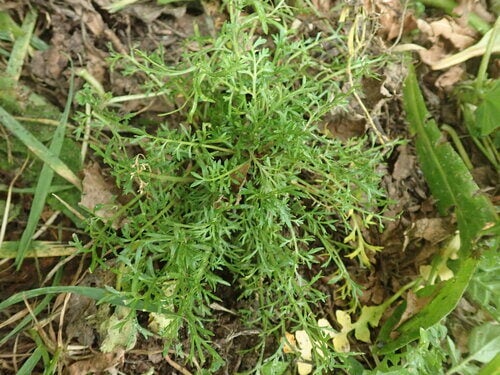
Diplotaxis muralis
(L.) DC
Wall rocket, Perennial rocket
iNaturalist· cc-by-nc
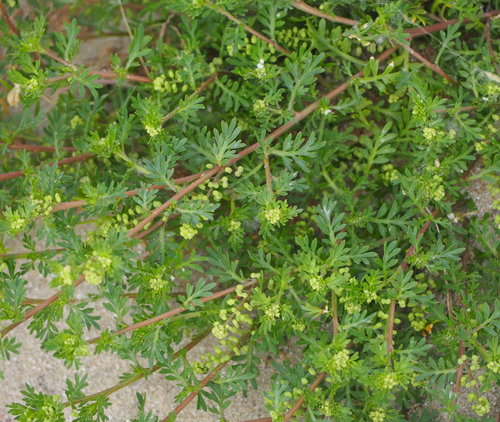
(c) Abdul-lateef Ismail, some rights reserved (CC BY-NC), uploaded by Abdul-lateef Ismail
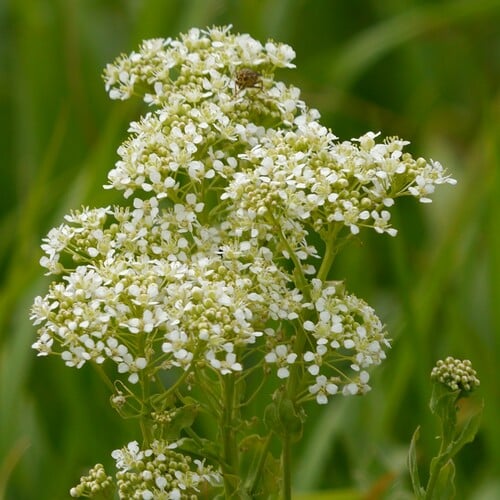
iNaturalist· cc-by-sa
(c) Fornax, some rights reserved (CC BY-SA)
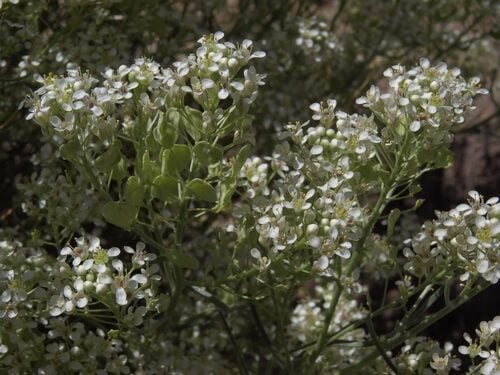
iNaturalist· cc-by-sa
(c) Fornax, some rights reserved (CC BY-SA)
Summary
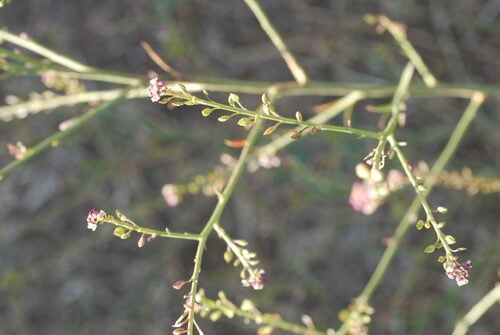
Source: WikipediaDiplotaxis muralis, the annual wall-rocket, is a species of flowering plant in the family Brassicaceae. This plant is native to Europe, Asia, and Africa, but it is found throughout the temperate world, where it has naturalized. This is an erect mustard-like plant rarely reaching half a meter in height. It has lobed leaves and its stems are topped with dense inflorescences of yellow, or occasionally light purple, flowers with small oval petals and large anthers. The fruit is a podlike silique two to four centimeters long.
Description
A cabbage family herb. It is an annual plant. It is an erect plant. It grows 8-60 cm high. It has hairs on the lower stem. The leaves are narrowly oval and 2-9 cm long by 1-4 cm wide. The flowers are pale yellow.
Edible Uses
The leaves are eaten raw. They can be finely chopped and added sparingly to salads or used as a flavouring in cooked dishes. The flavour is piquant, somewhat resembling rocket (Eruca sativa), but with a sharp aftertaste.
Traditional Uses
It has a sharp pungent taste so is used in small amounts along with other foods in a salad. They can also be used for flavouring cooked dishes. The flowers can be eaten and used as a garnish.
Medicinal Uses
None known
Distribution
It grows in warm temperate places. It grows on sandy soils, sand dunes and in limestone areas. It is hardy to frost. In Argentina it grows between sea level and 700 m above sea level. Tasmania Herbarium. It suits hardiness zone 7.
Where It Grows
Africa, Albania, Algeria, Argentina, Australia, Balkans, Britain, Bulgaria, Canada, Caribbean, Chile, China, Dominican Republic, Europe*, France, Georgia, Germany, Greece, Haiti, Hungary, Italy, Korea, Libya, Luxembourg, Mediterranean, Morocco, Netherlands, New Zealand, North Africa, North America, Poland, Portugal - Madeira Islands, Romania, Russia, Sicily, South Africa, South America, Spain, Switzerland, Tasmania, Tunisia, Turkey, Türkiye, Ukraine, USA, West Indies, Yugoslavia,
Cultivation
Plants are grown from seed. Seed are sown directly where they are to grow.
Propagation
Seed is best sown in situ as soon as it is ripe, though it can also be sown in situ in spring. Germination usually occurs in autumn.
Other Uses
None known Special Uses Food Forest
Other Information
It is a commercially cultivated vegetable.
Synonyms
Also Known As
Erva diaulina, Flor amarilla, Jaramago amarillo, Mostacilla, Rucola selvatica, Sylvetta, Wild arugula
References (23)
- Bianchini, F., Corbetta, F., and Pistoia, M., 1975, Fruits of the Earth. Cassell. p 58
- Dashorst, G.R.M., and Jessop, J.P., 1998, Plants of the Adelaide Plains & Hills. Botanic Gardens of Adelaide and State Herbarium. p 70
- Facciola, S., 1998, Cornucopia 2: a Source Book of Edible Plants. Kampong Publications, p 58
- Flora of China @ efloras.org Volume 8
- Geraci, A., et al, 2018, The wild taxa utilized as vegetables in Sicily (Italy): a traditional component of the Mediterranean diet. Journal of Ethnobiology and Ethnomedicine (2018) 14:14
Show all 23 references Hide references
- Hussey, B.M.J., Keighery, G.J., Cousens, R.D., Dodd, J., Lloyd, S.G., 1997, Western Weeds. A guide to the weeds of Western Australia. Plant Protection Society of Western Australia. p 116
- Jackes, D. A., Edible Forest Gardens
- Kays, S. J., and Dias, J. C. S., 1995, Common Names of Commercially Cultivated Vegetables of the World in 15 languages. Economic Botany, Vol. 49, No. 2, pp. 115-152
- Lamp, C & Collet F., 1989, Field Guide to Weeds in Australia. Inkata Press. p 104
- Lazarides, M. & Hince, B., 1993, Handbook of Economic Plants of Australia, CSIRO. p 82
- Malezas Comestibles del Cono Sur, INTA, 2009, Buernos Aires
- Morley, B.D., & Toelken, H.R., (Eds), 1983, Flowering Plants in Australia. Rigby. p 105
- Paczkowska, G. & Chapman, A.R., 2000, The Western Australian Flora. A Descriptive Catalogue. Western Australian Herbarium. p 186
- Pasta, S., et al, 2020, An Updated Checklist of the Sicilian Native Edible Plants: Preserving the Traditional Ecological Knowledge of Century-Old Agro-Pastoral Landscapes. Frontiers in Plant Science. Volume 11|Article 388
- Plants for a Future database, The Field, Penpol, Lostwithiel, Cornwall, PL22 0NG, UK. http://www.scs.leeds.ac.uk/pfaf/
- Plants of Haiti Smithsonian Institute http://botany.si.edu
- Syst. nat. 2:634. 1821
- Tasmanian Herbarium Vascular Plants list p 17
- USDA, ARS, National Genetic Resources Program. Germplasm Resources Information Network - (GRIN). [Online Database] National Germplasm Resources Laboratory, Beltsville, Maryland. Available: www.ars-grin.gov/cgi-bin/npgs/html/econ.pl (10 April 2000)
- Wiersema, J. H. & Leon, B., 2013, World Economic Plants. A Standard Reference CRC Press. 2nd Ed. p 251
- World Checklist of Useful Plant Species 2020. Royal Botanic Gardens, Kew
- www.southernharvest.com.au
- Zhou Taiyan, Lu Lianli, Yang Guang, Ihsan A. Al-Shehbaz, BRASSICACEAE (CRUCIFERAE), Flora of China.