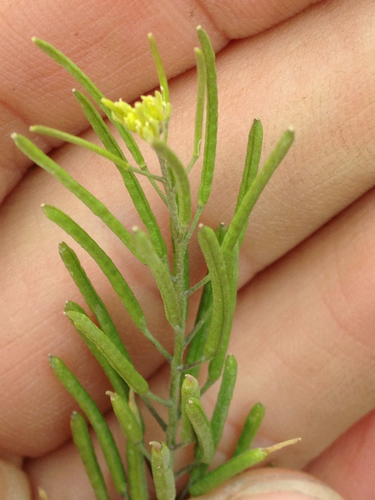
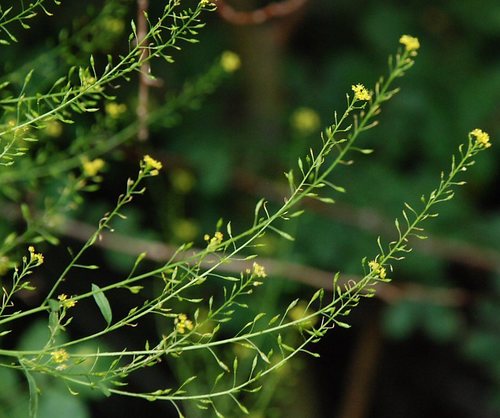
Brassica oleracea var. alboglabra
(L.H. Bailey) Musil
Chinese Kale, Chinese broccoli, White flowered broccoli
gbif· cc-by
GBIF
Summary
Source: WikipediaBrassica oleracea, also known as wild cabbage in its uncultivated form, is a plant of the family Brassicaceae. The species originated from feral populations of related plants in the Eastern Mediterranean, where it was most likely first cultivated. It has many common cultivars that are used as culinary vegetables, including cabbage, broccoli, cauliflower, romanesco, kale, Brussels sprout, collard, Savoy cabbage, kohlrabi, and gai lan.
Description
A cabbage plant with a single fleshy stem. Although it keeps growing from year to year it is normally grown as an annual. It grows 45 cm high and spreads 40 cm across. The leaves are dark green and rounded on long stems. Plants start to flower when 10 leaves are present. Flowers are white but there are varieties with yellow flowers. There are several named cultivars.
Edible Uses
The flower stalks, flower heads, buds, and tender leaves are all eaten. The stems are typically steamed or braised and often served with oyster sauce, or used in soups.
Traditional Uses
The flower stalk, flower heads, buds and tender leaves are all eaten. The stems are steamed or braised and often served with oyster sauce. They are also used in soups.
Medicinal Uses
Chinese kale contains 13.65 mg per 100 g dry weight and 7.3 mg fresh weight of alpha-tocopherol (Vitamin E).
Distribution
It does best in a fertile soil. The soil needs to be well drained. It prefers a pH of 6-7. Temperatures during the day of 18°-28°C are best. It can tolerate frost. It grows well in tropical regions but cool temperatures are necessary for flowering. It suits hardiness zones 8-11.
Where It Grows
Australia, Cambodia, China, Cuba, Fiji, Hawaii, Indochina, Indonesia, Japan, Kiribati, Malaysia, Nauru, Pacific, SE Asia, Taiwan, Thailand, USA, West Indies,
Cultivation
Plants are grown from seed. Seed can be sown direct or put in a nursery then transplanted. Seed are sown about 0.5 cm deep. Seeds germinate in 3-10 days. A spacing of 15 cm is suitable. Wide spacing causes stems to become thick and tough. Because plants are shallow rooted, they need regular watering.
Production
It is fast growing. Flower heads are harvested after about 9 weeks. Heads are harvested individually to allow others to form. Harvesting is done before buds start to open. It is grown as an annual crop in winter months in southern China.
Other Information
It is a commercially cultivated vegetable.
Notes
There are about 30 Brassica species and many cultivated varieties. It has 13.65 mg per 100 g dry weight and 7.3 mg fresh weight of alpha-tocopherol (Vitamin E).
Nutrition
| Part | Moisture | kJ | kcal | Protein | Vit A | Vit C | Iron | Zinc |
|---|---|---|---|---|---|---|---|---|
| Flowers cooked | 93.5 | 92 | 22 | 1.1 | 164 | 28.2 | 0.6 | 0.4 |
| Leaves | — | — | — | 41 | — | — | — | — |
| Stems | — | — | — | — | — | — | — | — |
Synonyms
Also Known As
Berza, Fat-shan, Gai lan choi, Gai lan, Gailarn, Jie-lan, Kaai laan tsoi, Kailaan, Kai-lan
References (23)
- Ching, L. S. & Mohamed, S., 2001, Alpha-Tocopherol Content in 62 Edible Tropical Plants. J. Agric. Food Chem. 2001, 49, 3101−3105
- Crawford, M., 2012, How to grow Perennial Vegetables. Green Books. p 89
- Creasy, R., 2000, The Edible Asian Garden. Periplus p 32
- Cundall, P., (ed.), 2004, Gardening Australia: flora: the gardener's bible. ABC Books. p 255
- East, A. J. and Dawes. L. A., 2009, Homegardening as a panacea: a case study of South Tarawa. Asia Pacific Viewpoint 50(3) pp 338-352 (As Brassica alboglabra)
Show all 23 references Hide references
- Facciola, S., 1998, Cornucopia 2: a Source Book of Edible Plants. Kampong Publications, p 54
- Hu, Shiu-ying, 2005, Food Plants of China. The Chinese University Press. p 403 (As Brassica alboglabra)
- Kays, S. J., and Dias, J. C. S., 1995, Common Names of Commercially Cultivated Vegetables of the World in 15 languages. Economic Botany, Vol. 49, No. 2, pp. 115-152
- Kiple, K.F. & Ornelas, K.C., (eds), 2000, The Cambridge World History of Food. CUP p 1754 (As Brassica alboglabra)
- Larkcom, J., 1991, Oriental Vegetables, John Murray, London, p31
- Miguel, E., et al, 1989, A checklist of the cultivated plants of Cuba. Kulturpflanze 37. 1989, 211-357
- Morgan, W. and Midmore, D., 2003, Chinese Broccoli (Kailaan) in Southern Australia. RIRDC Publication No 02/161
- Plants for a Future database, The Field, Penpol, Lostwithiel, Cornwall, PL22 0NG, UK. http://www.scs.leeds.ac.uk/pfaf/
- Schneider, E., 2001, Vegetables from Amaranth to Zucchini: The essential reference. HarperCollins. p 190
- Siemonsma, J. S. and Piluek, K. (Eds), 1994, Plant Resources of South-East Asia No. 8 Vegetables. Prosea Foundation, Bogor, Indonesia, p 115
- Small, E., 2009, Top 100 Food Plants. The world's most important culinary crops. NRC Research Press. p 304
- Smith, K., 1998. Growing Uncommon Fruits and Vegetables. New Holland. p 58
- Staples, G.W. and Herbst, D.R., 2005, A tropical Garden Flora. Bishop Museum Press, Honolulu, Hawaii. p 201
- U.S.D.A. Misc. Publ. 643:12. 1948
- USDA, ARS, National Genetic Resources Program. Germplasm Resources Information Network - (GRIN). [Online Database] National Germplasm Resources Laboratory, Beltsville, Maryland. Available: www.ars-grin.gov/cgi-bin/npgs/html/econ.pl (10 April 2000)
- van Wyk, B., 2005, Food Plants of the World. An illustrated guide. Timber press. p 100
- Wiersema, J. H. & Leon, B., 2013, World Economic Plants. A Standard Reference CRC Press. 2nd Ed. p 114
- Woodward, P., 2000, Asian Herbs and Vegetables. Hyland House. p 37