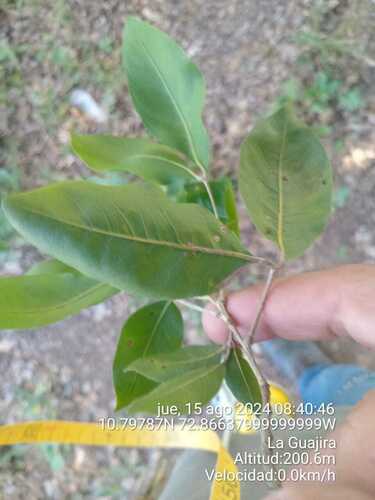
Diploglottis campbellii
Cheel
Small-leaved Tamarind
iNaturalist· cc-by-nc
(c) Sandy, some rights reserved (CC BY-NC)
iNaturalist· cc-by-nc
(c) Sandy, some rights reserved (CC BY-NC)
iNaturalist· cc-by-nc
(c) Sandy, some rights reserved (CC BY-NC)
Summary
Source: WikipediaDiploglottis campbellii is a rainforest tree northern New South Wales and southeastern Queensland. Growing to 30 metres tall, it is commonly known as the small-leaved tamarind. It is rare and threatened and is restricted to a small number of sites, each with a maximum of 3 trees per site. However, it is readily available from nurseries in the Northern Rivers area of New South Wales, and in south-eastern Queensland. It has soft hairy new growth that becomes hairless with age. It has a grey brown trunk, the outer surface of live bark is green with orange to brown blotches, leaves 10–35 cm long, leaflets 4–8 cm, glossy upper surface, pale dull bottom surface The inflorescence type is a panicle up to 15 centimetres long with small creamy brown flowers, Fruit usually 2 lobed but can be 1 or 3 lobed (each lobe holding a single seed), hairless, Red (rarely yellow) with a brown capsule, ripe Feb- April.
Description
A shrub or small tree. It grows 10-18 m high and spreads 3-5 m across. The bark is grey-brown and cracked. The young shoots are angular. The leaves are 10-30 cm long. The leaves are spreading and divided into leaflets along the stalk. There are 4-8 leaflets which are 7-15 cm long by 2-6 cm wide. They are broadly sword shaped. The flower panicles are 5-16 cm long and with many branches. The flowers are 0.4-0.6 cm across. The flowers are creamy-brown and have a scent. The fruit is a capsule 4-6 cm wide and with 3 lobes. The fruit are hard and yellowish-brown with a red aril around the seeds. This is edible. There are 3 seeds which are about 2 cm across.
Edible Uses
The fruit of small-leaved tamarind is edible, and has a piquant flavour. It is used in sauces and preserves. Because the tree is very rare in the wild availability of fruit was a limitation for many years. However, increased planting of small-leaved tamarind has resulted in larger volumes of fruit becoming available for food, as well as ensuring the survival of this species. The plant has proved adaptable in cultivation, being used in amenity horticulture and bushfood plantings. It is extensively planted in Lismore.
Distribution
It grows in the rainforest. It grows in warm temperate places and will grow in the tropics. It needs well drained soil and light shade. It suits hardiness zones 9-11. Geelong Botanical Gardens. Coffs Harbour Botanical Gardens.
Where It Grows
Australia*,
Notes
There are 8 Diploglottis species.
References (13)
- Cherikoff V. & Isaacs, J., The Bush Food Handbook. How to gather, grow, process and cook Australian Wild Foods. Ti Tree Press, Australia p 146, 147
- Cundall, P., (ed.), 2004, Gardening Australia: flora: the gardener's bible. ABC Books. p 504
- Edible and Useful Native Plants (off internet)
- Elliot, W.R., & Jones, D.L., 1984, Encyclopedia of Australian Plants suitable for cultivation. Vol 3. Lothian. p 290
- Etherington, K., & Imwold, D., (Eds), 2001, Botanica's Trees & Shrubs. The illustrated A-Z of over 8500 trees and shrubs. Random House, Australia. p 265
Show all 13 references Hide references
- Hibbert, M., 2002, The Aussie Plant Finder 2002, Florilegium. p 88
- Jones D, L, 1986, Ornamental Rainforest Plants in Australia, Reed Books, p 124, 340
- Low, T., 1991, Wild Food Plants of Australia. Australian Nature FieldGuide, Angus & Robertson. p 87
- Lyle, S., 2006, Discovering fruit and nuts. Land Links. p 262
- Molyneux, B & Forrester, S., 1997, The Austraflora A-Z of Australian Plants. Reed. p 74
- Nicholson, N & H., 1996, Australian Rainforest Plants, Terania Rainforest Publishing. NSW. p 27
- Williams, J.B., Harden, G.J., and McDonald, W.J.F., 1984, Trees and shrubs in rainforests of New South Wales and Southern Queensland. Univ. of New England, Armidale. p 45
- Yallakool Reserve Plant List July 1, 2009 Off internet