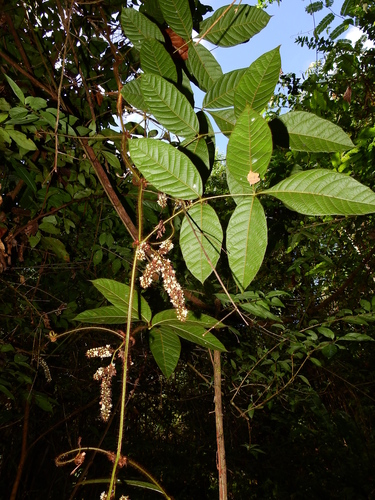
Sapindus saponaria
L.
Wingleaf soapberry
iNaturalist· cc-by-nc
(c) luizpol, some rights reserved (CC BY-NC)
iNaturalist· cc-by-nc
(c) Lisa Travis, some rights reserved (CC BY-NC)
Summary
Source: WikipediaSapindus saponaria is a small to medium-sized deciduous tree native to the Americas. Common names include rocky mountain maple, wingleaf soapberry, western soapberry, jaboncillo, sulluku and manele and a'e (Hawaiian). Its genus name, Sapindus, comes from the Latin, meaning Indian soap, and its specific epithet means "soapy". Western Soapberry is closely related to the maple family of trees. Although western soapberry lumber is not harvested commercially due to its rarity, it was highly esteemed in the recent past by indigenous ethnic groups like the Plains Apache, for its hardness and resilience. Western soapberry is classified as a "least concern" species, and due to its hardiness, it thrives in regions with poor soil and extreme drought. However, agricultural development threatens the existence of certain local communities in south-central Oklahoma. The fruit of western soapberry is mildy toxic if ingested orally, due to the high saponin content. The high saponin content also allows for the fruit to be used as a form of lathering soap. Despite the mild oral toxicity, the fruits of soapberry species may have topical health benefits.
Description
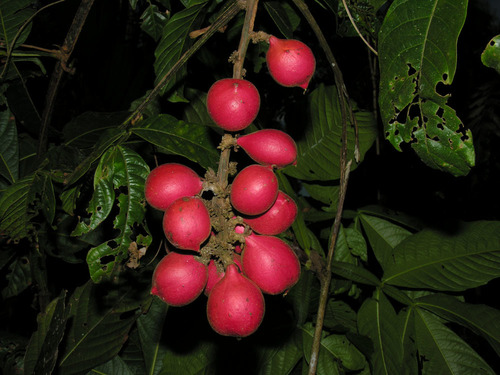
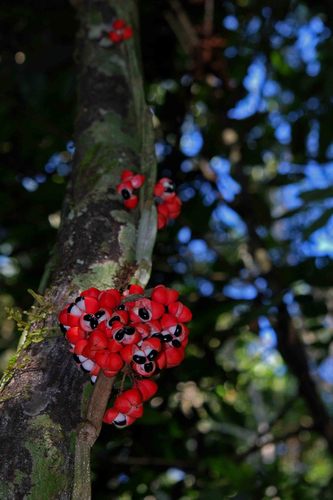
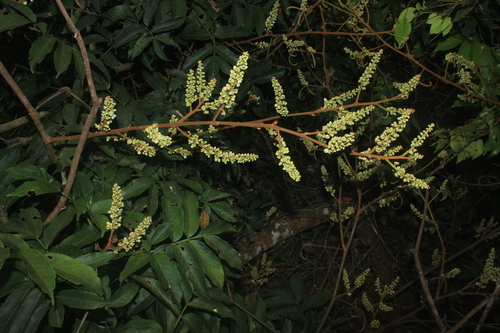
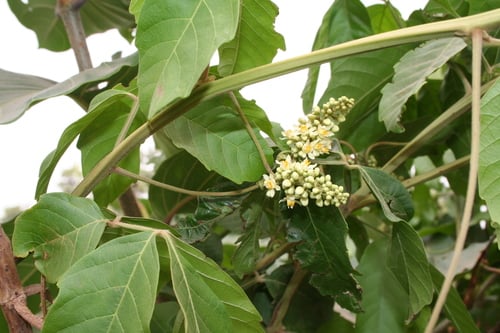
A tree. It grows 6-16 m high. The trunk is 60 cm across. The bark is grey, cracked and flaky. The leaves have leaflets along the stalk. There are 5-17 narrow leaflets. They are 5-18 cm long. The flowers are white and 4 mm across. The fruit is a one seeded berry. It is 1-1.5 cm across. It has a yellow pulp that lets light through. The fruit remain on the tree after ripening. The seeds are brown.
Edible Uses
An oil is obtained from the seed, though no specific edible preparations are documented.
Traditional Uses
The leaves are boiled in water and the solution mixed with millet flour.
This uses section is brief — help expand it
Medicinal Uses
A medicinal oil has been obtained from the crushed seeds. The root and stem barks are astringent, bitter, and tonic. The fruit is diuretic. Rich in saponins, it is used for treating anaemia.
Known Hazards
The seeds are toxic. They are used as a fish poison. The fruits and the seeds contain up to 30% emulsifying saponins. Although poisonous, saponins are poorly absorbed by the human body and so most pass through without harm. Saponins are quite bitter and can be found in many common foods such as some beans. They can be removed by carefully leaching in running water. Thorough cooking, and perhaps changing the cooking water once, will also normally remove most of them. However, it is not advisable to eat large quantities of food that contain saponins. Saponins are much more toxic to some creatures, such as fish, and hunting tribes have traditionally put large quantities of them in streams, lakes etc in order to stupefy or kill the fish. (Parts of plant are poisonous if ingested)
Distribution
It is a tropical plant. It grows in dry gravelly soil. It grows along streams. It grows between 700-1,800 m above sea level. It can grow in arid places.
Where It Grows
Africa, American Samoa, Antilles, Argentina, Belize, Bolivia, Brazil, Burundi, Cape Verde, Caribbean, Central Africa, Central America, Chile, China, Colombia, Congo, Costa Rica, Côte d'Ivoire, Cuba, Dominican Republic, East Africa, Easter Island, Ecuador, Egypt, El Salvador, French Guiana, Ghana, Grenada, Guadeloupe, Guatemala, Guianas, Guinea, Guinée, Guyana, Haiti, Hawaii, Honduras, India, Indochina, Indonesia, Ivory Coast, Jamaica, Japan, Korea, Laos, Liberia, Marquesas, Mexico, Mozambique, Myanmar, Nicaragua, North Africa, North America, Panama, Papua New Guinea, PNG, Paraguay, Peru, Philippines, Puerto Rico, SE Asia, Seychelles, Sierra Leone, Slovenia, South America*, Suriname, Taiwan, Tanzania, Thailand, Trinidad and Tobago, USA, Venezuela, Vietnam, West Africa, West Indies, Zimbabwe,
Cultivation
Succeeds in a sunny position in any well-drained soil. Plants are very tolerant of a wide range of soils, including those that are dry, stony or nutrient deficient. Established plants are very drought tolerant. Tolerant of salt-laden winds. Plants have a moderate rate of growth, able to reach a height of around 2.5 metres within 2 years from seed. The flowers are mostly male, with some female flowers and also some bisexual. The male flowers are produced in great quantities, they seem to fall from the tree almost like rain and litter the ground beneath. Flowering Time: Late Winter/Early Spring. Bloom Color: Cream/Tan. The fruits are usually harvested in late summer to early autumn, typically from August to October (Northern Hemisphere) when they are fully ripe and have turned brown. The Soapberry tree typically flowers in spring to early summer, around April to June (Northern Hemisphere), producing clusters of white to cream-colored flowers. The Soapberry tree is considered a moderate to fast-growing species, reaching heights of 10 to 15 meters (33 to 49 feet) within several years, depending on growing conditions. Sapindus saponaria is typically self-fertile, meaning it can produce fruit without the need for cross-pollination.
Propagation
Seed is best sown as soon as it is ripe in a partially shaded position in a nursery seedbed or individual containers. A low to moderate germination rate can be expected, with sprouting occurring within 20–40 days. When seedbed-sown seedlings reach 4–6cm in height, pot them into individual containers; they should be ready to plant out 6–7 months later. Seed stores well at ambient temperatures and humidity, remaining viable for more than 12 months. Greenwood cuttings can also be used.
Other Uses
The tree functions well as a shade tree, small street tree, and seaside or xerophytic planting. It is an excellent pioneer species for restoring native woodland and establishing woodland gardens, tolerating a wide range of soils and sunny situations while providing food for native fauna. The fleshy fruit, which smells of strawberries, produces soapy suds when cut up and soaked in water. The husks contain about 30% saponins and are used in some areas to wash wool and silk with notable rejuvenating results. The fruit is also used as a soap and hair shampoo. The orange-brown fruit is about 2cm in diameter. An insecticide can be made from the crushed seeds. A fibre from the inner bark is used to make ropes. The ornamental black, shiny seeds are used as beads and for making craftwork, rosaries, and buttons. The heartwood is yellow to light brown and the sapwood whitish. The wood is coarse-textured, compact, hard, moderately heavy, and not durable when exposed; it is used in building construction and for making toys, boxes, and similar items. The tree's flowers are rich in nectar and pollen and attract bees and other pollinators. The dense canopy provides shelter and nesting sites for birds and small animals, and the rough bark, leaf litter, and fallen berries offer overwintering habitat for beneficial invertebrates.
Notes
It is used in medicine.
Synonyms
Also Known As
Bilo, Bo hon, Boliche, Campeche, Checo, Chereco, Chiku, Cuyas, Doye eo, Focu, Jaboncilloa, Jelen mututu ja, Jorupe, Jurupe, Kho sak, Magyi-bauk, Milno drevo, Pacon, Pohon leraj amerika, Sasabila, Tasabia, Tsaco
References (15)
- Burkill, H. M., 1985, The useful plants of west tropical Africa, Vol. 5. Kew.
- Condit, R., et al, 2011, Trees of Panama and Costa Rica. Princeton Field Guides. p 432
- Garcia-Serrano, C. R., & Del Monte, J. P., 2004, The Use of Tropical Forest (Agroecosystems and wild Plant harvesting) as a Source of Food in the Bribri and Cabecar Cultures in the Caribbean Coast of Costa Rica. Economic Botany 58(1) pp 58-71
- Grandtner, M. M., 2008, World Dictionary of Trees. Wood and Forest Science Department. Laval University, Quebec, Qc Canada. (Internet database http://www.wdt.qc.ca)
- Grandtner, M. M. & Chevrette, J., 2013, Dictionary of Trees, Volume 2: South America: Nomenclature, Taxonomy and Ecology. Academic Press p 583
Show all 15 references Hide references
- http://www.botanic-gardens-ljubljana.com/en/plants
- Plants of Haiti Smithsonian Institute http://botany.si.edu/antilles/West Indies
- Roa, J. A. G. & Boada, D. S. G., 2018, Fundación para el Fortalecimiento de la Fruticultura y Plantas Alimenticias no Convencionales en Colombia.
- Royal Botanic Gardens, Kew (1999). Survey of Economic Plants for Arid and Semi-Arid Lands (SEPASAL) database. Published on the Internet; http://www.rbgkew.org.uk/ceb/sepasal/internet [Accessed 10th June 2011]
- Sukarya, D. G., (Ed.) 2013, 3,500 Plant Species of the Botanic Gardens of Indonesia. LIPI p 494
- Torre, de la, L., et al, 2008, Enciclopedia de las Plantas Útiles del Ecuador. Herbario QCA. Pontificia Universidad Católica del Ecuador. p 568
- Van den Eynden, V., et al, 2003, Wild Foods from South Ecuador. Economic Botany 57(4): 576-603
- Van Sam, H. et al, 2004, Trees of Laos and Vietnam: A Field Guide to 100 Economically or Ecologically Important Species. Blumea 29 (2004) 201-349
- World Checklist of Useful Plant Species 2020. Royal Botanic Gardens, Kew
- Zizka, G., 1991, Flowering Plants of Easter Island. Palmarum Hortus Francofurtensis