Diospyros virginiana
L.
American persimmon
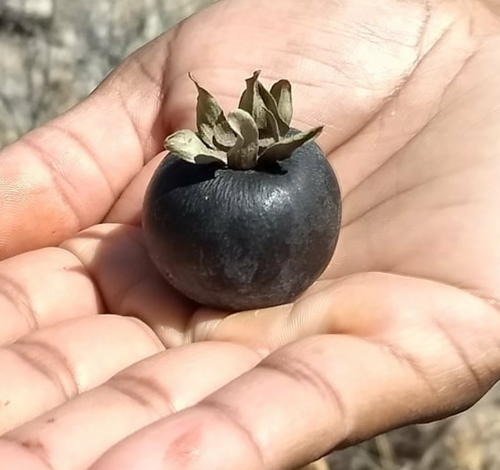
iNaturalist· cc-by-nc
(c) Bill Rankin, some rights reserved (CC BY-NC)
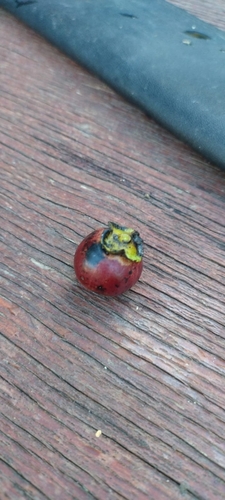
iNaturalist· cc-by-nc
(c) Scott K. Johnsgard, some rights reserved (CC BY-NC)
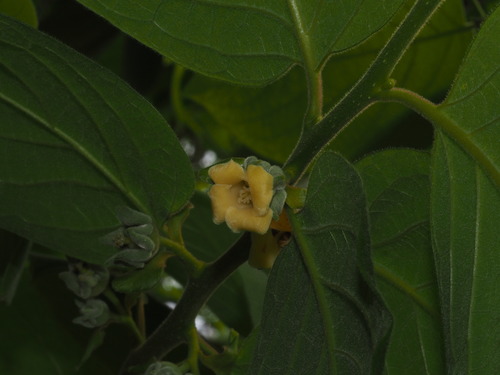
iNaturalist· cc-by-nc
(c) Scott K. Johnsgard, some rights reserved (CC BY-NC)
Summary
Source: WikipediaDiospyros virginiana is a persimmon species commonly called the American persimmon, common persimmon, eastern persimmon, simmon, possumwood, possum apples, or sugar plum. It ranges from southern Connecticut to Florida, and west to Texas, Louisiana, Oklahoma, Kansas, and Iowa. The tree grows in the wild but has been cultivated for its fruit and wood since prehistoric times by Native Americans. Both the tree and the fruit are referred to as persimmons, with the latter appearing in desserts and cuisine in the U.S. South and Midwest. The tree is typically dioecious, so one must have both male and female plants to obtain fruit. Commercial varieties include the very productive Early Golden, the productive John Rick, Miller, Woolbright and the Ennis, a seedless variety. Another nickname of the American persimmon, 'date-plum' also refers to a persimmon species found in South Asia and South Europe, Diospyros lotus. Today, persimmons are also grown on small farms as a heritage crop.
Description
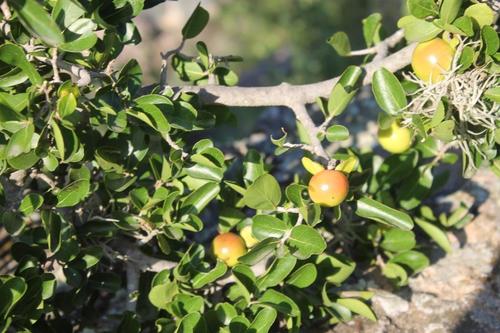
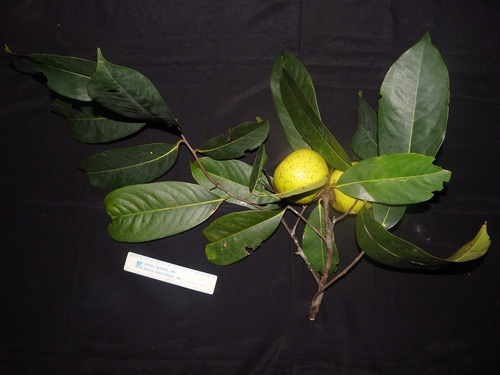
A medium sized deciduous tree. It can be 30 m tall. In cultivation it is often only 6-9 m high. The bark is dark brown to black. It cracks into small squares. The leaves are alternate. The leaves are oval and 12 cm long by 7.5 cm across. They are pointed and do not have teeth. The flowers are separately male and female and on separate plants. They are bell shaped and about 1 cm long. The flowers are cream. The male flowers occur in clusters and the female ones occur singly. The fruit are small to medium sized and sweet. They are 3-4.5 cm across. They are green and ripen to reddish yellow or orange. They are sweet and edible.
Edible Uses
The fruit can be eaten raw, cooked, or dried, and used in breads, cakes, pies, and puddings. Roughly the size of a plum and up to 4.5cm in diameter, it has an exquisitely rich flavour when fully ripe — almost at the point of spoiling — but is very harsh and astringent before then. The fruit may not ripen fully in a cool summer, though frosting normally brings out a very good flavour. It can also be harvested in autumn, preferably after a frost, and bletted — kept in a cool place and eaten only when very soft and nearly rotten. Much of the fruit on trees in a relatively sunny position at Kew after a warm 1996 summer was still not fully ripe, though it ripened well off the tree. Molasses can be made from the fruit pulp. An oil extracted from the seeds is said to taste like peanut oil. Dried leaves make a tea that is high in vitamin C, with a pleasant flavour somewhat like sassafras. Roasted seeds serve as a coffee substitute.
Traditional Uses
The fruit are eaten raw once ripe. They are also used in cakes, breads, pies, puddings and for jam and pancakes. They can also be dried for later use. They have been used for bread. They have been fermented into beer or wine or vinegar. The leaves can be used for a tea. Roasted seeds have been used as a coffee substitute.
Medicinal Uses
A decoction of the boiled fruit was used to treat bloody stools — this likely refers to the unripe fruit, which is strongly astringent. The leaves are rich in vitamin C and are used as an antiscorbutic. A decoction of the inner bark is highly astringent and has been used as a mouth rinse for thrush and sore throats. Applied externally, it serves as a wash for warts or cancers.
Distribution
It is a temperate plant. It is native to the Eastern United States. It grows naturally in river valley forests. It is cold hardy when dormant and mature. Trees need 300 chill hours. It suits hardiness zones 5-9.
Where It Grows
Asia, Australia, Balkans, Britain, Central Asia, Europe, Georgia, Himalayas, Indochina, Indonesia, Macedonia, Nepal, North America*, Russia, SE Asia, Sikkim, Slovenia, Tajikistan, Thailand, USA*,
Cultivation
Requires a good deep loamy soil in sun or light shade. If being grown for its fruit, the tree requires a warm, sunny, sheltered position. It dislikes very acid or wet and poorly drained soils. Plants are somewhat tender when young, though dormant mature trees are hardy to about -35°c. The young growth in spring, even on mature plants, is frost-tender and so it is best to grow the plants in a position sheltered from the early morning sun. Dioecious, but the female tree can produce seedless fruits in the absence of a pollinator. It is likely that unfertilized fruits are more astringent than fertilized fruits since this is the case with D. kaki. Trees can start producing fruit when only a few years old, a specimen seen at Kew Botanical gardens in autumn 1996 was only 1.5 metres tall and was bearing a very large crop of fruit. This species is occasionally cultivated for its edible fruit, there are several named varieties. 'Dooley' grows well near the northern limits of persimmon culture. 'Geneva Red' also grows well at the northern limits of persimmon culture. The fruit is medium to large. 'Meader' grows well in cooler areas, it is self-fertile. Plants have a long tap root and are difficult to transplant, it is best to plant them out in their permanent position as soon as possible and to give protection overwinter for the first year or two. The ssp. D. virginiana platycarpa has sweet succulent flesh, it grows wild from Missouri to Arkansas. A sprouting standard sending up shoots from the base. Persimmon trees grow at a moderate rate, typically reaching maturity in 3 to 5 years, with a full height of 15 to 25 feet (4.5 to 7.6 meters) depending on the species and growing conditions. Some species of Diospyros, like Diospyros virginiana (American persimmon), are self-fertile, while others may require cross-pollination to produce fruit effectively. Persimmons are typically harvested in autumn, depending on the species and climate. Persimmons usually flower in late spring to early summer.
Propagation
Seed is best sown in a cold frame as soon as it is ripe. Stored seed requires cold stratification and should be sown as early in the year as possible. Germination usually occurs within 1–6 months at 15°C. Pot up seedlings into fairly deep pots as soon as they are large enough to handle, then plant out into permanent positions in early summer. Provide some protection from winter cold for the first winter or two outdoors. Cuttings of half-ripe wood can be taken in July or August in a frame. Layering can be done in spring.
Other Uses
Persimmon trees suit agroforestry systems, providing edible fruit for wildlife and human consumption, shade, and improved soil structure. This species can also be used as a rootstock for D. kaki. The wood is strong, hard, heavy, fine-grained, elastic, and resistant to wear; it is valued for making wooden ware, turnery, and especially handles for golf clubs. Flowers attract pollinators — particularly bees — being rich in nectar and pollen. The fruit is a valuable food source for birds, mammals, and insects, and the foliage provides shelter; older trees may offer nesting or roosting sites for birds. Bark, leaf litter, and decaying matter at the base provide overwintering and shelter sites for invertebrates.
Production
A mature tree can produce 45 kg of fruit in one year.
Notes
There are about 485 species of Diospyros mostly in the tropics.
Nutrition
| Part | Moisture | kJ | kcal | Protein | Vit A | Vit C | Iron | Zinc |
|---|---|---|---|---|---|---|---|---|
| Fruit - raw | 64.4 | 531 | 127 | 0.8 | — | 66 | 2.5 | — |
Synonyms
Also Known As
American seedless persimmon, Halle beth, Piakmine, Pohon eben amerika, Possumwood, Ougoufle, Simmon, Viržinski ebenovec
References (39)
- Anderson, E. F., 1993, Plants and people of the Golden Triangle. Dioscorides Press. p 209
- Beckstrom-Sternberg, Stephen M., and James A. Duke. "The Foodplant Database." http://probe.nalusda.gov:8300/cgi-bin/browse/foodplantdb.(ACEDB version 4.0 - data version July 1994)
- Bodkin, F., 1991, Encyclopedia Botanica. Cornstalk publishing, p 346
- Brouk, B., 1975, Plants Consumed by Man. Academic Press, London. p 194
- Bussman, R. W., et al, 2021, Unity in diversity—food plants and fungi of Sakartvelo (Republic of Georgia), Caucasus. Journal of Ethnobiology and Ethnomedicine (2021) 17:72 p 9
Show all 39 references Hide references
- Cheifetz, A., (ed), 1999, 500 popular vegetables, herbs, fruits and nuts for Australian Gardeners. Random House p 190
- Coombes, A.J., 2000, Trees. Dorling Kindersley Handbooks. p 139
- Cundall, P., (ed.), 2004, Gardening Australia: flora: the gardener's bible. ABC Books. p 504
- Duke, J.A., 1992, Handbook of Edible Weeds. CRC Press. p 88
- Elias, T.S. & Dykeman P.A., 1990, Edible Wild Plants. A North American Field guide. Sterling, New York p 238
- Esperanca, M. J., 1988. Surviving in the wild. A glance at the wild plants and their uses. Vol. 2. p 147
- Etherington, K., & Imwold, D., (Eds), 2001, Botanica's Trees & Shrubs. The illustrated A-Z of over 8500 trees and shrubs. Random House, Australia. p 264
- Facciola, S., 1998, Cornucopia 2: a Source Book of Edible Plants. Kampong Publications, p 92
- Gouldstone, S., 1983, Growing your own Food-bearing Plants in Australia. Macmillan p 122
- Grandtner, M. M., 2008, World Dictionary of Trees. Wood and Forest Science Department. Laval University, Quebec, Qc Canada. (Internet database http://www.WDT.QC.ca)
- Hedrick, U.P., 1919, (Ed.), Sturtevant's edible plants of the world. p 278
- Hermandez Bermejo, J.E., and Leon, J. (Eds.), 1994, Neglected Crops. 1492 from a different perspective. FAO Plant Production and Protection Series No 26. FAO, Rome. p 30
- Hibbert, M., 2002, The Aussie Plant Finder 2002, Florilegium. p 87
- Jackes, D. A., Edible Forest Gardens
- John, L., & Stevenson, V., 1979, The Complete Book of Fruit. Angus & Robertson p 227
- Jordan, J., et al, 2006, Vascular Plants Utilized by the Plains Apache in Southwestern Oklahoma, Publications of the Oklahoma Biological Survey. 2nd Series. Volume 7: 24-33, 2006
- Kiple, K.F. & Ornelas, K.C., (eds), 2000, The Cambridge World History of Food. CUP p 1833
- Little, E.L., 1980, National Audubon Society Field Guide to North American Trees. Alfred A. Knopf. p 635
- Lord, E.E., & Willis, J.H., 1999, Shrubs and Trees for Australian gardens. Lothian. p 53
- Lyle, S., 2006, Discovering fruit and nuts. Land Links. p 185
- Martin, F.W. & Ruberte, R.M., 1979, Edible Leaves of the Tropics. Antillian College Press, Mayaguez, Puerto Rico. p 190 (As Diospyros virginiana var. mosieri)
- NYBG Herbarium "edible"
- Plants for a Future database, The Field, Penpol, Lostwithiel, Cornwall, PL22 0NG, UK. http://www.scs.leeds.ac.uk/pfaf/
- Recher, P, 2001, Fruit Spirit Botanical Gardens Plant Index. www.nrg.com.au/~recher/ seedlist.html p 2
- Self, M., 199, Phoenix Seeds catalogue. p 16
- Sp. pl. 2:1057. 1753
- Sukarya, D. G., (Ed.) 2013, 3,500 Plant Species of the Botanic Gardens of Indonesia. LIPI p 240
- Suresh, C. P. et al, 2014, Wild Edible Tree Fruits of Sikkim Himalayas. Journal of Tree Sciences 33(1): 43-48
- USDA, ARS, National Genetic Resources Program. Germplasm Resources Information Network - (GRIN). [Online Database] National Germplasm Resources Laboratory, Beltsville, Maryland. Available: www.ars-grin.gov/cgi-bin/npgs/html/econ.pl (10 April 2000)
- van Wyk, B., 2005, Food Plants of the World. An illustrated guide. Timber press. p 179
- Wiersema, J. H. & Leon, B., 2013, World Economic Plants. A Standard Reference CRC Press. 2nd Ed. p 250
- Wild Edible Plants of the Whitmire Wildflower Garden. Missouri Botanical Gardens.
- World Checklist of Useful Plant Species 2020. Royal Botanic Gardens, Kew
- www.worldagroforestrycentre.org/treedb/