Diospyros pyrrhocarpa
Miq.
Anang
wikimedia· cc-by-sa
Simon Waldherr (via Wikimedia Commons)
gbif· cc0
President and Fellows of Harvard College
gbif· cc0
President and Fellows of Harvard College
gbif· cc0
President and Fellows of Harvard College
Summary
Source: WikipediaDiospyros pyrrhocarpa is a tree in the family Ebenaceae. It grows up to 23 metres (80 ft) tall. Twigs dry greyish to brownish. Inflorescences bear up to three flowers. The fruits are roundish to ovoid-ellipsoid, up to 5 cm (2 in) in diameter. The specific epithet pyrrhocarpa is from the Greek meaning 'fiery red or yellow fruits'. Habitat is lowland mixed dipterocarp forests. D. pyrrhocarpa ranges from the Andaman and Nicobar Islands through Thailand, Peninsular Malaysia, Sumatra, and Borneo to the Philippines. In Cebu and Negros Regions in the Philippines, the tree is commonly known as Kunalum.
Description
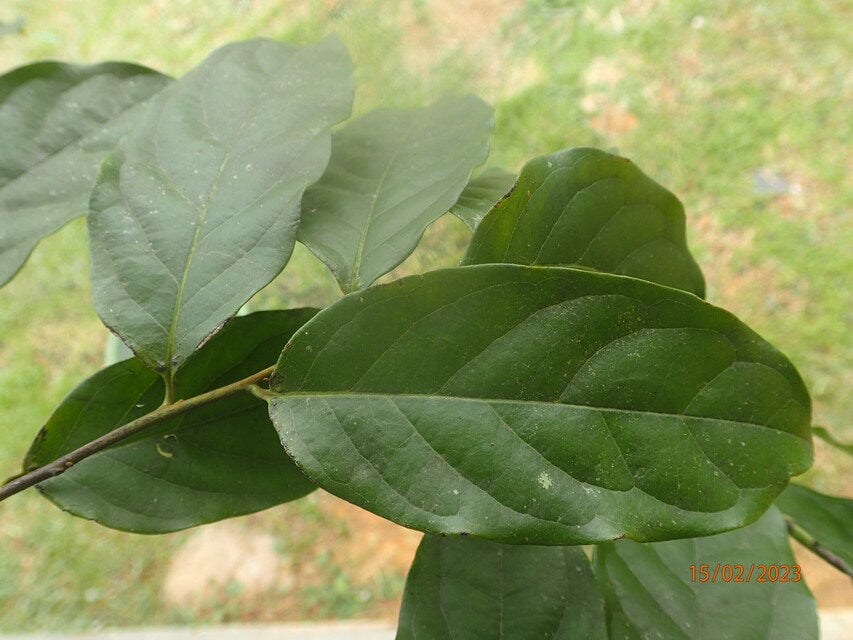
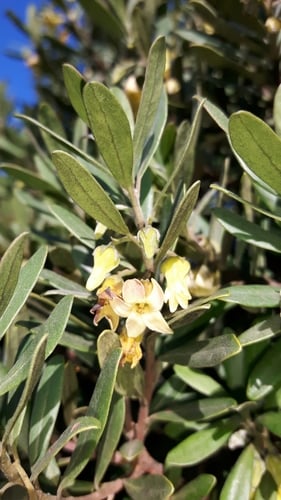
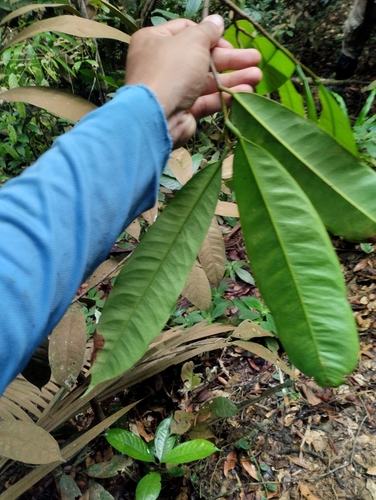
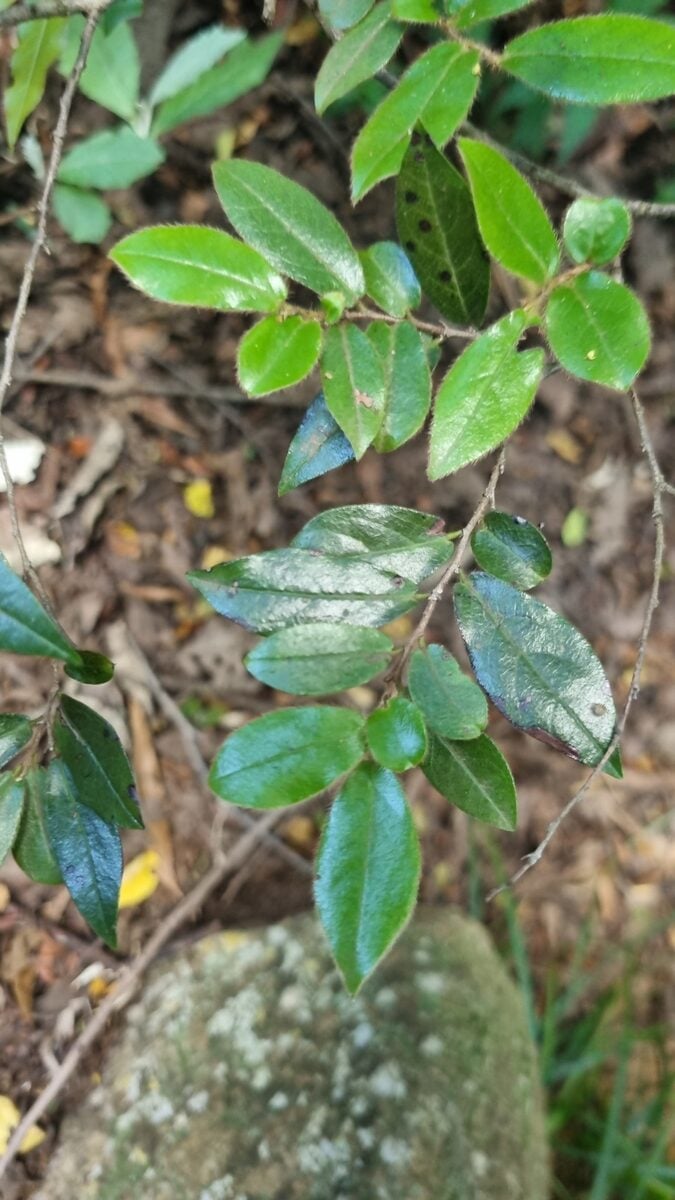
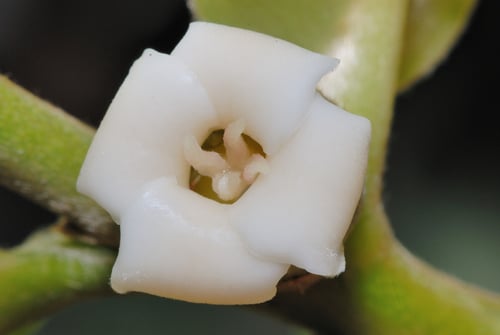
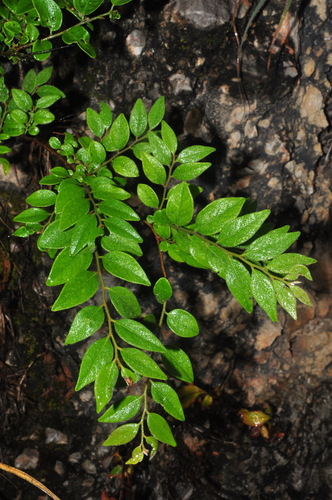
A small tree with a spreading crown. The green portion of the branchlets is smooth. The leaves are alternate. The male flowers are in clusters alternately and arise from leaf axils. They are white. Female flowers are rounded. The fruit are a flattened round shape. They are orange when ripe and have a soft covering over them.
Edible Uses
The fleshy portion of the fruit is eaten raw.
Traditional Uses
The fleshy portion of the fruit is eaten raw.
This uses section is brief — help expand it
Distribution
A tropical plant. Common in the Makiling Forest, College, Laguna in the Philippines.
Where It Grows
Asia, India, Andaman Islands, Nicobar, Indochina, Myanmar, Pacific, Philippines, SE Asia, Singapore, Vietnam,
Cultivation
A dioecious species, both male and female forms need to be grown if fruit and seed are required.
Propagation
Seed - in general the seed of Diospyros species has a very short viability and so should be sown as soon as possible. The flesh should be removed since this contains germination inhibitors. Sow the seed in a shady position in a nursery seedbed. The sowing media for ebony uses soil and fine sand at the ratio 3:1. The seed is planted horizontally or vertically with the radicle end down, with a sowing depth of 1 - 1½ times the thickness of seed. Distance between the seeds is 3 - 5cm. Seeds are very sensitive to desiccation during germination and early growth, so must be regularly watered at this time. Normally the seed will germinate after one week. As a rule fresh seeds have a high percentage of fertility. The seedlings develop long taproots at an early stage, often before any appreciable elongation of the shoot takes place. The growth of the seedling is decidedly slow .
Other Uses
A red dye is obtained from the tannin-rich immature fruit. It is used to colour linen. It can also render material waterproof, and so has been used to treat Chinese umbrellas. The heartwood is jet black, but small and often defective; it is clearly demarcated from the sapwood, which is almost white, turning yellowish in seasoning, but often staining, either evenly or in streaks and mottlings, to light gray. We do not have any more specific information for this species. However, though varying widely in the relative proportion and the colouring of sapwood and heartwood, all the woods of the genus Diospyros are practically indistinguishable as regards their structure, as described below:- Whether or not a given species produces heartwood depends largely on the size the tree has attained, but evidently also on other conditions, as there is a wide variation in the relative amounts of sapwood and heartwood even in individuals of the same species. When produced, the heartwood can be black with rosy, yellowish, brownish, or ashy streaks, sometimes it is nearly or totally black; it is generally sharply demarcated from the thin to very wide band of whitish, yellowish, or red sapwood. The texture is fine, smooth and (especially in the heartwood) very dense; the grain is generally very straight. The wood is hard to very hard; heavy to very heavy; the sapwood is tough and flexible whilst the heartwood is brittle; the heartwood is very durable, the sapwood moderately so. It is difficult to season well, logs almost invariably checking in several directions from the heart outward, while sawn lumber must be stacked carefully and weighted to prevent warping; once thoroughly dried, however, it becomes very stable. Its density makes it difficult to work, but it takes a beautiful surface under sharp tools. Small trees containing little or no heartwood are used locally for posts, beams, joists, rafters, window sills, parts of agricultural implements, etc.; also, in lumbering, small poles are used for skids on account of their hardness, toughness and smooth wearing qualities. The heartwood (or sometimes sap and heart together) is used for scabbards, canes, hilts, tool handles, gunstocks, saw frames, etc.; it is a favorite for musical instruments, especially finger boards and keys of guitars; furniture, cabinetwork, inlaying; paper weights, inkstands and similar desk supplies; the sapwood, which is almost as hard as the heartwood and very much tougher, is an excellent material for T-squares and other drawing instruments, for shuttles, bobbins, spindles, golf-club heads and shafts, axe, pick, and hammer handles, etc.
Notes
There are about 485 species of Diospyros mostly in the tropics.
Synonyms
Also Known As
Te, Thi lua
References (6)
- Ambasta, S.P. (Ed.), 2000, The Useful Plants of India. CSIR India. p 178
- Jayaraman, U., & Singh, V., 1987, A Census of Edible Species of Diospyros L. in India. J. Econ. Tax. Bot. Vol. 10 No. 2 pp 416-419
- Monsalud, M.R., Tongacan, A.L., Lopez, F.R., & Lagrimas, M.Q., 1966, Edible Wild Plants in Philippine Forests. Philippine Journal of Science. p 461
- Pham-Hoang Ho, 1999, An Illustrated Flora of Vietnam. Nha Xuat Ban Tre. p 655
- Singh, D. B., et al, 2001, Nutrient composition of some wild edible fruits of Andaman and Nicobar Islands. J. Appl. Hort., 3(1):60-62, January-June, 2001
Show all 6 references Hide references
- Singh, H.B., Arora R.K.,1978, Wild edible Plants of India. Indian Council of Agricultural Research, New Delhi. p 55