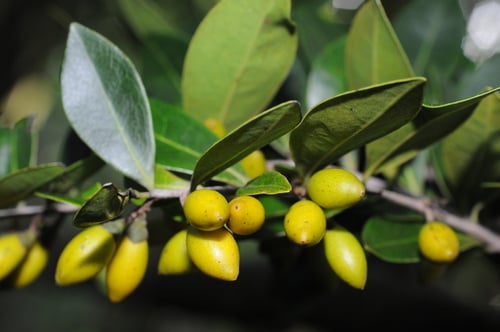
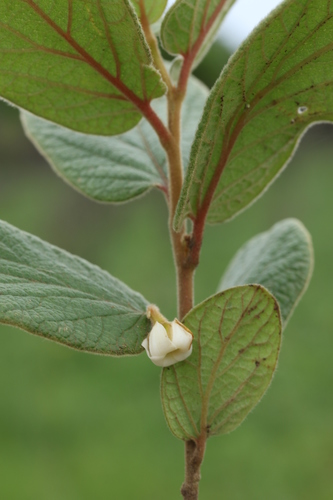
Diospyros melanoxylon
Roxb.
Coromandel Ebony persimmon
iNaturalist· cc-by-nc
(c) Subbu Ramanathan, some rights reserved (CC BY-NC), uploaded by Subbu Ramanathan
iNaturalist· cc-by-nc
(c) Radha Veach, some rights reserved (CC BY-NC), uploaded by Radha Veach
iNaturalist· cc-by-nc-sa
(c) c michael hogan, some rights reserved (CC BY-NC-SA), uploaded by c michael hogan
Summary
Source: WikipediaDiospyros melanoxylon, the Coromandel ebony or East Indian ebony, is a species of flowering tree in the family Ebenaceae native to India and Sri Lanka; it has a hard, dry bark. Its common name derives from Coromandel, the coast of southeastern India. Locally it is known as temburini or by its Hindi name tendu. In Odisha, Jharkhand, and Assam, it is known as kendu. In Andhra Pradesh, and Telangana it is known as tuniki. The leaves can be wrapped around tobacco to create the Indian beedi, which has outsold conventional cigarettes in India.
Description
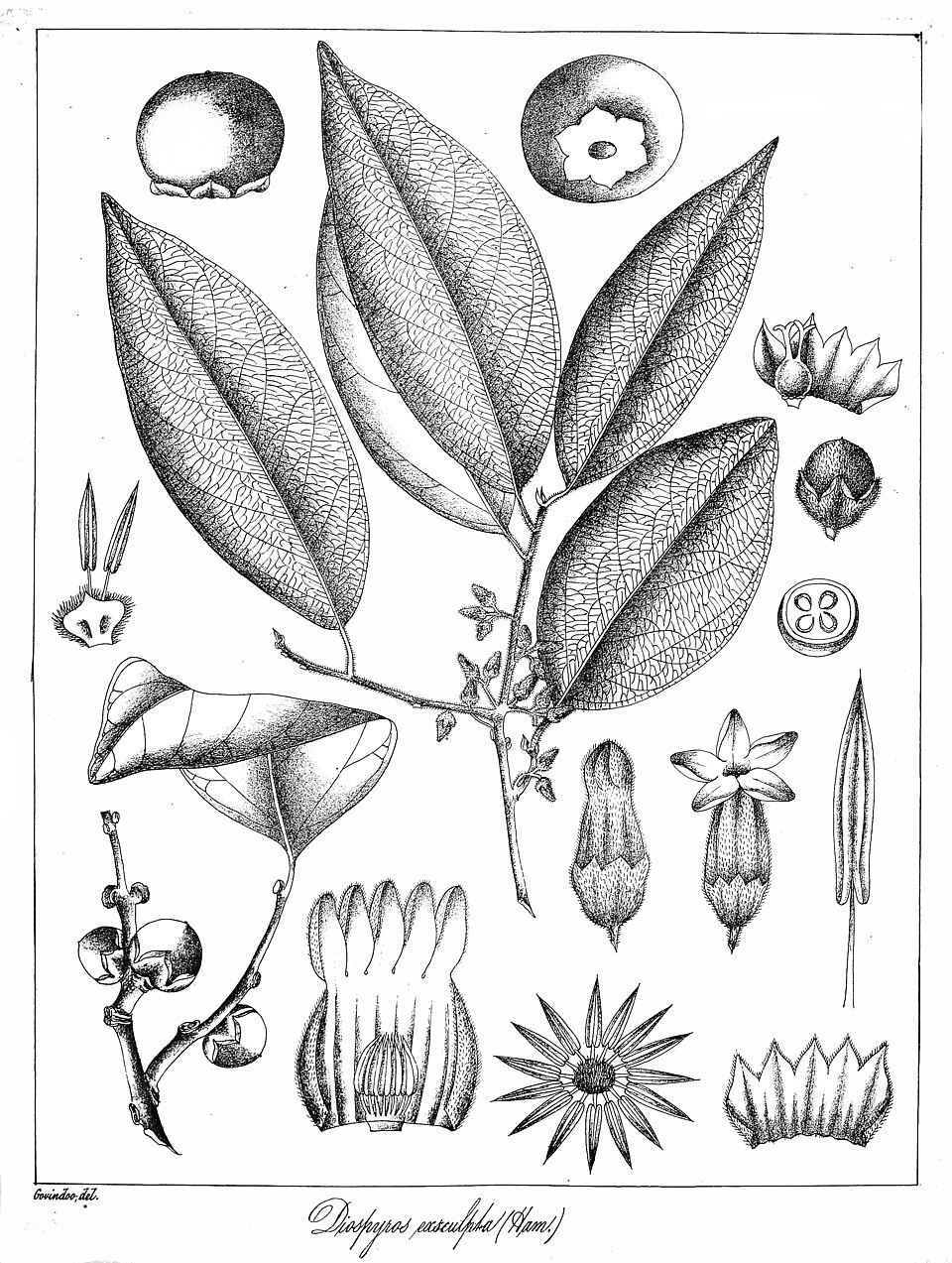
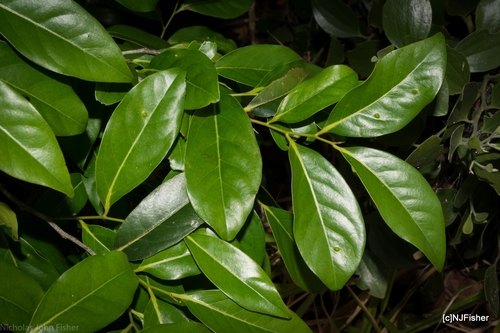
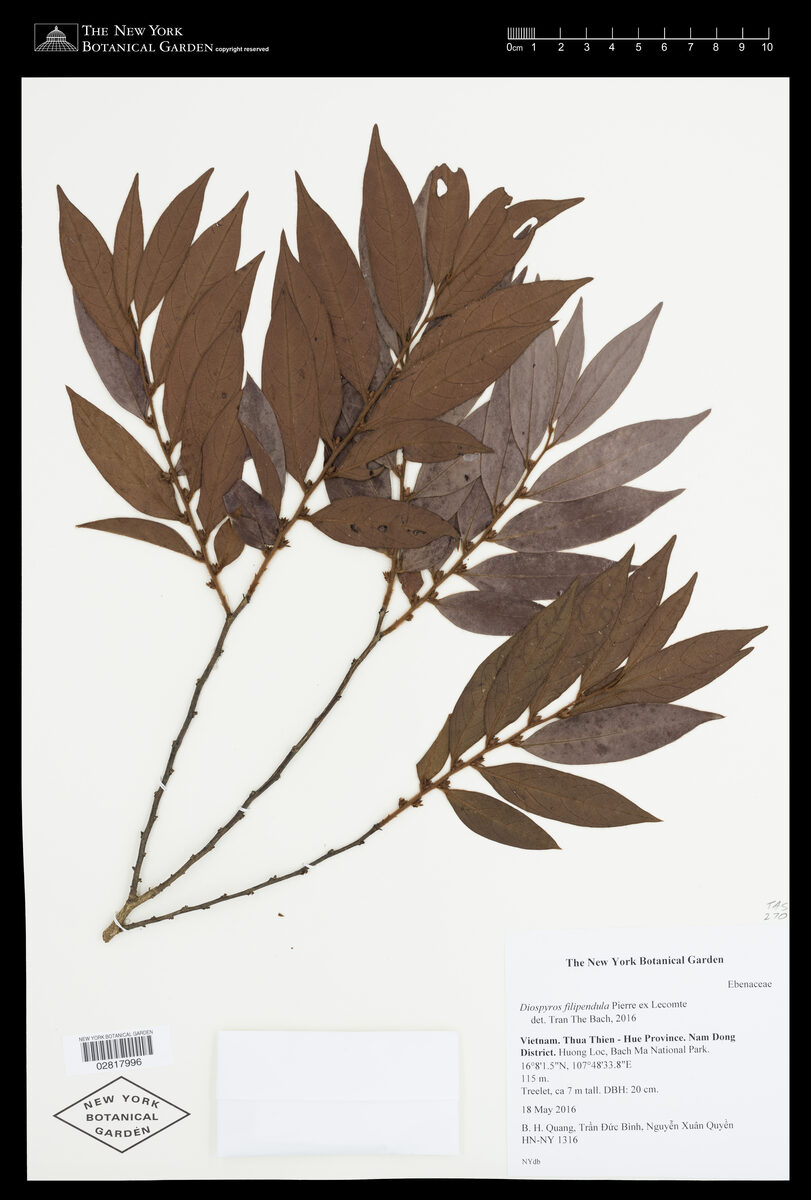
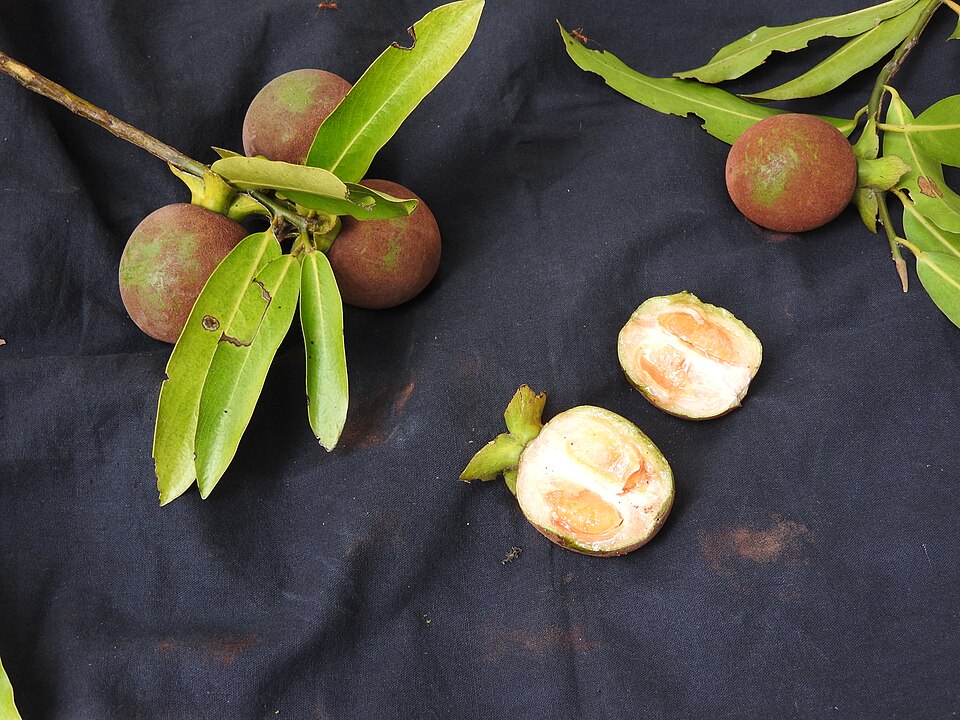
A medium sized tree. It grows to 15 m high. The bark is dark brown. It peels in large irregular pieces. There are many branches forming a dense crown. The leaves vary. They are 10-30 cm long by 2-10 cm wide. They are leathery. The base tapers to a wrinkled stalk. The flowers are greenish. The male flowers are in drooping clusters of 2-7 flowers. The female flowers occur singly and are 2-3 cm across. The fruit is yellow to brown. It is covered with rusty hairs. The fruit are round and 4-6 cm across. The fruit pulp is sweet and edible.
Edible Uses
The ripe fruits are eaten fresh; unripe fruit are buried in sand to ripen. The seeds are powdered and eaten. Fruits are sold in markets and are popular and nutritious.
Traditional Uses
The ripe fruit are eaten. Unripe fruit are buried in sand until they ripen. The seeds are powdered and eaten.
This uses section is brief — help expand it
Medicinal Uses
The leaf of the tree contains valuable flavones. The pentacyclic triterpenes found in the leaves possess antimicrobial properties, while the bark shows antihyperglycemic activity. The bark of four Diospyros species found in India has been determined to have significant antiplasmodial effects against Plasmodium falciparum, which causes malaria in humans.
Distribution
A tropical plant. It grows throughout the plains in India in deciduous forest.
Where It Grows
Andamans, Asia, Bangladesh, Himalayas, India*, Malaysia, Nepal*, Northeastern India, Pakistan, SE Asia, Sri Lanka,
Cultivation
Plants are grown from seed.
Propagation
Seed - pre-soaking the seeds for about 12 hours in cold water improves germination. Seeds can be sown in situ. Orthodox seed storage behaviour; viability maintained for 1 year in open storage; viability lost within 1 year in hermetic storage at room temperature with 11-15% mc. As a rule fresh seeds have a high percentage of fertility. The seedlings develop long taproots at an early stage, often before any appreciable elongation of the shoot takes place. The growth of the seedling is decidedly slow .
Other Uses
The leaves are used as the wrapping around tobacco to make bidi cigarettes in India. The leaves possess unrivalled qualities of flavour, colour, flexible and leathery texture, decay resistance and easy workability, which make them admirably suitable for wrapping bidis. The wood is hard, whitish-pink, tough, fairly durable. It is used for building, shoulder poles, mine props and shafts of carriages. The ebony is very heavy and valued for carving and other ornamental works. A good fuel wood; the calorific value of the sapwood is 4957 kcal/kg and of the heartwood, 5030 kcal/kg.
Production
In India fruit are available June to August. In southern India, February to April.
Other Information
The fruit are sold in markets. They are popular and nutritious.
Notes
There are about 485 species of Diospyros mostly in the tropics.
Nutrition
| Part | Moisture | kJ | kcal | Protein | Vit A | Vit C | Iron | Zinc |
|---|---|---|---|---|---|---|---|---|
| Fruit | — | — | — | 0.4 | — | 0.5 | — | — |
Synonyms
Also Known As
Abanasi, Bale, Beedi-leaf tree, Bidipata, Dirghapataka, Dirghapatraka, Govindo, Karai, Kari, Karundumbi, Kendu, Kumki, Mancigata, Nallatumki, Taidu, Taidua, Tamrug, Tembhrun, Tembhurani, Tembhurni, Tembhru, Temburni, Temru, Tendu, Tendupata, Thumbimaram, Thummika pandlu, Timburni, Timru, Tiril, Tumari, Tumbi, Tumida, Tumki, Tumri, Tuniki
References (50)
- Ambasta, S.P. (Ed.), 2000, The Useful Plants of India. CSIR India. p 177
- Banerjee, A., et al, 2013, Ethnobotanical Documentation of Some Wild Edible Plants in Bankura District, West Bengal, India. The Journal of Ethnobiology and Traditional Medicine. Photon 120 (2013) 585-590
- Basha, S. K. M., Ethnobotanical Trees of Sri Lanka Malleswara Wildlife Sanctuary; Eastern Ghats, Andhra Pradesh.
- Behera K. K., et al, 2008, Wild Edible Plants of Mayurbhanj District, Orissa, India. J. Econ. Taxon. Bot. Vol. 32 (Suppl.) pp 305-314
- Bole, P.V., & Yaghani, Y., 1985, Field Guide to the Common Trees of India. OUP p 41
Show all 50 references Hide references
- Burkill, I.H., 1966, A Dictionary of the Economic Products of the Malay Peninsula. Ministry of Agriculture and Cooperatives, Kuala Lumpur, Malaysia. Vol 1 (A-H) p 845
- Chandrakumar, P., et al, 2015, Ethnobotanical studies of wild edible plants of Gond, Halba and Kawar tribes of Salekasa Taluka, Gondia District, Maharashtra State, India. International Research Journal of Pharmacy 6(8)
- Chandrashekara, U. M., 2009, Tree species yielding edible fruit in the coffee-based homegardens of Kerala, India: their diversity, uses and management. Food Sec. 1:361-370
- Chauhan, S. H., et al, 2018, Consumption patterns of wild edibles by the Vasavas: a case study from Gujarat, India. Journal of Ethnobiology and Ethnomedicine (2018) 14:5
- Dobriyal, M. J. R. & Dobriyal, R., 2014, Non Wood Forest Produce an Option for Ethnic Food and Nutritional Security in India. Int. J. of Usuf. Mngt. 15(1):17-37
- Ekka, N. S. & Ekka, A., 2016, Wild Edible plants Used by Tribals of North-east Chhattisgarh (Part-I), India. Research Journal of Recent Sciences. Vol. 5(ISC-2015), 127-131 (2016)
- Gouldstone, S., 1983, Growing your own Food-bearing Plants in Australia. Macmillan p 122
- Hedrick, U.P., 1919, (Ed.), Sturtevant's edible plants of the world. p 278
- Jadhav, R., et al, 2015, Forest Foods of Northern Western Ghats: Mode of Consumption, Nutrition and Availability. Asian Agri-History Vol. 19, No. 4: 293-317
- Jayaraman, U., & Singh, V., 1987, A Census of Edible Species of Diospyros L. in India. J. Econ. Tax. Bot. Vol. 10 No. 2 pp 416-419
- Kala, C. P., 2009, Aboriginal uses and management of ethnobotanical species in deciduous forests of Chhattisgarh state in India. Journal of Ethnobiology and Ethnomedicine. 5:32
- Khayde, M. S., et al, 2009, Wild Edible Plants Used by the tribes of Akole Tahasil of Ahmednagar District (MS), India. Ethnobotanical Leaflets 13:1328-36
- Kuvar, S. D. & Shinde, R. D., 2019, Wild Edible Plants used by Kokni Tribe of Nasik District, Maharashtra. Journal of Global Biosciences. Volume 8, Number 2, 2019, pp. 5936-5945
- Mehta, P. S. et al, 2010, Native plant genetic resources and traditional foods of Uttarakhand Himalaya for sustainable food security and livelihood. Indian Journal or Natural products and Resources. Vol 1(1), March 2010 pp 89-96
- Mishra, S. & Chaudhury, S. S., 2012, Ethnobotanical flora used by four major tribes of Koraput, Odisha, India. Genetic Resources Crop Evolution 59:793-804
- Misra S. & Misra M., 2016, Ethnobotanical and Nutritional Evaluation of Some Edible Fruit Plants of Southern Odisha, India. International Journal of Advances in Agricultural Science and Technology, Vol.3 Issue.1, March- 2016, pg. 1-30
- Misra, S., 2018, Ethno Botany and Nutritional Status of Some Edible Plants of South Odisha, India. International Journal of Advances in Agricultural Science and Technology, Vol.5 Issue.2, February- 2018, pg. 21-32
- Pandy, R. K. & Saini, S. K., 2007, Edible plants of tropical forests among tribal communities of Madhya Pradesh. Indian Journal of Traditional Knowledge. 6(1), pp 185-190
- Pasha, M. K. & Uddin, S. B., 2019, Minor Edible Fruits of Bangladesh. Bangladesh J. Plant Taxon. 26(2): 299–313
- Pl. Coromandel 1:36, t. 46. 1795
- Prachi, K., et al, 2012, Underutilized wild fruits of North Maharashtra. Journal of Research in Plant Sciences. (2012) 1:071-076
- Pradhan, R., et al, 2020, Potential Wild Edible Plants and its Significance in Livelihood of Indigenous People of Male Mahadeshwara Hills, Karnataka. Economic Affairs Vol. 64, No. 4 pp. 01-14
- Ramachandran, V. S., 2007, Wild edible plants of the Anamalais, Coimbatore district, western Ghats, Tamil Nadu. Indian Journal or Traditional Knowledge. 6(1) pp 173-176
- Ramakrishna, N. & Singh, DSR, R., 2020, Ethno-Botanical Studies of Edible Plants Used by Tribal Women in Nirmal District. IJSRSET p 309
- Rao, M. L. S., et al, 2014, Indigenous Plant Foods which are commonly consumed by the tribal communities in Dumbriguda Area of Visakhapatnam District, Andhra Pradesh, India. Biolife. Vol 2, Issue 3
- Ray, A., et al, 2020, How many Wild Edible Plants do we Use. Frontiers in Sustainable Food Systems. 4:56 p 12
- Reddy, B. M., 2012, Wild edible plants of Chandrapur district, Maharashtra, India. Indian Journal of Natural Products and Resources. 3(1) pp 110-117
- Reddy, K. N. et al, 2007, Traditional knowledge on wild food plants in Andhra Pradesh. Indian Journal of Traditional Knowledge. Vol. 6(1): 223-229
- Ruiters-Welcome, A. K., 2019, Food plants of southern Africa. Ph.D. thesis. Univ. of Johannesburg p 52
- Saidulu, P. et al, 2015, Ethnobotanical Knowledge Studied in Pocharam Wildlife Sanctuary, Telangana, India. Not Sci Biol, 2015, 7(2):164 -170
- Singh, G. K. & Ahirwar, R. K., 2013, An Ethnobotanical Survey for Certain Wild Edible Plants of Chanda Forest District Dindori Central India. International Journal of Science and Research. 6:14
- Sahni, K.C., 2000, The Book of Indian Trees. Bombay Natural History Society. Oxford. p 122
- Setiya, A. V., et al, 2016, Exploration and documentation of some wild edible plants used by the aboriginals from Gadchiroli District (M.S.) India. International Advanced Research Journal in Science, Engineering and Technology. 3(7)
- Singh, H.B., Arora R.K.,1978, Wild edible Plants of India. Indian Council of Agricultural Research, New Delhi. p 55
- Singh, V. and Singh, P., 1981, Edible Wild Plants of Eastern Rajasthan. J. Econ. Tax. Bot. Vol 2 pp 197-207
- Singh, V. B., et al, (Ed.) Horticulture for Sustainable Income and Environmental Protection. Vol. 1 p 215
- Tamil herbs, 2007, Edible Plants of the Tropical Dry Evergreen Forest.
- Toppo, P. et al, 2016, Wild edible plants of Dhamtari district of Chhattisgarh, India. Van Sangyan Vol. 3, No. 4
- Uprety, Y., et al, 2010, Non-timber Forest Products in Bardiya District of Nepal: Indigenous Use, Trade and Conservation. J Hum Ecol, 30(3): 143-158
- USDA, ARS, National Genetic Resources Program. Germplasm Resources Information Network - (GRIN). [Online Database] National Germplasm Resources Laboratory, Beltsville, Maryland. Available: www.ars-grin.gov/cgi-bin/npgs/html/econ.pl (10 April 2000)
- Wiersema, J. H. & Leon, B., 2013, World Economic Plants. A Standard Reference CRC Press. 2nd Ed. p 249
- Wild edible plants of Himachal Pradesh
- World Checklist of Useful Plant Species 2020. Royal Botanic Gardens, Kew
- www.worldagroforestrycentre.org/treedb/
- Yadav, D. K., 2011, Study on Biodiversity and Edible Bioresources of Betla National Park, Palamu, Jharkhand (India). The 2011 Las Vegas International Academic Conference.