Diospyros nigra
(J. F. Gmel.) Perrier
Black sapote, Black persimmon
iNaturalist· cc-by-nc
(c) gladys, some rights reserved (CC BY-NC), uploaded by gladys
iNaturalist· cc-by-sa
(c) Oscar Alejandro Morales Juárez, some rights reserved (CC BY-SA)
iNaturalist· cc-by-nc
(c) Carlos G Velazco-Macias, some rights reserved (CC BY-NC)
Summary
Source: WikipediaDiospyros nigra, the black sapote, is a species of persimmon. Common names include chocolate pudding fruit, black soapapple and (in Spanish) zapote prieto. The tropical fruit tree is native to Mexico, Central America, and Colombia. The common name sapote refers to any soft, edible fruit. Black sapote is not related to white sapote nor mamey sapote. The genus Diospyros has numerous other fruit bearing tree species in addition to the persimmons and black sapote. It is said to taste like chocolate pudding.
Description
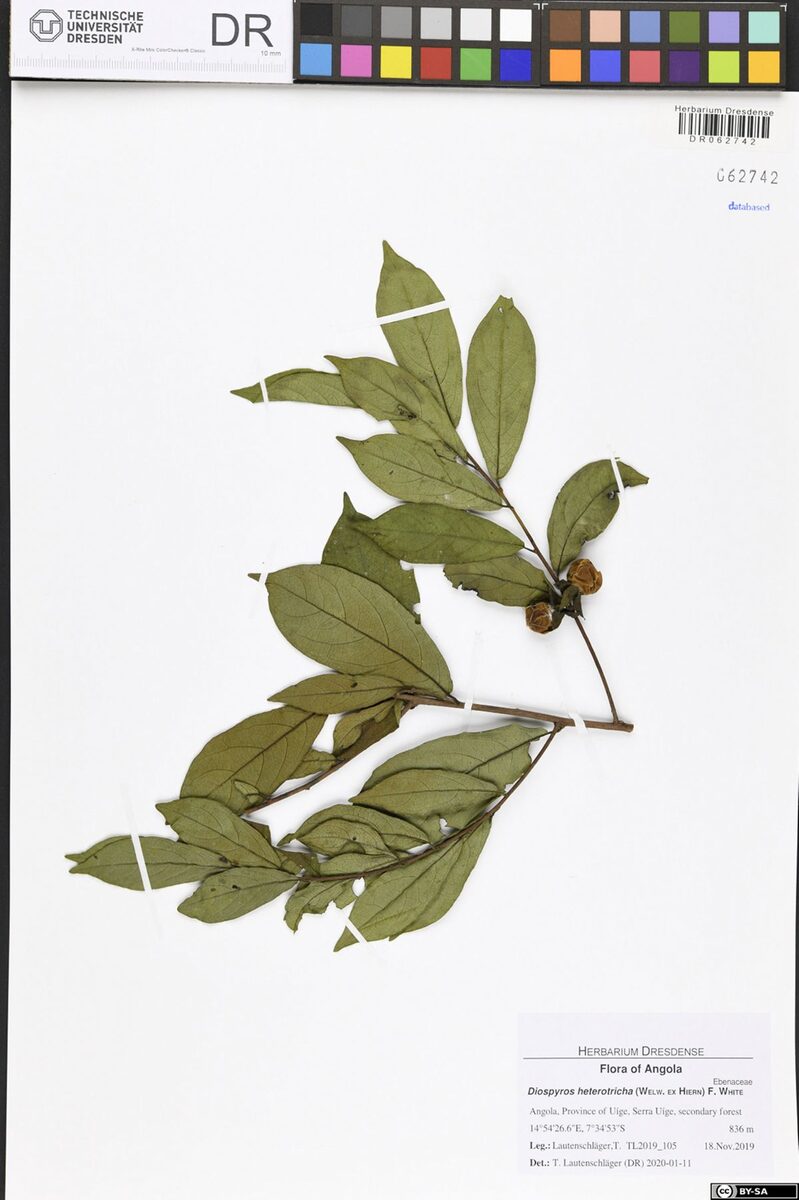
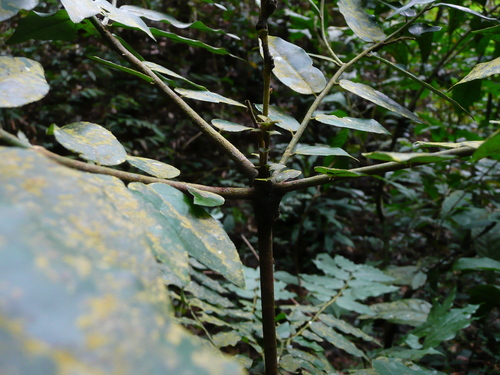
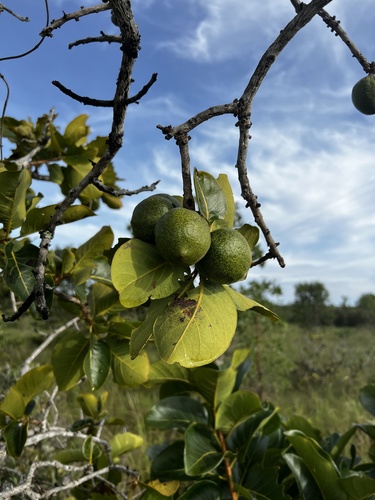
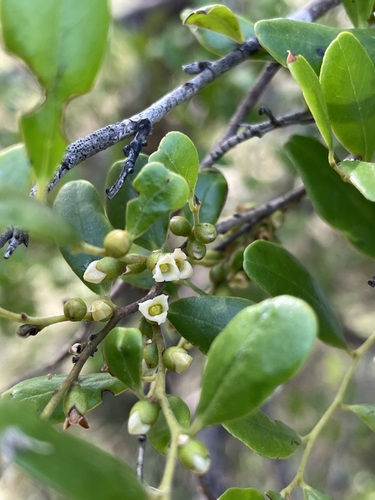
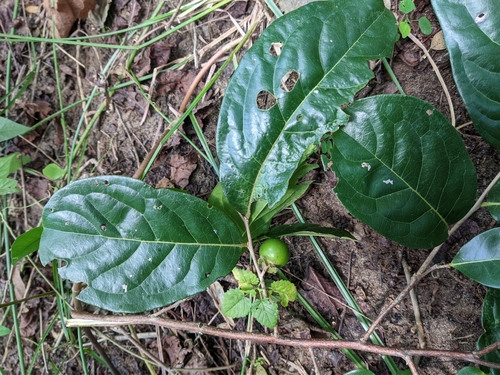
A medium sized tree. The crown is rounded and the tree is evergreen. It grows 10-26 m high. The bark is black. The leaves are glossy and dark green. They are 10-15 cm long. The flowers are of one sex and are yellowish green. The female flowers occur singly and the male flowers in small clusters. The fruit are large and dark green to black. They are 6-12 cm across. The flesh is dark chocolate coloured, when ripe. It is edible with a sweet taste. The fruit may be seedless but often have 5 seeds.
Edible Uses
The fruit is eaten fresh and used in desserts, pies, preserves, ice cream, cakes, and jam. It is also fermented into a brandy-like drink.
Traditional Uses
The fruit are eaten fresh. They are also good for desserts. They are used in pies, preserves, ice cream and cakes and other desserts. They are used for jam. They are also fermented into a brandy like drink.
Distribution
A tropical plant. It grows in lowland and mountain forests up to 1,800 m above sea level. It suits hot tropical lowland areas. In Mexico trees grow from sea level to 1800 m altitude. They will grow in most soils. Fully grown trees can tolerate 1-2°C of frost. It can grow in arid places. It suits hardiness zones 11-12.
Where It Grows
Africa, Asia, Australia, Belize, Brazil, Caribbean, Central America*, Colombia, Cook Islands, Costa Rica, Cuba, Dominican Republic, Ecuador, El Salvador, Guatemala, Haiti, Hawaii, Honduras, Indonesia, Malaysia, Mauritius, Mexico*, Nicaragua, North America, Pacific, Panama, Philippines, Pohnpei, Puerto Rico, SE Asia, Singapore, South America, USA, West Indies,
Cultivation
Plants are usually grown from seed. Seed germinate 30 days after sowing. Seedlings are transplanted into pots and into the field after 1-2 years. Young healthy stems can be air-layered. Trees can be shield budded. A spacing of 6-8 m is suitable. Plants can also be grafted.
Production
It is slow growing. Fruit are produced 5 year after planting. The fruit are ripe when the calyxes around the stem start to lift. Fruit mature in 200-300 days.
Other Information
It is a commercially cultivated fruit.
Notes
Plants have 3-4 x the Vitamin C of oranges. There are about 485 species of Diospyros mostly in the tropics.
Synonyms
Also Known As
Biaahui, Biaqui, Bom-rza, Bonza, Caca-poule, Chocolate pudding fruit, Cuputishim Ebano, Ebano, Guayabote, Hunchuikle, Inu, Junchuikl, Malisuuruata, Ma-ta-mui, Mueque, Munec, Muneque, Pillahui, Pohon kesemek hitam, Sapote negro, Saual, Sawalh, Sirunda-urata, Ta-toho, Talang-gubat, Tauch, Tauch-ya, Tauche, Tilzapot, Tilzapoti, Totocuitlzapoti, Tsupilul, Tzapultiltic, Xency, Xinde, Zapote negro, Zapote prieto
References (53)
- Black sapote references Diospyros nigra
- Burkill, I.H., 1966, A Dictionary of the Economic Products of the Malay Peninsula. Ministry of Agriculture and Cooperatives, Kuala Lumpur, Malaysia. Vol 1 (A-H) p 842 (As Diospyros ebenaster)
- Cheifetz, A., (ed), 1999, 500 popular vegetables, herbs, fruits and nuts for Australian Gardeners. Random House p 188 (As Diospyros digyna)
- Coronel, R.E., 1982, Fruit Collections in the Philippines. IBPGR Newsletter p 6 (As Diospyros ebenaster)
- Cruz, I. M., et al, 2015, Edible fruits and seeds in the State of Mexico. Revista Mexicana de Ciencias Agricolas. Vol. 6. Num. 2 pp 331-346
Show all 53 references Hide references
- Darley, J.J., 1993, Know and Enjoy Tropical Fruit. P & S Publishers. p 26 (As Diospyros digyna)
- Facciola, S., 1998, Cornucopia 2: a Source Book of Edible Plants. Kampong Publications, p 92 (As Diospyros digyna)
- Food Composition Tables for use in East Asia FAO http://www.fao.org/infoods/directory No. 968 (As Diospyros ebenaster)
- Gomez Pompa & Sosa, eds. 1978-. Flora de Veracruz (As Diospyros digyna)
- Gonzalez-Espinosa, M. et al, 2011, The Red List of Mexican Cloud Forest Trees. Flora and Fauna International, Cambridge. p 27
- Gouldstone, S., 1983, Growing your own Food-bearing Plants in Australia. Macmillan p 127 (As Diospyros ebenaster), p 122 (As Diospyros obtusifolia)
- Grandtner, M. M., 2008, World Dictionary of Trees. Wood and Forest Science Department. Laval University, Quebec, Qc Canada. (Internet database http://www.WDT.QC.ca) (Also as Diospyros ebenaster)
- Grandtner, M. M. & Chevrette, J., 2013, Dictionary of Trees, Volume 2: South America: Nomenclature, Taxonomy and Ecology. Academic Press p 202 (As Diospyros digyna)
- Hedrick, U.P., 1919, (Ed.), Sturtevant's edible plants of the world. p 278 (As Diospyros obtusifolia)
- Hermandez Bermejo, J.E., and Leon, J. (Eds.), 1994, Neglected Crops. 1492 from a different perspective. FAO Plant Production and Protection Series No 26. FAO, Rome. p 15 (As Diospyros digyna)
- Hibbert, M., 2002, The Aussie Plant Finder 2002, Florilegium. p 87 (As Diospyros digyna)
- Ibarra-Manriquez, G., et al, 1997, Useful Plants of the Los Tuxtlas Rain Forest (Veracruz, Mexico): Considerations of their Market Potential. Economic Botany, Vol. 51, No. 4, pp. 362-376 (As Diospyros digyna)
- John, L., & Stevenson, V., 1979, The Complete Book of Fruit. Angus & Robertson p 284 (As Diospyros digyna)
- Kermath, B. M., et al, 2014, Food Plants in the Americas: A survey of the domesticated, cultivated and wild plants used for Human food in North, Central and South America and the Caribbean. On line draft. p 313 (As Diospyros revoluta)
- Kiple, K.F. & Ornelas, K.C., (eds), 2000, The Cambridge World History of Food. CUP p 1734 (As Diospyros digyna)
- Leal, M. L. et al, 2018, Knowledge, use, and disuse of unconventional food plants. Journal of Ethnobiology and Ethnomedicine (2018) 14:6 (As Diospyros digyna)
- Llamas, K.A., 2003, Tropical Flowering Plants. Timber Press. p 186 (As Diospyros digyna)
- Lopez-Diago, D. & Garcia, N., 2021, Wild edible fruits of Colombia. Biota ColomBiana 22 (2) p 35
- Lorenzi, H., Bacher, L., Lacerda, M. & Sartori, S., 2006, Brazilian Fruits & Cultivated Exotics. Sao Paulo, Instituto Plantarum de Estuados da Flora Ltda. p 400 (As Diospyros digyna)
- Lyle, S., 2006, Discovering fruit and nuts. Land Links. p 181 (As Diospyros digyna)
- Mapes, C. & Basurto, F., 2016, Biodiversity and Edible Plants of Mexico. Chapter 5 in R. Lira, et al. (eds.), Ethnobotany of Mexico, Ethnobiology, Springer. p 101 (As Diospyros digyna)
- Martin, F. W., et al, 1987, Perennial Edible Fruits of the Tropics. USDA Handbook 642 p 25 (As Diospyros ebenaster)
- Miguel, E., et al, 1989, A checklist of the cultivated plants of Cuba. Kulturpflanze 37. 1989, 211-357 (As Diospyros digyna)
- Milow, P., et al, 2013, Malaysian species of plants with edible fruits or seeds and their evaluation. International Journal of Fruit Science. 14:1, 1-27 (As Diospyros digyna)
- Morton, Julia F., 1987, Fruits of Warm Climates. Creative Resources Systems, Inc. . p. 416 (As Diospyros digyna)
- Norrington, L., & Campbell, C., 2001, Tropical Food Gardens. Bloomings Books. p 95 (As Diospyros digyna)
- Pascual-Mendoza, S. et al, 2021, Traditional knowledge of edible plants in an indigenous community in the Sierra Norte of Oaxaca, Mexico. Plant Biosystems - An International Journal Dealing with all Aspects of Plant Biology
- Piedra-Malagón, E. M. et al, 2022, Edible native plants of the Gulf of Mexico Province. Biodiversity Data Journal 10: e80565 p 18
- Pl. hort. schoenbr. 3:35, t. 313. 1803 (As Diospyros digyna)
- Purseglove, J.W., 1968, Tropical Crops Dicotyledons, Longmans. p 646 (As Diospyros digyna)
- Recher, P, 2001, Fruit Spirit Botanical Gardens Plant Index. www.nrg.com.au/~recher/ seedlist.html p 2 (As Diospyros digyna)
- Roa, J. A. G. & Boada, D. S. G., 2018, Fundación para el Fortalecimiento de la Fruticultura y Plantas Alimenticias no Convencionales en Colombia.
- Royal Botanic Gardens, Kew (1999). Survey of Economic Plants for Arid and Semi-Arid Lands (SEPASAL) database. Published on the Internet; http://www.rbgkew.org.uk/ceb/sepasal/internet [Accessed 16th April 2011] (As Diospyros digyna)
- Segura, S., et al, 2018, The edible fruit species in Mexico. Genet Resour Crop Evol (2018) 65:1767–1793 (Also as Diospyros revoluta)
- Smith, N., Mori, S.A., et al, 2004, Flowering Plants of the Neotropics. Princeton. p 136 (As Diospyros digyna)
- Solomon, C., 2001, Encyclopedia of Asian Food. New Holland. p 329 (As Diospyros digyna)
- Standley & Steyerm. 1946-1976. Flora of Guatemala. (As Diospyros digyna)
- Staples, G.W. and Herbst, D.R., 2005, A tropical Garden Flora. Bishop Museum Press, Honolulu, Hawaii. p 272 (As Diospyros digyna)
- Sukarya, D. G., (Ed.) 2013, 3,500 Plant Species of the Botanic Gardens of Indonesia. LIPI p 240
- Tankard, G., 1990, Tropical fruit. An Australian Guide to Growing and using exotic fruit. Viking p 26 (As Diospyros digyna)
- Terrell et al. 1986. Agric. Handb. no. 505. (AH 505) (As Diospyros digyna)
- USDA, ARS, National Genetic Resources Program. Germplasm Resources Information Network - (GRIN). [Online Database] National Germplasm Resources Laboratory, Beltsville, Maryland. Available: www.ars-grin.gov/cgi-bin/npgs/html/econ.pl (10 April 2000) (As Diospyros digyna)
- van Wyk, B., 2005, Food Plants of the World. An illustrated guide. Timber press. p 179 (As Diospyros digyna)
- Verheij, E. W. M., and R. E. Coronel, eds. 1991. Edible fruits and nuts. In: E. W. M. Verheij & R. E. Coronel (eds.), Plant Resources of South-East Asia (PROSEA). 2:152 (As Diospyros digyna)
- Wiersema, J. H. & Leon, B., 2013, World Economic Plants. A Standard Reference CRC Press. 2nd Ed. p 249 (As Diospyros digyna)
- Woodson & Schery, eds. 1943-1980. Flora of Panama (As Diospyros digyna)
- World Checklist of Useful Plant Species 2020. Royal Botanic Gardens, Kew
- www.worldagroforestrycentre.org/sea/products/afdbases/af/asp/SpeciesInfo.asp?SpID=18080 (As Diospyros digyna)