Diospyros dendo
Welw. ex Hiern
Gaboon persimmon
gbif· cc-by-nc-sa
Jan Klein & West & Central Africa program
gbif· cc-by-nc-sa
Jan Klein & West & Central Africa program
gbif· cc-by-nc-sa
Jan Klein & West & Central Africa program
Description
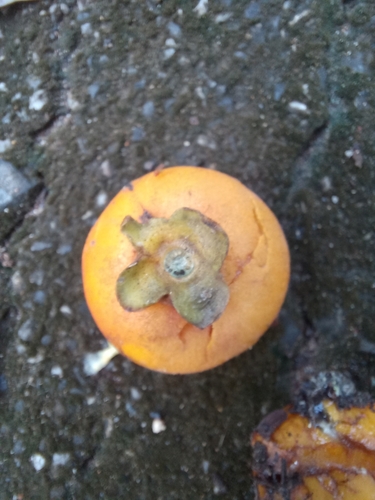
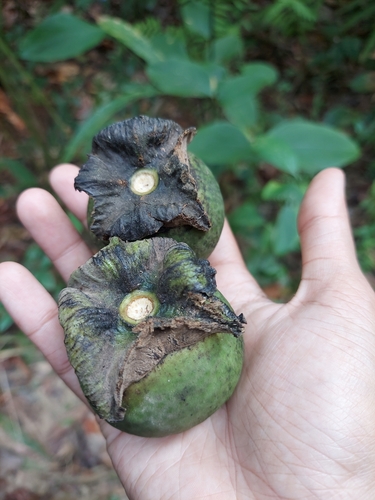
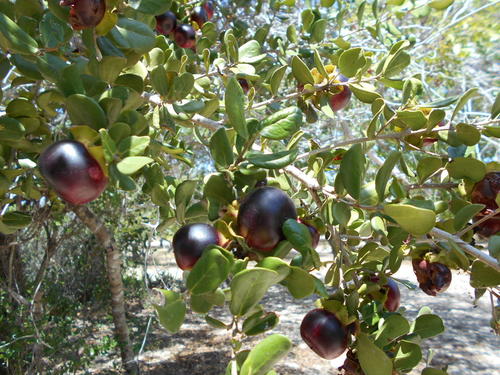
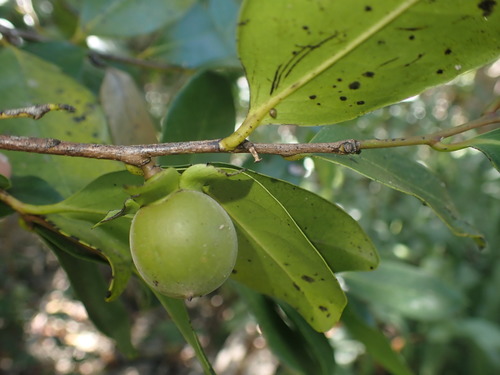
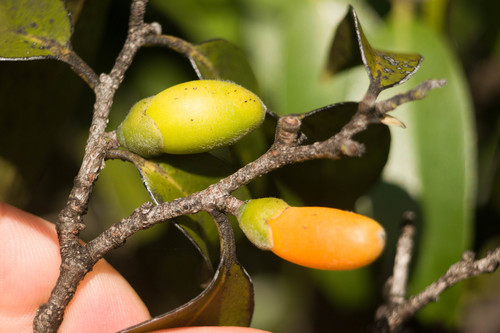
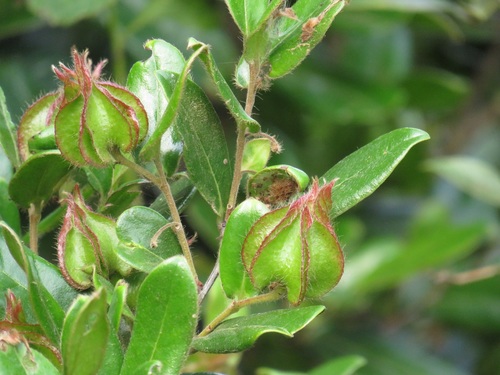
A tree. It grows about 15 m high and has a trunk about 1 m across. The trunk can be twisted and fluted. The bark is like a guava tree. It is smooth and falls in thin papery scales. The leaves are up to 18 cm long and 7 cm wide. The male flowers are crowded into 5-12 flowered flat topped arrangement. The female flowers are almost stalkless and in clusters of 2-5. The fruit is about 1.2 cm across. They are dark red. It is surrounded by a calyx with 4-5 large lobes. They are triangular with very wavy margins.
Edible Uses
The fruit is eaten.
Distribution
A tropical plant.
Where It Grows
Africa, Angola, Benin, Cameroon, Central Africa, Central African Republic, CAR, Congo DR, Equatorial Guinea, Gabon, Nigeria, West Africa,
Cultivation
A tree of the lowland, moist tropics. We have seen no individual confirmation for this species, but in general Diospyros species are dioecious and require both male and female forms to be grown if fruit and seed are required.
Propagation
Seed - it has a very short viability and so should be sown as soon as possible. The flesh should be removed since this contains germination inhibitors. Sow the seed in a shady position in a nursery seedbed. The sowing media for ebony uses soil and fine sand at the ratio 3:1. The seed is planted horizontally or vertically with the radicle end down, with a sowing depth of 1 - 1½ times the thickness of seed. Distance between the seeds is 3 - 5cm. Seeds are very sensitive to desiccation during germination and early growth, so must be regularly watered at this time. Normally the seed will germinate after one week. In one trial, fresh seed, sown one day after collection, showed 85% germination rate within 17 - 65 days. As a rule fresh seeds have a high percentage of fertility. The seedlings develop long taproots at an early stage, often before any appreciable elongation of the shoot takes place. The growth of the seedling is decidedly slow .
Other Uses
The bark yields a dye and a tanning material. The wood is strong, dense and durable. It is a 'brown ebony' with black streaks in the heart-wood which is very hard and amounts to about one third of the diameter of the main stem. It is potentially usable for timber, and it makes a good firewood. It is used for turnery and inlay work.
Production
In Central African Republic plants fruit in May.
Notes
There are about 485 species of Diospyros mostly in the tropics.
Synonyms
Also Known As
Dendo, Igi-dudu
References (9)
- Burkill, H. M., 1985, The useful plants of west tropical Africa, Vol. 2. Kew.
- Busson, 1965,
- Dalziel, J. M., 1937, The Useful plants of west tropical Africa. Crown Agents for the Colonies London.
- Food Composition Tables for use in Africa FAO http://www.fao.org/infoods/directory No. 1007
- Jardin, C., 1970, List of Foods Used In Africa, FAO Nutrition Information Document Series No 2.p 133
Show all 9 references Hide references
- Keay, R.W.J., 1989, Trees of Nigeria. Clarendon Press, Oxford. p 383
- Peters, C. R., O'Brien, E. M., and Drummond, R.B., 1992, Edible Wild plants of Sub-saharan Africa. Kew. p 105
- Vivien, J., & Faure, J.J., 1996, Fruitiers Sauvages d'Afrique. Especes du Cameroun. CTA p 143
- World Checklist of Useful Plant Species 2020. Royal Botanic Gardens, Kew