Dicliptera chinensis
(L.) Juss.
Chinese foldwing
iNaturalist· cc0
no rights reserved, uploaded by 葉子
iNaturalist· cc0
no rights reserved
Description
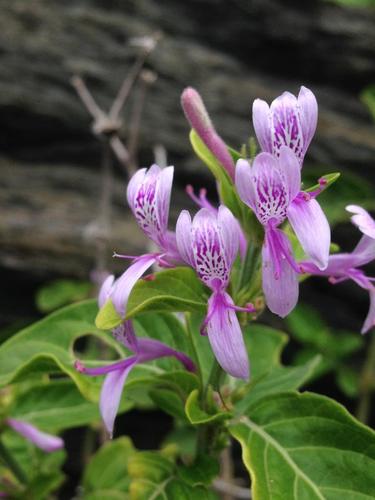
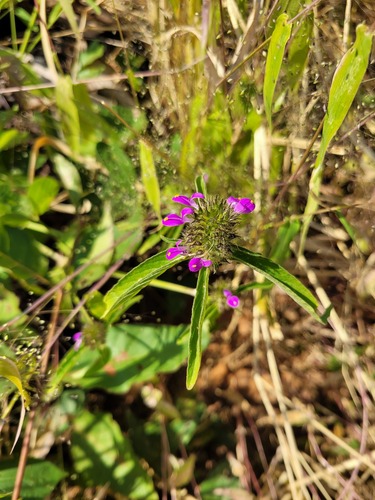
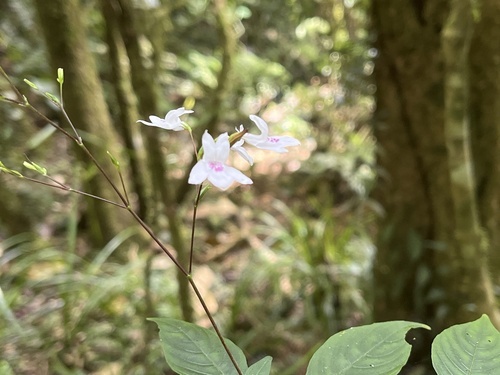
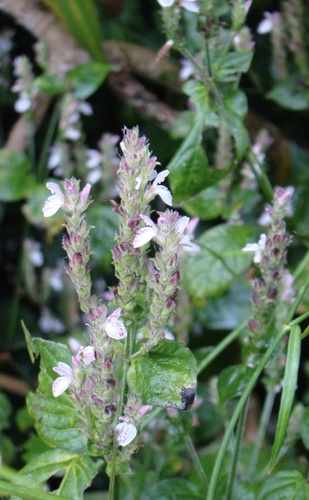
A herb. It keeps growing from year to year. It grows 30-50 cm high. It has soft hairs. The leaves are narrowly oval and 3-5 cm long by 1-3 cm wide. They taper to a short tip. The flowers are pink-purple and small. They do not have stalks. They are in groups in the axils of leaves.
Edible Uses
The young leaves and tips are used uncooked or steamed to flavour food, soups, and potherbs. They are also used to colour rice. The leaves can be made into tea. It is sold in local markets in China as a cultivated food plant.
Traditional Uses
The young leaves and tips are used uncooked or steamed to flavour food. They are used in soups and potherbs. They are also used to colour rice.
This uses section is brief — help expand it
Distribution
A tropical plant. It grows from sea level to high altitudes. It is best in humid and shaded locations. In southern China it grows near streams below 1,800 m above sea level. In Sichuan and Yunnan.
Where It Grows
Asia, Bangladesh, China, Hawaii, India, Indochina, Indonesia, Pacific, SE Asia, Taiwan, Vietnam,
Cultivation
It grows easily from seed.
Other Information
It is a cultivated food plant. It is sold in local markets in China.
Notes
There are about 150 Dicliptera species. They grow in the tropics and subtropics.
Nutrition
| Part | Moisture | kJ | kcal | Protein | Vit A | Vit C | Iron | Zinc |
|---|---|---|---|---|---|---|---|---|
| Leaves | 86.6 | 151 | 36 | 5.9 | — | 76 | — | — |
Synonyms
Also Known As
Cay gan heo, Cuu can, Djookoot djampang, Ladien, Nan lan, Pinten, Plinten, Ya ke suo, Zhu gan cai
References (10)
- Ann. Mus. Natl. Hist. Nat. 9:268. 1807
- Burkill, I.H., 1966, A Dictionary of the Economic Products of the Malay Peninsula. Ministry of Agriculture and Cooperatives, Kuala Lumpur, Malaysia. Vol 1 (A-H) p 817
- Cao, Y., et al, 2020, Ethnobotanical study on wild edible plants used by three trans-boundary ethnic groups in Jiangcheng County, Pu’er, Southwest China. Journal of Ethnobiology and Ethnomedicine (2020) 16:66
- Hu, Shiu-ying, 2005, Food Plants of China. The Chinese University Press. p 675 (As (Vahl) Nees)
- Li, D. et al, 2017, Ethnobotanical survey of herbal tea plants from the traditional markets in Chaoshan, China. Journal of Ethnopharmacology. 205 (2017) 195-206
Show all 10 references Hide references
- Martin, F.W. & Ruberte, R.M., 1979, Edible Leaves of the Tropics. Antillian College Press, Mayaguez, Puerto Rico. p 171
- Mot So Rau Dai an Duoc O Vietnam. Wild edible Vegetables. Ha Noi 1994, p 144
- Ochse, J.J. et al, 1931, Vegetables of the Dutch East Indies. Asher reprint. p 1
- Tanaka, Y. & Van Ke, N., 2007, Edible Wild Plants of Vietnam: The bountiful garden. Orchid books. p 15
- Yang, R., et al, 2008, Content and distribution of flavonoids among 91 edible plant species. Asia Pac. J. Clin. Nutru. 17(S1): 275-279