Dialium platysepalum
Baker
iNaturalist· cc-by-nc
(c) usebcm, some rights reserved (CC BY-NC), uploaded by usebcm
gbif· cc0
President and Fellows of Harvard College
gbif· cc0
President and Fellows of Harvard College
Description
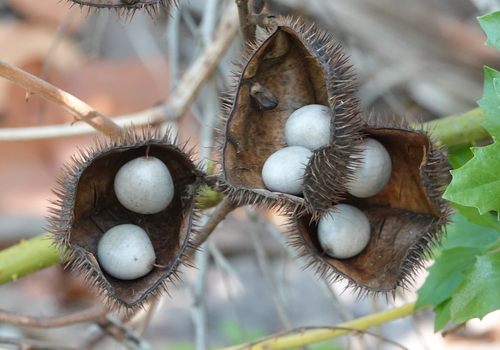
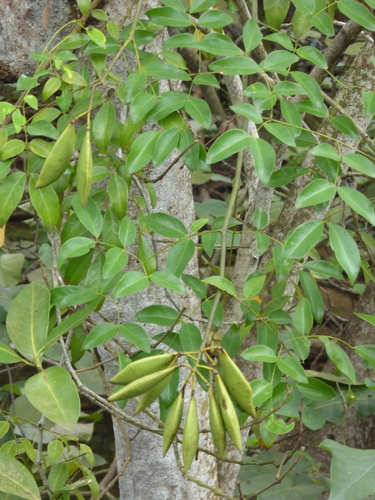
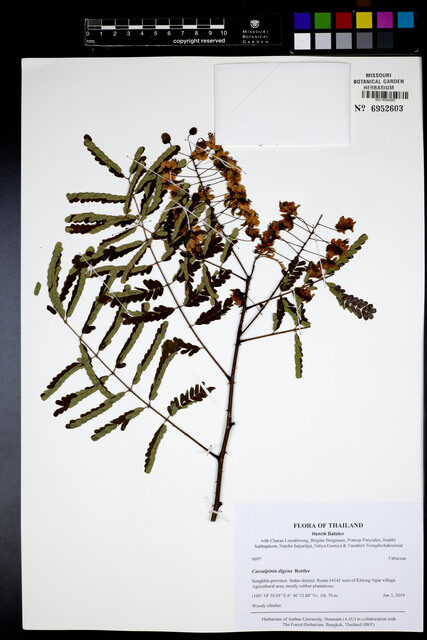
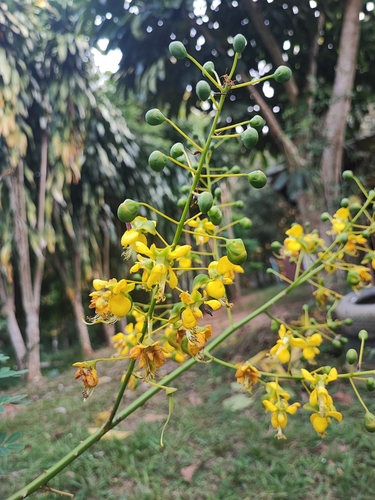
A tree. It grows to 45 m high. The trunk does not have branches for 21 m. The leaves are compound. They have 5-11 leaflets. These are oblong and 6-8 cm long by 2-4 cm wide. They are shiny and dark green. There are golden hairs underneath. Leaves are thinly leathery. The leaves end with an abrupt tip. The base is rounded or tapering. There are 10-12 pairs of secondary veins. The flowers are densely hairy. The fruit is an oval pod. It is 2-2.5 cm long. The wall is hard. It is covered with dense brown hairs. The seed is round but unequal. It is about 1.5 mm long.
Edible Uses
Fruit - raw. The brownish-black fruits contain an acid-flavoured brown pulp. It is eaten as a local delicacy.
Traditional Uses
The fruit are eaten raw.
This uses section is brief — help expand it
Distribution
A tropical plant. It grows in lowland rainforest and freshwater swamps. It can be found up to 500 m altitude in Kalimantan. It can be on sandy or clay soils.
Where It Grows
Asia, Brunei, India, Indochina, Indonesia, Malaysia, Pacific, Philippines, Sarawak, SE Asia, Thailand,
Cultivation
The plant can flower all year round. This species has a symbiotic relationship with certain soil bacteria, these bacteria form nodules on the roots and fix atmospheric nitrogen. Some of this nitrogen is utilized by the growing plant but some can also be used by other plants growing nearby.
Other Uses
This tree is one of several species yielding a timber known as 'Keranji'. The general description of this wood is as follows:- The heartwood is golden-brown or red-brown; clearly demarcated from the white to yellowish sapwood. The texture is fine to moderately coarse and even; the grain interlocked or wavy. The wood is heavy; moderately durable but the sapwood is susceptible to insect and fungal attack. It can be easy to very difficult to resaw and cross-cut depending on the species; planing is easy to slightly difficult, and the planed surface is moderately smooth; nailing property is good. The wood is suitable for heavy construction, flooring, handles for striking tools and batons.
Other Information
Fruit are sold in markets.
Notes
There are about 40 Dialium species. They grow in tropical SE Asia. They probably all have edible fruit. Also as Caesalpinaceae.
Synonyms
Also Known As
Keranji kuning besar, Keranji kuning kecil, Keranji tebal kecil, Kuranji hutan
References (10)
- Argent, G et al, nd, Manual of the Larger and More important non Dipterocarp Trees of Central Kalimantan Indonesia. Volume 2 Forest Research Institute, Samarinda, Indonesia. p 355
- Burkill, I.H., 1966, A Dictionary of the Economic Products of the Malay Peninsula. Ministry of Agriculture and Cooperatives, Kuala Lumpur, Malaysia. Vol 1 (A-H) p 812 (Also as Dialium maingayi and Dialium wallichii)
- Chai, P. P. K. (Ed), et al, 2000, A checklist of Flora, Fauna, Food and Medicinal Plants. Lanjak Entimau Wildlife Sanctuary, Sarawak. Forestry Malaysia & ITTO. p 168 (Also as Dialium maingayi and Dialium triste)
- J. D. Hooker, Fl. Brit. India 2:270. 1878
- Milow, P., et al, 2013, Malaysian species of plants with edible fruits or seeds and their evaluation. International Journal of Fruit Science. 14:1, 1-27
Show all 10 references Hide references
- Saw, L.G., LaFrankie, J. V. Kochummen, K. M., Yap S. K., 1991, Fruit Trees in a Malaysian Rain Forest. Economic Botany, Vol. 45, No. 1, pp. 120-136 (Also as Dialium maingayi and Dialium wallichii)
- Slik, F., www.asianplant.net
- Soerianegara, I. & Lemmens, R. H. M. L., (Eds.) 1993, Timber trees: Major commercial timbers. Plant Resources of South-East Asia. Wageningen. No. 5(1). p 166
- Suwardi, A. B., et al, 2020, Ethnobotany and conservation of indigenous edible fruit plants in South Aceh, Indonesia. Biodiversitas Vol. 21, No. 5, pp 1850-1860
- World Checklist of Useful Plant Species 2020. Royal Botanic Gardens, Kew