Caesalpinia bonduc
(L.) Roxb.
Bonduc nut, Grey nicker
iNaturalist· cc-by
(c) Claire Herzog, some rights reserved (CC BY)
iNaturalist· cc-by
(c) Claire Herzog, some rights reserved (CC BY)
iNaturalist· cc-by
(c) Claire Herzog, some rights reserved (CC BY)
Description
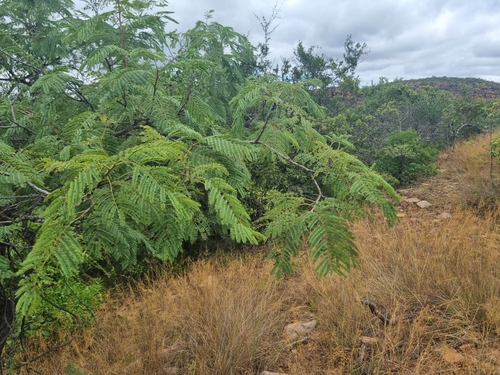
A scrambling shrub. It has long branches. They can be 15 m long. These have re-curved hooked spines. Young plant parts have brown hairs. The leaves are 30-80 cm long and twice divided. The final leaflets are 2-6 cm long by 1-3 cm wide. The fruit are pods 5-9 cm long by 2-5 cm wide. They are prickly . There are 1-2 seeds. They are 1-2 cm across and very hard.
Edible Uses
The roasted seeds are used as a coffee substitute.
Traditional Uses
The roasted seeds have been used as a coffee substitute. Caution:
This uses section is brief — help expand it
Medicinal Uses
Nodules on the plant's roots contain symbiotic bacteria that fix nitrogen. This is used as a nutrient by the vine and also benefits other plants growing in close proximity. It is a popular local ornamental plant in Malaysia. This plant has been used in traditional medicine. The seeds have tonic and antipyretic properties and the bark and leaves have been used likewise. The root can be pounded to remedy caterpillar stings, it can be boiled and its broth drank to regulate menstruation. An oil extracted from the seeds has been used in cosmetics and for treating discharges from the ear. Tongans make the hard seeds (talatala 'amoa) into leis or play with them like marbles; its spiky leaves and stems are used in fruit bat snares.
Known Hazards
Seeds are noted with a caution flag; handle with care as they are very hard.
Distribution
It is a tropical plant. It grows near sea shores and up to 200 m above sea level. It can be up to 800 m.
Where It Grows
Africa, Asia, Australia, Benin, British Indian Ocean Terr., BIOT, Central Africa, China, East Africa, Easter Island, Fiji, Gabon, Guiana, Guianas, Guyana, Indochina, Indonesia, Kiribati, Laos, Madagascar, Malaysia, Maldives, Marquesas, Marshall Islands, Micronesia, Mozambique, Myanmar, Nauru, Niue, Pacific, Papua New Guinea, PNG, Philippines, Puerto Rico, Rotuma, Sao Tome and Principe, SE Asia, South America, St. Kitts and Nevis, Suriname, Taiwan, Tuvalu, Vietnam, West Africa, West Indies,
Cultivation
Plants can be grown from seeds. The seeds need treatment to break the hard seed coat.
Other Information
It is a cultivated plant.
Notes
Also as Caesalpinaceae. It is used as medicine.
Synonyms
Also Known As
Fananomahery, Fever nut, Honi, Kaloklok, Kashi kaburan, Kemrunggi, M'koni, Mata de playa, Talamoa, Votalalaka
References (13)
- Dansi, A., et al, 2008, Traditional leafy vegetables and their use in the Benin Republic. Genet Resour Crop Evol (2008) 55:1239–1256
- Dansi, A., et al, 2009, Traditional leafy vegetables in Benin: folk nomenclature, species under threat and domestication. Acta Bot. Gallica 156(2), 183-199
- Franklin, J., Keppel, G., & Whistler, W., 2008, The vegetation and flora of Lakeba, Nayau and Aiwa Islands, Central Lau Group, Fiji. Micronesica 40(1/2): 169–225, 2008
- Kermath, B. M., et al, 2014, Food Plants in the Americas: A survey of the domesticated, cultivated and wild plants used for Human food in North, Central and South America and the Caribbean. On line draft. p 157
- Melzer, R. & Plumb, J., 2011, Plants of Capricornia. Belgamba, Rockhampton. p 83
Show all 13 references Hide references
- PROTA
- Selvam, V., 2007, Trees and shrubs of the Maldives. RAP Publication No. 2007/12 p 42
- Sujanapal, P., & Sankaran, K. V., 2016, Common Plants of Maldives. FAO & Kerala FRI, p 63
- Sukarya, D. G., (Ed.) 2013, 3,500 Plant Species of the Botanic Gardens of Indonesia. LIPI p 908
- Thaman, R. R, 2016, The flora of Tuvalu. Atoll Research Bulletin No. 611. Smithsonian Institute p 88
- Topp, J. M. W., 1988, An Annotated Check List of the Flora of Diego Garcia, British Ocean Territory. Atoll Research Bulletin No. 313 (Rare)
- World Checklist of Useful Plant Species 2020. Royal Botanic Gardens, Kew (As Guilandina bonduc)
- Zizka, G., 1991, Flowering Plants of Easter Island. Palmarum Hortus Francofurtensis