Acacia calcicola
Forde & Ising
Northern Myall, Shrubby mulga
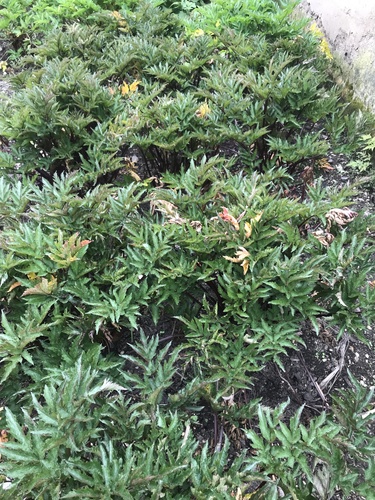
iNaturalist· cc-by-nc
(c) Ciaran Ernst-Russell, some rights reserved (CC BY-NC), uploaded by Ciaran Ernst-Russell
iNaturalist· cc-by-nc
(c) Jarah Marginata, some rights reserved (CC BY-NC)
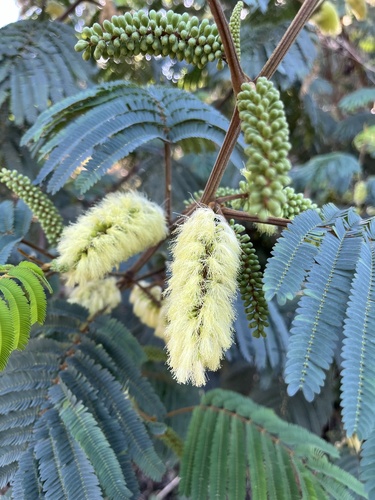
iNaturalist· cc-by-nc
(c) Jarah Marginata, some rights reserved (CC BY-NC)
Summary
Source: WikipediaAcacia calcicola, commonly known as shrubby wattle, shrubby mulga, myall-gidgee, northern myall and grey myall is a species of flowering plant in the family Fabaceae and is native to arid areas of central Australia. The Pitjantjatjara peoples know the tree as ikatuka, the Warlpiri know it as jirlarti and the Arrernte know it as irrakwetye. It is a rounded shrub or straggly tree, with narrowly linear, linear or very narrowly elliptic phyllodes, spherical heads of golden yellow flowers, and more or less woody pods resembling a string of beads up to 120 mm (4.7 in) long.
Description
A shrub or small tree. It grows 5 m tall. There are prickles along the stem. The leaves are twice divided and there are 8-18 pairs of pinnae. There are up to 50 pairs of pinnules on each pinnae. The flowers are yellow. They are in large clusters at the ends of branches. The pods are flattened.
Edible Uses
The ash is used to make a chewing ball, traditionally combined with nicotine-containing leaves to enhance the effect.
Traditional Uses
The ash is used to make a chewing ball along with leaves containing nicotine to increase the effect.
This uses section is brief — help expand it
Distribution
It occurs in inland Australia. It grows on calcareous or neutral soils. It is a very hardy plant.
Where It Grows
Australia*,
Cultivation
It is grown from seed.
Production
Flowering is August to November with pods from November to December.
Notes
There are about 1,350 Acacia species. Over 1,000 occur in Australia. Also as Mimosaceae.
Also Known As
Grey Myall, Myall-gidgee
References (4)
- Doran, J.C., & Turnbull, J.W. (Eds), 1997, Australian Trees and Shrubs: species for land rehabilitation and farm plantings in the tropics. ACIAR Monograph No 24. p 120
- Elliot, W.R., & Jones, D.L., 1982, Encyclopedia of Australian Plants suitable for cultivation. Vol 2. Lothian. p 28
- Paczkowska, G . & Chapman, A.R., 2000, The Western Australian Flora. A Descriptive Catalogue. Western Australian Herbarium. p 301
- Trans. Roy. Soc. South Australia 81:153. 1958