Cardamine diphylla
Michx.
Crinkleroot, Toothwort, Pepper-root, Two-leaved toothwort
iNaturalist· cc0
no rights reserved, uploaded by Kent McFarland
iNaturalist· cc-by
(c) Tom Norton, some rights reserved (CC BY)
iNaturalist· cc-by
(c) Tom Norton, some rights reserved (CC BY)
Summary
Source: WikipediaCardamine diphylla (broadleaf toothwort, crinkle root, crinkle-root, crinkleroot, pepper root, twin-leaved toothwort, twoleaf toothwort, toothwort) is a flowering plant in the family Brassicaceae. It is a spring flowering woodland plant that is native to eastern North America.
Description
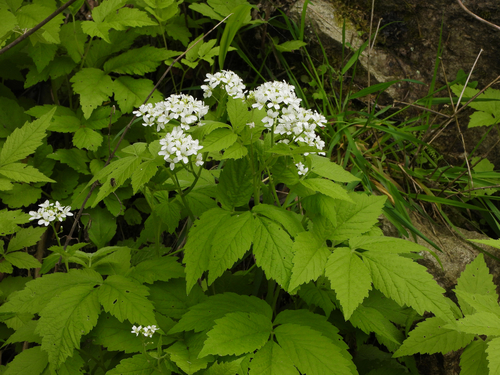
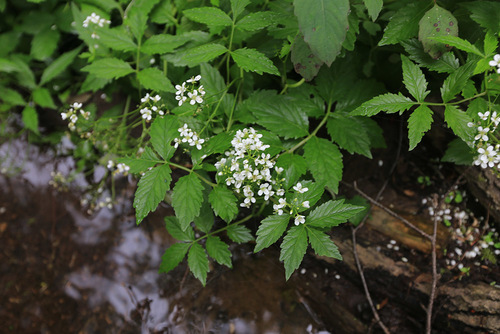
A small herb. It grows 20-40 cm tall. The rhizome of underground stem has teeth. The lower leaves are mostly compound. The leaves on the stem are in pairs and have teeth. These are each divided into 3 broad leaflets.
Edible Uses
The Abenaki use it as a condiment. The Cherokee parboil and rinse the stems and leaves, add hot grease, salt and water, and boiled them until they are soft as potherbs. They also use the leaves in salads, and smoke the plant. The Iroquois eat the roots raw with salt or boiled. The Ojibwa mix the roots with salt, vinegar, or sugar and use them as a condiment.
Traditional Uses
The roots have a horseradish-like flavour. They are used in salads and eaten raw like radishes. The leaves can be eaten raw but are better cooked in soups, stew or casseroles.
Medicinal Uses
The ground root is mixed with vinegar by the Algonquin people of Quebec and used as a relish. They also give an infusion to children to treat fevers, and use an infusion of the plant and sweet flag root to treat heart disease. The Cherokee use a poultice of the root for headaches, chew the root for colds and gargle an infusion for sore throats. The Lenape use the roots as a stomach medicine, and use an infusion of the roots combined with other plants as a treatment for scrofula and venereal disease. The Delaware Nation of Oklahoma use a compound containing the root as a stomach remedy, for scrofula, and for venereal disease. The Iroquois take an infusion of the whole plant to strengthen the breasts. They also chew the raw root for stomach gas, apply a poultice of roots to swellings, take a cold infusion of the plant for fever and for "summer complaint, drink a cold infusion of the roots for "when love is too strong", and use an infusion of the roots when "heart jumps and the head goes wrong." They also use a compound for chest pains. They also take an infusion of the plant at the beginning of tuberculosis. The Malecite use an infusion of the roots as a tonic, and chew green or dried roots for hoarseness. The Micmac use the root as a sedative, to clear the throat and for hoarseness, and use the root as a tonic.
Distribution
It is a temperate plant. It grows in rich damp woodlands and meadows. It grows in hardiness zones 3-8.
Where It Grows
Asia, Canada, Europe, North America*, USA,
Synonyms
References (12)
- Beckstrom-Sternberg, Stephen M., and James A. Duke. "The Foodplant Database." http://probe.nalusda.gov:8300/cgi-bin/browse/foodplantdb.(ACEDB version 4.0 - data version July 1994) (As Dentaria)
- Bircher, A. G. & Bircher, W. H., 2000, Encyclopedia of Fruit Trees and Edible Flowering Plants in Egypt and the Subtropics. AUC Press. p 82
- Facciola, S., 1998, Cornucopia 2: a Source Book of Edible Plants. Kampong Publications, p 58
- Hedrick, U.P., 1919, (Ed.), Sturtevant's edible plants of the world. p 160
- Jackes, D. A., Edible Forest Gardens
Show all 12 references Hide references
- Kermath, B. M., et al, 2014, Food Plants in the Americas: A survey of the domesticated, cultivated and wild plants used for Human food in North, Central and South America and the Caribbean. On line draft. p 183
- Kiple, K.F. & Ornelas, K.C., (eds), 2000, The Cambridge World History of Food. CUP p 1871
- Lim, T. K., 2015, Edible Medicinal and Non Medicinal Plants. Volume 9, Modified Stems, Roots, Bulbs. Springer p 33
- MacKinnon, A., et al, 2009, Edible & Medicinal Plants of Canada. Lone Pine. p 216
- Plants for a Future database, The Field, Penpol, Lostwithiel, Cornwall, PL22 0NG, UK. http://www.scs.leeds.ac.uk/pfaf/
- Tozer, F., 2007, The Uses of Wild Plants. Green Man Publishing. p 77 (As Dentaria diphylla)
- www.wildediblefood.com (As Dentaria diphylla)