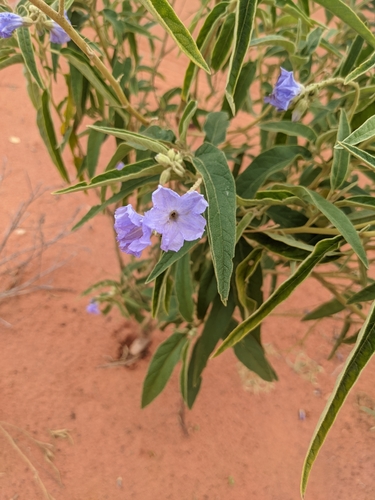
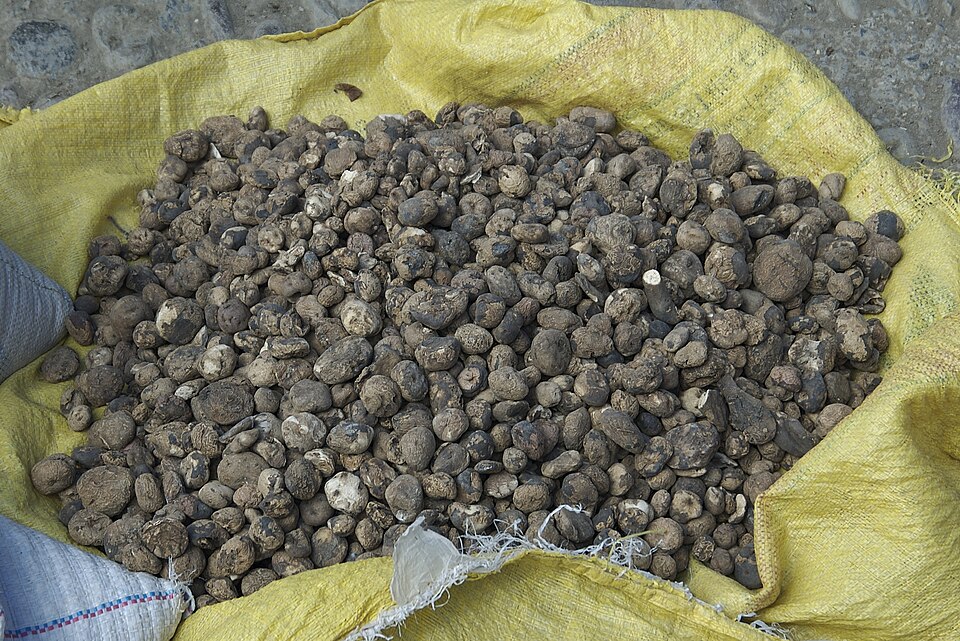
Datura innoxia
Mill.
Downy thorn apple, Black datura
iNaturalist· cc-by-nc
(c) diegocook, some rights reserved (CC BY-NC)
iNaturalist· cc-by-nc
(c) diegocook, some rights reserved (CC BY-NC)
iNaturalist· cc-by-nc
(c) diegocook, some rights reserved (CC BY-NC)
Description
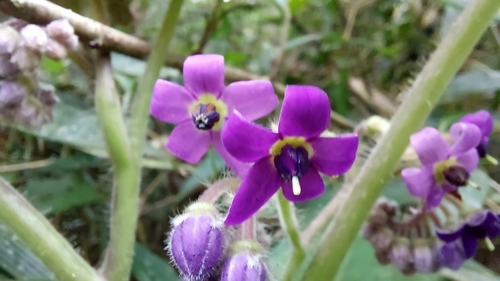
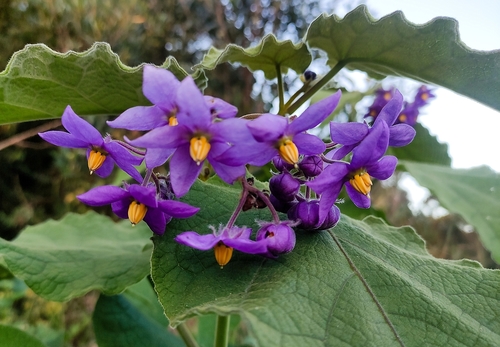
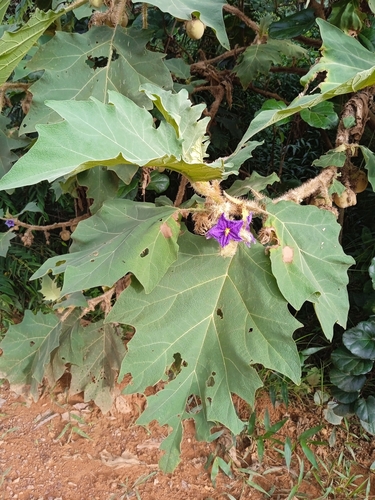
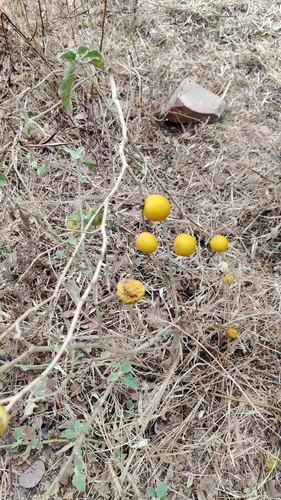
A herb. It is an annual plant. It grows up to 2 m high. The stems have short hairs. The leaves are slightly hairy above and very hairy underneath. They have an unpleasant smell. The fruit is a very densely prickly drooping capsule. It is poisonous.
Edible Uses
The fruit, which grows up to 5cm long and 7cm wide, can be ground up and mixed with clay — the clay likely has a neutralising effect on the toxins. This is an extremely toxic plant and its use as a food cannot be recommended. A stupefying beverage is also made from the leaves and roots.
Traditional Uses
CAUTION: IT IS POISONOUS. The seeds are very poisonous. They have been used to make an alcoholic drink. The active poisonous alkaloids are atropine, hyoscyamine and hyoscine.
Medicinal Uses
All parts of the plant are anodyne, antispasmodic, hallucinogenic, hypnotic, and narcotic. It has been used historically as a painkiller and in the treatment of insanity, fevers with catarrh, diarrhoea, and skin diseases. The plant contains several alkaloids, the most active being scopolamine, a potent cholinergic-blocking hallucinogen used to calm schizoid patients. Alkaloid concentrations by plant part are: leaves 0.52% scopolamine, calyces 1.08%, stems 0.3%, roots 0.39%, fruits 0.77%, capsules 0.33%, seeds 0.44%, and the whole plant 0.52–0.62%. Any use of this plant should be approached with extreme caution and undertaken only under the supervision of a qualified practitioner, as the toxic dose is very close to the medicinal dose.
Known Hazards
All parts of Datura plants are toxic, containing dangerous levels of tropane alkaloids (hyoscyamine, hyoscine) and may be fatal if ingested by humans and other animals, including livestock and pets. The main observed effects of ingestion are enlarged pupils, dry mouth, trouble breathing, blurred vision, hallucinations, panic, death. In some places, it is prohibited to buy, sell or cultivate Datura plants. When cultivated, the plant is usually treated as an annual to be grown from seed, but its tuberous roots (somewhat reminiscent of those of the cultivated Dahlia) can be kept from freezing and planted in the spring of the following year. Datura innoxia, like other Datura species, contains the highly toxic alkaloids atropine, hyoscine (scopolamine), and hyoscyamine. The Aztecs called the plant by the Nahuatl names toloatzin and toloaxihuitl (trans. "the plant with the nodding head" - in reference to the nodding seed capsules) and used it long before the Spanish conquest of Mexico for many therapeutic purposes, such as poultices for wounds where it acts as an anodyne. Although the Aztecs warned against madness and "various and vain imaginings", many Native Americans have used the plant as an entheogen for hallucinations and rites of passage. The alkaloids of these plants are very similar to those of mandrake, deadly nightshade, and henbane, which are also highly poisonous plants used cautiously for effective pain relief in antiquity. Datura intoxication typically produces a complete inability to differentiate reality from fantasy (delirium, as contrasted to hallucination); hyperthermia; tachycardia; bizarre, and possibly violent behavior; and severe mydriasis with resultant painful photophobia that can last several days. Pronounced amnesia is another commonly reported effect. There can easily be a 5:1 variation in toxins from plant to plant, and a given plant's toxicity depends on its age, where it is growing, and local weather conditions. These wide variations make Datura exceptionally hazardous to use as a drug. In traditional cultures, users needed to have a great deal of experience and detailed plant knowledge so that no harm resulted from using it. Such knowledge is not widely available in modern cultures, so many unfortunate incidents result from ingesting Datura. In the 1990s and 2000s, the United States media contained stories of adolescents and young adults dying or becoming seriously ill from intentionally ingesting Datura. It has also been planted throughout the world as an ornamental plant for its attractive large leaves, large white flowers, and distinctive thorny fruit. However, the plant is now considered an invasive species in several locations. For example, because of the similarity of its life cycle to that of cotton, it is a weed of cotton fields. It is also a potential seed contaminant.
Distribution
It is a subtropical plant. It grows in hot arid places with a marked dry season. It grows in sandy, stony and loamy soils. It grows from sea level to 2,000 m above sea level. It can grow in arid places.
Where It Grows
Afghanistan, Africa, Asia, Australia, Botswana, Cameroon, Canary Islands, Central Africa, Central America, Chad, Colombia, Côte d'Ivoire, Cyprus, Dominican Republic, East Africa, Ecuador, Egypt, Ethiopia, Ghana, Guinea, Guinée, Guinea-Bissau, Himalayas, Honduras, India, Iraq, Israel, Ivory Coast, Libya, Malawi, Malaysia, Mediterranean, Mexico*, Middle East, Mozambique, Namibia, Nepal, New Caledonia, Niger, Nigeria, North Africa, North America, Oman, Pakistan, Palestine, Peru, Puerto Rico, Sahel, Saudi Arabia, SE Asia, Senegal, Somalia, South Africa, Southern Africa, South America, Sudan, Syria, USA, Venezuela, West Africa, West Indies, Yemen, Zambia, Zimbabwe,
Cultivation
A plant of subtropical to tropical areas. It is not very cold-hardy, tolerating temperatures down to about -5°c. Prefers a rich light sandy soil and an open sunny position. It is best grown in a fertile calcareous soil. This species is extremely susceptible to the various viruses that afflict the potato family (Solanaceae), it can act as a centre of infection so should not be grown near potatoes or tomatoes.
Propagation
Sow seed in individual pots in early spring in a greenhouse, placing 3 or 4 seeds per pot and thinning to the strongest plant if needed. Seed usually germinates in 3–6 weeks at 15°C. Plant out in late spring or early summer after the last expected frosts. In areas with hot summers, an outdoor sowing in situ in mid to late spring is also worth trying.
Other Uses
Planted worldwide as an ornamental for its large leaves, large white flowers, and distinctive thorny fruit, though it is now considered an invasive species in several locations.
Notes
There are 10 Datura species.
Synonyms
Also Known As
Barambal, Enumu, Semina daturae, Toloache
References (10)
- Ambasta, S.P. (Ed.), 2000, The Useful Plants of India. CSIR India. p 163
- Beckstrom-Sternberg, Stephen M., and James A. Duke. "The Foodplant Database." http://probe.nalusda.gov:8300/cgi-bin/browse/foodplantdb.(ACEDB version 4.0 - data version July 1994) (As Datura meteloides)
- Cundall, P., (ed.), 2004, Gardening Australia: flora: the gardener's bible. ABC Books. p 476
- Hibbert, M., 2002, The Aussie Plant Finder 2002, Florilegium. p 83
- Hussey, B.M.J., Keighery, G.J., Cousens, R.D., Dodd, J., Lloyd, S.G., 1997, Western Weeds. A guide to the weeds of Western Australia. Plant Protection Society of Western Australia. p 218
Show all 10 references Hide references
- Lamp, C & Collet F., 1989, Field Guide to Weeds in Australia. Inkata Press. p 101
- Pickering, H., & Roe, E., 2009, Wild Flowers of the Victoria Falls Area. Helen Pickering, London. p 107
- Plants for a Future database, The Field, Penpol, Lostwithiel, Cornwall, PL22 0NG, UK. http://www.scs.leeds.ac.uk/pfaf/
- Royal Botanic Gardens, Kew (1999). Survey of Economic Plants for Arid and Semi-Arid Lands (SEPASAL) database. Published on the Internet; http://www.rbgkew.org.uk/ceb/sepasal/internet [Accessed 11th June 2011]
- World Checklist of Useful Plant Species 2020. Royal Botanic Gardens, Kew