Dactyloctenium radulans
(R. Br.) P. Beauv.
Button grass
iNaturalist· cc-by
(c) Kym Nicolson, some rights reserved (CC BY)
iNaturalist· cc-by-nc
(c) Tom Hunt, some rights reserved (CC BY-NC)
iNaturalist· cc-by-nc
(c) Tom Hunt, some rights reserved (CC BY-NC)
Summary
An annual grass reaching 20cm tall with hermaphroditic flowers. Tolerates light sandy, medium loamy, and heavy clay soils across a range of pH levels from mildly acidic to basic. Grows in semi-shade or full sun and prefers consistently moist soil.
Description
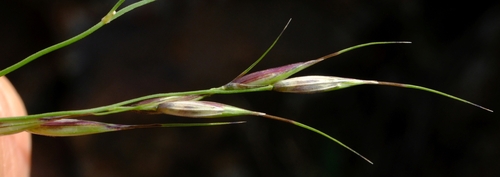
An annual grass. It lies along the ground. It can grow 15-30 cm high. The stems are slender. These taper towards the tip. The leaf sheath is smooth, loose and keeled. The ligule is thin and hairy of the edges. The flowering stalk has 6 finger-like spikes. These are 1-2 cm long and clustered in a head.
Edible Uses
The seeds can be eaten raw or cooked.
Medicinal Uses
No medicinal uses are known for this plant.
Distribution
A tropical plant. It grows on flat country in the Kimberleys. It can grow on salty, limestone or alluvial soils. It grows in tropical places but also in temperate places. It can grow in arid places.
Where It Grows
Australia*,
Propagation
Propagate by seed.
Other Uses
No other uses are known for this plant.
Notes
There are 13 Dactyloctenium species.
References (13)
- Bindon, P., 1996, Useful Bush Plants. Western Australian Museum. p 98
- Cancilla, D., 2018, Ethnobotanical and Ethnozoological Values Desktop Assessment - Eliwana Project. p 11
- Cherikoff V. & Isaacs, J., The Bush Food Handbook. How to gather, grow, process and cook Australian Wild Foods. Ti Tree Press, Australia p 189, 194
- Ess. Agrostogr. 72, 160. 1812
- Hall, N. et al, 1972, The Use of Trees and Shrubs in the Dry Country of Australia, AGPS, Canberra. p 173
Show all 13 references Hide references
- Hunter, J.T., 2017, Is there a relationship between contemporary high Aboriginal plant resource locations and mapped vegetation communities? Cunninghamia 17:27-34. The Royal Botanic Garden Sydney. ISSN 2200 - 405X
- Kenneally, K.E., Edinger, D. C., and Willing T., 1996, Broome and Beyond, Plants and People of the Dampier Peninsula, Kimberley, Western Australia. Department of Conservation and Land Management. p 219
- Latz, P.K., 1996, Bushfires and Bushtucker: Aboriginal plant use in Central Australia. IAD Press Alice Springs p 160
- Lazarides, M. & Hince, B., 1993, Handbook of Economic Plants of Australia, CSIRO. p 76
- Morley, B.D., & Toelken, H.R., (Eds), 1983, Flowering Plants in Australia. Rigby. p 391
- Paczkowska, G. & Chapman, A.R., 2000, The Western Australian Flora. A Descriptive Catalogue. Western Australian Herbarium. p 100
- Petheram, R.J. and Kok, B., 2003, Plants of the Kimberley Region of Western Australia. UWA Press p 109
- Wheeler, J.R.(ed.), 1992, Flora of the Kimberley Region. CALM, Western Australian Herbarium, p 1144