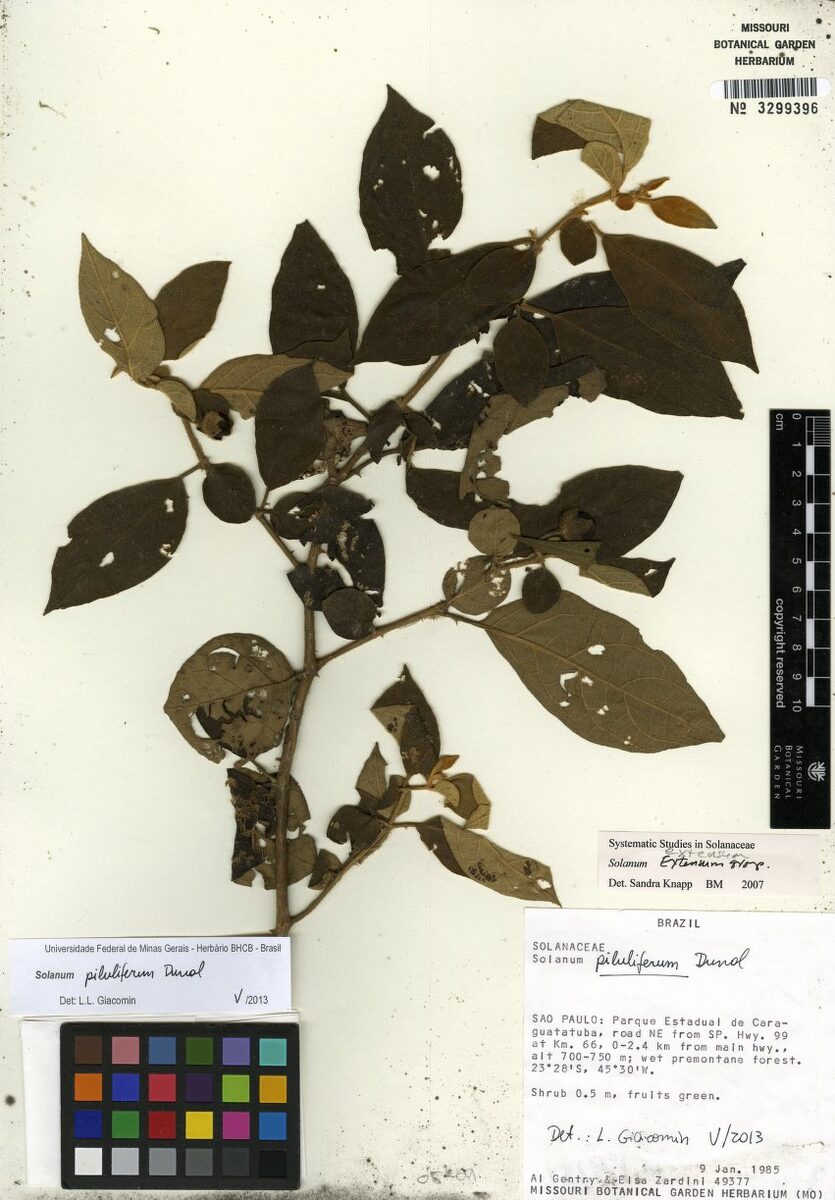
Cyphomandra betacea
(Cavanilles) Sendtner
Tree tomato, Tamarillo
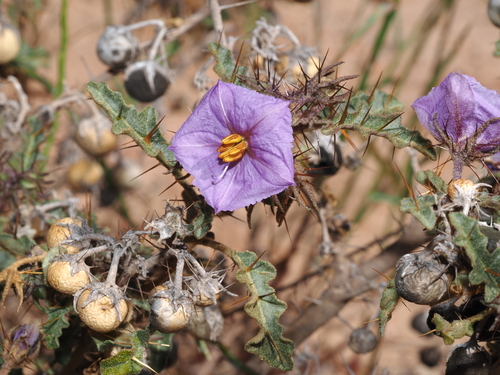
iNaturalist· cc-by-nc
(c) Aurelio Molina Hernández., some rights reserved (CC BY-NC)
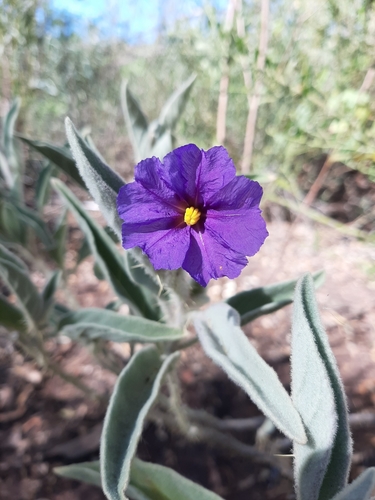
iNaturalist· cc-by
(c) Abril Bastons, some rights reserved (CC BY)
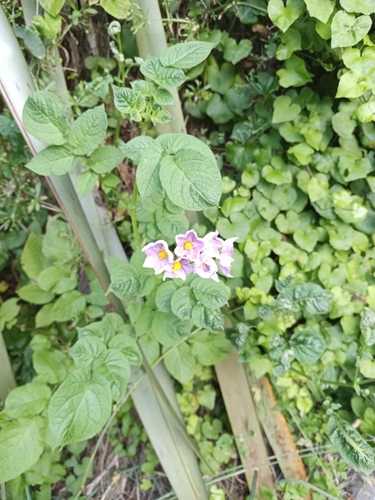
iNaturalist· cc-by
(c) Abril Bastons, some rights reserved (CC BY)
Summary
An evergreen frost-tender tree growing to 5 m tall by 4 m wide at a fast rate, with year-round foliage. Hardy to UK zone 9. Hermaphroditic flowers are insect-pollinated and self-fertile. Requires full sun and well-drained soil across light sandy, medium loamy, and heavy clay types, with pH tolerance from mildly acidic to mildly alkaline. Prefers consistently moist soil.
Description
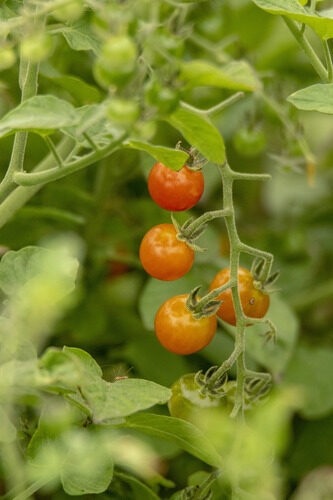
This is a small fruit tree or shrub in the tomato and tobacco family. It grows as a shrub with soft wood and it grows up to 4 m high. The stem is 5-10 cm across. It is brittle and shallow rooted. The leaves are large (25 cm x 12 cm) and soft. They are heart shaped at the base. The flowers are 1-2 cm across with a sweet smell. They are in loose clusters near the ends of branches. Flowers are normally self pollinating but need wind. The fruit is about 6-12 cm long, the shape of a hen's egg and red or orange in colour. They hang off the ends of the branches. The skin of the fruit is somewhat tough but the flesh around the seeds is soft and juicy. The flesh varies between yellow and dark purple. The flesh is edible. The seeds are black, thin and nearly flat. They are edible. There are several named cultivated varieties.
Edible Uses
The fruit can be eaten raw or cooked. Flavour varies considerably from tree to tree; the best forms are juicy and sub-acid and can be eaten out of hand, added to salads, or used in preserves, jams, and jellies. The fruit contains approximately 150 IU of vitamin A per 100 g and 25 mg of vitamin C, is rich in vitamin E and iron, and is low in carbohydrate. Individual fruits measure 4–10 cm long and 3–5 cm wide.
Traditional Uses
The content of the berries is eaten. It can be eaten raw or cooked. The layer just under the skin can be bitter while the layer around the seeds is sweet. The seeds can be eaten, or strained out. The outside skin is easily removed by immersing fruit in boiling water for one or two minutes. Sometimes the fruit is boiled to make a drink. The fruit can be stewed, grilled, baked, pickled, or used in jams, jellies, chutneys, conserves, pickles, pies, preserves and sauces.
Medicinal Uses
None known.
Distribution
Tree tomatoes are subtropical and the normal range is 750 m to 2200 m altitude in the equatorial tropics but can be up to 3000 m in continental tropical regions. They suit the tropical highlands. In Nepal it grows between 1000-1400 m altitude. It is slightly more hardy to cold temperatures than the tomato. They do best where average temperatures are about 15°-21°C. Plants don't fruit at low altitudes in the tropics. Plants do best where temperatures are above 10°C. Trees cannot stand much frost although mature trees will survive light frosts over short periods. They can't stand water-logging or drought. Trees can grow under shade but do better in the sun unless it is too hot and dry. Deep, fertile, permeable soil is best. The trees can be grown in shade as well as in full sunlight. They need garden sites that are clean of disease and fertile. Plants don't fruit at low altitudes in the tropics due to constant high temperatures. They are susceptible to frost damage. The brittle branches make them easily damaged by wind and therefore needing sheltered sites. They need shelter from strong wind. It suits hardiness zones 9-11.
Where It Grows
Africa, Andes, Antigua & Barbuda, Argentina, Asia, Australia, Bahamas, Bolivia, Brazil, Britain, Cameroon, Central Africa, Central America, Chile, China, Colombia, Congo DR, Costa Rica, Cuba, Dominica, Dominican Republic, East Africa, Ecuador, Egypt, Ethiopia, Europe, France, Germany, Ghana, Grenada, Guadeloupe, Guatemala, Haiti, Himalayas, Honduras, Hong Kong, India, Indochina, Indonesia, Jamaica, Japan, Kenya, Malawi, Malaysia, Martinique, Mediterranean, Mexico, Montserrat, Nepal, Netherlands Antilles, New Zealand, Nicaragua, Niue, North America, Northeastern India, Pacific, Panama, Papua New Guinea, PNG, Peru, Philippines, Portugal, Puerto Rico, Sao Tome and Principe, SE Asia, Sikkim, Slovenia, South Africa, Southern Africa, South America, Spain, Sri Lanka, St Kitts & Nevis, St Lucia, St Vincent & Grenadines, Tanzania, Tasmania, Thailand, Trinidad & Tobago, Uganda, USA, Venezuela, Virgin Islands, West Africa, West Indies, Zimbabwe,
Cultivation
They can be grown from seeds or cuttings. Seeds grow better is they are washed and dried then placed in a freezer for 24 hours before planting out. Seeds produce a high branched erect tree. Cuttings produce a lower bushier plant. Cuttings of 60-90 cm long stalks are suitable. Cuttings should be taken from 1 to 2 year old wood which is 1-2 cm thick. Root cuttings can also be used. It has shallow roots therefore needs careful weeding. A spacing of 3 m apart is sufficient. Because the roots are easily damaged by nematodes, plants grafted or budded onto rootstocks that are resistant to nematode will live longer. The root rot fungus can mean it is difficult to get plants established in old gardens. The root knot nematodes also mean trees can die more quickly than they should, and sometimes this occurs in 3 or 4 years. High humidity can also cause stem rots. Young plants can be pruned to produce lower branches and fruiting. As fruit is produced on new branches, branches which have borne fruit can be pruned out. Flowers are self compatible so that pollination can occur within the one plant by wind.
Propagation
Sow seed in spring in a greenhouse. Germination typically occurs within 4 weeks at 15°C or within 2 weeks at 25°C. Once large enough to handle, prick seedlings into individual pots and grow on in the greenhouse for at least their first winter. Plant out into permanent positions in late spring or early summer, after the last expected frosts. The plant can also be propagated from greenwood cuttings taken in a frame.
Other Uses
None known.
Production
It commences bearing in its second year, when grown from seed. Fruit production is continuous throughout the year. Trees can bear hundreds of fruit year round. The tree is short lived lasting 5 or 6 years. Yields of 20 kg per plant are possible. Fruit are ready to harvest when the red or yellow colour develops. Fruit can be stored in a refrigerator for 10 weeks provided they are not frozen (3°C). To remove the skin, pouring boiling water over the fruit and letting it stand for 4 minutes make this easy.
Other Information
It is a commercially cultivated vegetable. In Papua New Guinea it is quite often seen in the highlands and appears to be increasing in importance.
Notes
There are about 30 Cyphomandra species. They are high in antioxidant activity. Fruit are reasonably high in folates 16μg/100.
Nutrition
| Part | Moisture | kJ | kcal | Protein | Vit A | Vit C | Iron | Zinc |
|---|---|---|---|---|---|---|---|---|
| Fruit | 86.2 | 113 | 27 | 2 | 500 | 28 | 0.7 | — |
Synonyms
Also Known As
Baumtomate, Berenjena, Drevesasti paradižnik, Lipiline, Marathakkali, Ngogwe, Panthao gidibao, Pebang tigi chi, Rooka rambeda, Rukh tamatar, Sachatomate, Shu fan qie, Thei manta, Tomate de arbol
References (86)
- Tree tomato references Cyphomandra betacea
- Ajesh, T. P., et al, 2012, Ethnobotanical Documentation of Wild Edible Fruits used by Muthuvan Tribes of Idukki, Kerala-India. International Journal of Pharma and Bio Sciences 3(3): 479-487
- Ambasta, S.P. (Ed.), 2000, The Useful Plants of India. CSIR India. p 159
- Arora, R. K., 2014, Diversity in Underutilized Plant Species - An Asia-Pacific Perspective. Bioversity International. p 65
- Barcelo, R., 2015, Phytochemical Screening and Antioxidant Activity of Edible Wild Fruits in Benguet, Cordillera Administrative Region, Philippines. Electronic Journal of Biology, 2015, Vol.11(3): 80-89 (As Solanum)
Show all 86 references Hide references
- Bohs, L., Ethnobotany of the Genus Cyphomandra (Solanaceae). Economic Botany 43(2), 1989, p143-163.
- Bodkin, F., 1991, Encyclopedia Botanica. Cornstalk publishing, p 316
- Bohs, L., 1989, Ethnobotany of the Genus Cyphomandra (Solanaceae). Economic Botany 43(2) pp. 143-163
- Bohs, L. 2007. Phylogeny of the Cyphomandra clade of the genus Solanum (Solanaceae) based on ITS sequence data. Taxon 56:1012–1026
- Brickell, C. (Ed.), 1999, The Royal Horticultural Society A-Z Encyclopedia of Garden Plants. Convent Garden Books. p 332
- Burkill, H. M., 1985, The useful plants of west tropical Africa, Vol. 5. Kew.
- Burkill, I.H., 1935, A Dictionary of the Economic Products of the Malay Peninsula. p 747
- Castillo, R. O., 1995, Plant Genetic Resources in the Andes: Impact, Conservation, and Management. Crop Science 35:355-360
- Cheifetz, A., (ed), 1999, 500 popular vegetables, herbs, fruits and nuts for Australian Gardeners. Random House p 188
- Chin, H.F., & Yong, H.S., 1996, Malaysian Fruits in Colour. Tropical press, Kuala Lumpur p 96
- Chua-Barcelo, R. T., 2014, Ethnobotanical survey of edible wild fruits in Benguet, Cordillera administrative region, the Philippines. Asian Pac. J. Trop. Biomed. 4(Suppl. 1):S525-S538 (As Solanum betacea)
- Cruz, I. M., et al, 2015, Edible fruits and seeds in the State of Mexico. Revista Mexicana de Ciencias Agricolas. Vol. 6. Num. 2 pp 331-346
- Cundall, P., (ed.), 2004, Gardening Australia: flora: the gardener's bible. ABC Books. p 1346 (As Solanum betaceum)
- Darley, J.J., 1993, Know and Enjoy Tropical Fruit. P & S Publishers. p 122
- Dawes, S.N., and M.E., Callaghan, 1970, Composition of New Zealand fruit. 1. Tamarillo (Cyphomandra betacea ). New Zealand J. Sci. (Wellington) 13:447-451.
- Duarte, M. C., et al, 2022, Diversity of Useful Plants in Cabo Verde Islands: A Biogeographic and Conservation Perspective. Plants 2022, 11, 1313 p 16 (As Solanum)
- Etherington, K., & Imwold, D., (Eds), 2001, Botanica's Trees & Shrubs. The illustrated A-Z of over 8500 trees and shrubs. Random House, Australia. p 248
- Facciola, S., 1998, Cornucopia 2: a Source Book of Edible Plants. Kampong Publications, p 233 (Also as Cyphomandra crassifolia)
- Fletcher, W.A., 1979, Growing tamarillos. New Zealand Ministry of Agric., Stock & Fish. Bull. 307: 1-27.
- Flora 28:172. 1845
- Flowerdew, B., 2000, Complete Fruit Book. Kyle Cathie Ltd., London. p 151
- Foo, J.T.S.(ed), 1996, A Guide to Common Vegetables. Singapore Science Foundation. p 133
- Fouqué, A., 1972, Espèces fruitières d'Amérique tropicale. Institut français de recherches fruitierès outre-mer (As Solanum betaceum)
- French, B.R., 1986, Food Plants of Papua New Guinea, A Compendium. Asia Pacific Science Foundation p 236
- Ghorbani, A., et al, 2012, A comparison of the wild food plant use knowledge of ethnic minorities in Naban River Watershed Nature Reserve, Yunnan, SW China. Journal of Ethnobiology and Ethnomedicine; 8:17
- Gouldstone, S., 1983, Growing your own Food-bearing Plants in Australia. Macmillan p 131
- Grubben, G. J. H. and Denton, O. A. (eds), 2004, Plant Resources of Tropical Africa 2. Vegetables. PROTA, Wageningen, Netherlands. p 561
- Harkonen, M. & Vainio-Mattila, K., 1998, Some examples of Natural Products in the Eastern Arc Mountains. Journal of East African Natural History 87:265-278
- Hearne, D.A., & Rance, S.J., 1975, Trees for Darwin and Northern Australia. AGPS, Canberra p 50
- Heiser, Charles B. Jr. The Fascinating World of the Nightshades. Dover Publications, 1987. Republication of 1969 edition. pp. 111-115.
- Hermandez Bermejo, J.E., and Leon, J. (Eds.), 1994, Neglected Crops. 1492 from a different perspective. FAO Plant Production and Protection Series No 26. FAO, Rome. p17, 185
- Hibbert, M., 2002, The Aussie Plant Finder 2002, Florilegium. p 80
- Hu, Shiu-ying, 2005, Food Plants of China. The Chinese University Press. p 660
- Jardin, C., 1970, List of Foods Used In Africa, FAO Nutrition Information Document Series No 2.p 131
- John, L., & Stevenson, V., 1979, The Complete Book of Fruit. Angus & Robertson p 276
- Katende, A.B., Birnie, A & Tengnas B., 1995, Useful Trees and Shrubs for Uganda. Identification, Propagation and Management for Agricultural and Pastoral Communities. Technical handbook No 10. Regional Soil Conservation Unit, Nairobi, Kenya. p 220
- Kapelle, M., et al, 2000, Useful plants within a Campesino Community in a Costa Rican Montane Cloud Forest. Mountain Research and Development, 20(2): 162-171
- Kays, S. J., and Dias, J. C. S., 1995, Common Names of Commercially Cultivated Vegetables of the World in 15 languages. Economic Botany, Vol. 49, No. 2, pp. 115-152
- Kiple, K.F. & Ornelas, K.C., (eds), 2000, The Cambridge World History of Food. CUP p 1865
- Lazarides, M. & Hince, B., 1993, Handbook of Economic Plants of Australia, CSIRO. p 75
- Lembaga Biologi Nasional, 1977, Buah-Buahan, Balai Pustaka, Jakarta. p 126
- Lord, E.E., & Willis, J.H., 1999, Shrubs and Trees for Australian gardens. Lothian. p 53
- Lorenzi, H., Bacher, L., Lacerda, M. & Sartori, S., 2006, Brazilian Fruits & Cultivated Exotics. Sao Paulo, Instituto Plantarum de Estuados da Flora Ltda. p 623
- Macmillan, H.F. (Revised Barlow, H.S., et al) 1991, Tropical Planting and Gardening. Sixth edition. Malayan Nature Society. Kuala Lumpur. p 314
- Manandhar, N.P., 2002, Plants and People of Nepal. Timber Press. Portland, Oregon. p 186
- Martin, F. W., et al, 1987, Perennial Edible Fruits of the Tropics. USDA Handbook 642 p 62
- Mbuya, L.P., Msanga, H.P., Ruffo, C.K., Birnie, A & Tengnas, B., 1994, Useful Trees and Shrubs for Tanzania. Regional Soil Conservation Unit. Technical Handbook No 6. p 222
- Medhi, P. & Borthakur, S. K., 2013, Wild edible plants sold by the Zeme Nagas at the makeshift market of Mahur, Dima Hasao district of Assam. Pleione 7(1): 84 - 93. 2013
- Medhi, P., Sarma, A and Borthakur, S. K., 2014, Wild edible plants from the Dima Hasao district of Assam, India. Pleione 8(1): 133-148
- Miguel, E., et al, 1989, A checklist of the cultivated plants of Cuba. Kulturpflanze 37. 1989, 211-357
- Molla, A., Ethiopian Plant Names. http://www.ethiopic.com/aplants.htm
- Morton, J.F., 1982, The tree tomato, or tamarillo”, a fast growing, early fruiting small tree for subtropical environments. Prac. Florida State Hort. Soc. 95:81-85.
- Morton, Julia F. Fruits of Warm Climates. Creative Resources Systems, Inc. 1987. pp. 437-440.
- Musinguzi, E., et al, 2006, Utilization of Indigenous Food Plants in Uganda: A Case Study of South-Western Uganda. AJFAND Vol. 6(2):
- Fisch, M.B., 1974, The Tree tomato. Pages 269-309. in Calif. Rare fruit Grower’s Yearbook. 1974.
- Ochse, J.J., Dijkman, M.J.,Soule, M.J. & Wehlburg,C., 1961, Tropical and Subtropical Agriculture.
- Palgrave, K.C., 1996, Trees of Southern Africa. Struik Publishers. p 822
- Perry, F., and Hay, R., 1982, Guide to Tropical and Subtropical Plants. Sun Books p 54
- Plants for a Future database, The Field, Penpol, Lostwithiel, Cornwall, PL22 0NG, UK. http://www.scs.leeds.ac.uk/pfaf/
- Plowes, N. J. & Taylor, F. W., 1997, The Processing of Indigenous Fruits and other Wildfoods of Southern Africa. in Smartt, L. & Haq. (Eds) Domestication, Production and Utilization of New Crops. ICUC p 189
- Popenoe,
- Purseglove, J.W., 1968, Tropical Crops Dicotyledons, Longmans. p 523
- Recher, P, 2001, Fruit Spirit Botanical Gardens Plant Index. www.nrg.com.au/~recher/ seedlist.html p 2
- Schneider, E., 2001, Vegetables from Amaranth to Zucchini: The essential reference. HarperCollins. p 651
- Self, M., 199, Phoenix Seeds catalogue. p 17
- Singh, K.K., Singh, M. & Joshi, S. C., 2014, Phenolic content and Antioxidant Activity of some Underutilized Wild Edible Fruits of the Sikkim Himalaya. SMU Medical Journal. Vol. 1, No. 2 July 2014
- Smith, K., 1998. Growing Uncommon Fruits and Vegetables. New Holland. p 42
- Smith, P.M., 1979, Tree tomato, in Simmonds, N.W., (ed), Crop Plant Evolution. Longmans. London. p 321
- Striegel, L., et al, 2019, Promising Tropical Fruits High in Folates. Foods 2019, 8, 363; doi:10.3390/foods8090363. www.mdpi.com/journal/foods
- Strangeland, T et al, 2009, Total antioxidant activity in 35 Ugandan fruits and vegetables. Food Chemistry 113: 85-91
- Tapia, M. E., The role of under-utilised plant species with regard to increased food security and improved health of poor poeople, in mountain regions. IIAP-PNUD/Peru
- Terashima, H., et al, 1992, Ethnobotany of the Lega in the Tropical Rainforest of Eastern Zaire (Congo): Part Two, Zone de Walikale, African Study Monographs, Suppl. 19:1-60
- Terra, G.J.A., 1973, Tropical Vegetables. Communication 54e Royal Tropical Institute, Amsterdam, p 44
- TodaFruta.com.br
- USDA, ARS, National Genetic Resources Program. Germplasm Resources Information Network - (GRIN). [Online Database] National Germplasm Resources Laboratory, Beltsville, Maryland. Available: www.ars-grin.gov/cgi-bin/npgs/html/econ.pl (10 April 2000)
- van Wyk, B., 2005, Food Plants of the World. An illustrated guide. Timber press. p 172
- Vasquez, Roberto Ch. & Coimbra, German S., 1996, Frutas Silvestres Comestibles de Santa Cruz. p 226
- Williamson, J., 2005, Useful Plants of Malawi. 3rd. Edition. Mdadzi Book Trust. p 93
- Wiriadinata, H., 1995, Ethnobotany of Economic Plants in the Baliem Valley, Jayawijaya, Irian Jaya, Indonesian Institute of Science, Bogor, Indonesia
- www.worldagroforestrycentre.org/treedb/
- Young, J., (Ed.), 2001, Botanica's Pocket Trees and Shrubs. Random House. p 303