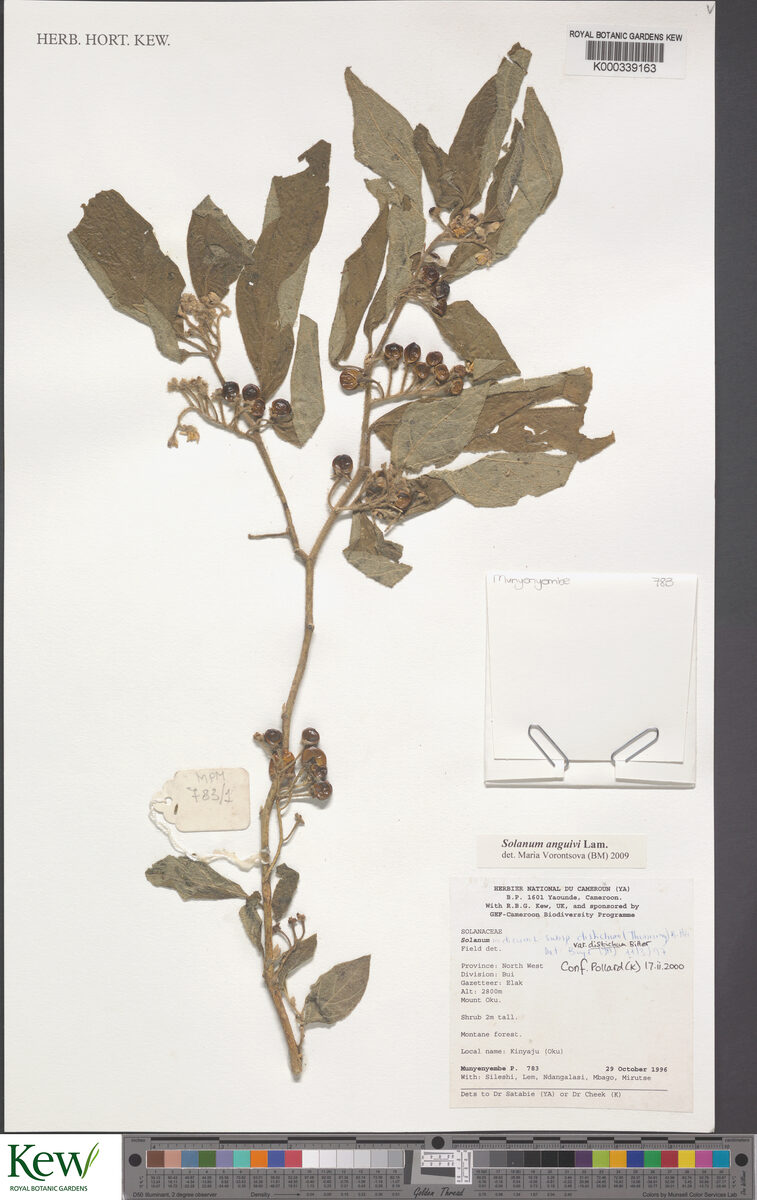
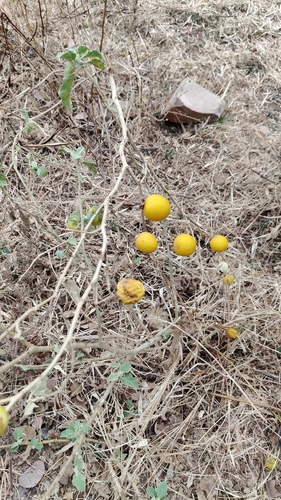
Solanum vescum
F. Muell.
Kangaroo apple, Gunyang, Green tomato, Green kangaroo apple
iNaturalist· cc-by-nc
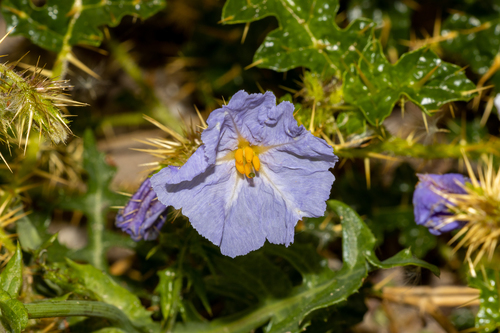
(c) camidge, some rights reserved (CC BY-NC)
iNaturalist· cc-by-nc
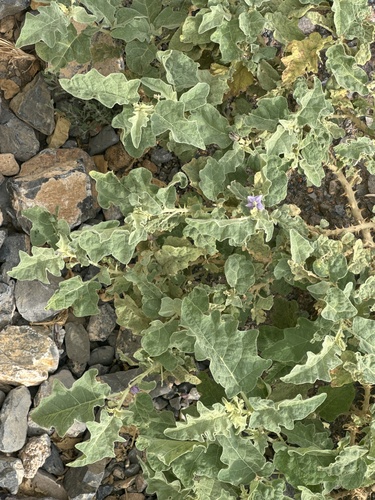
(c) Jenny Lawrence, some rights reserved (CC BY-NC), uploaded by Jenny Lawrence
iNaturalist· cc0
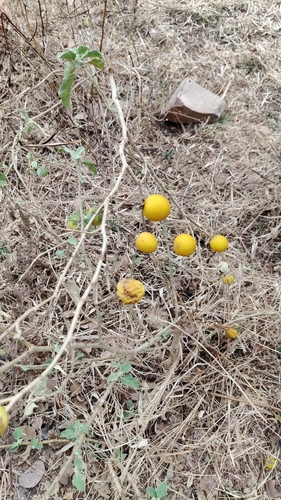
no rights reserved, uploaded by Cowirrie
Summary
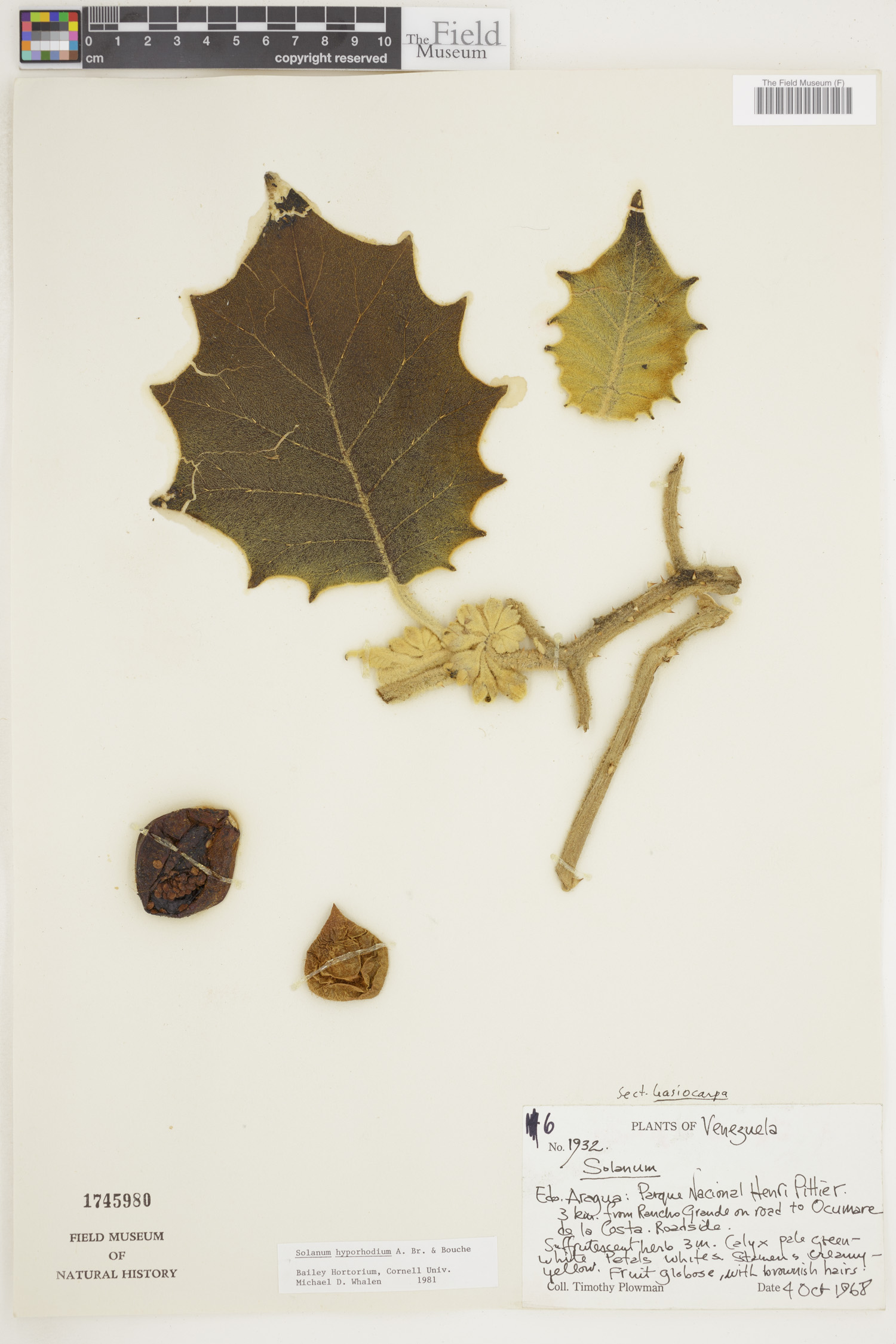
Source: WikipediaSolanum vescum, commonly known as green kangaroo apple or gunyang, is a small fruiting shrub in the family Solanaceae, native to eastern and southeastern Australia. Solanum vescum was first described by Victorian government botanist, Ferdinand von Mueller, in 1855 after being collected near the mouth of the Snowy River. The specific epithet is the neuter of the Latin adjective vescus, meaning "edible". Solanum vescum is a soft green shrub which grows to 1 or 2 m (3.3 or 6.6 ft) high. It lacks the spines of many other species of Solanum. Its juvenile leaves are ovate with three or four deep lobes, and measure 15 to 30 cm (5.9 to 11.8 in) long and 11–24 cm (4.3–9.4 in) wide. The adult leaves are narrowly lanceolate and either lack lobes (unusually for a Solanum) or have 2 to 4 on each side. The small purple flowers occur in winter and spring, and are followed by yellowish- or ivory-green 2–2.5 cm (0.79–0.98 in) diameter globular fruit, often streaked, which occur in bunches of 5 to 20. The range is from southeastern Queensland through eastern and central New South Wales (with Moree and Narrabri as western limits) and Victoria and into Tasmania. Solanum vescum is an understory shrub in a range of forest habitats including rainforest and wet and dry sclerophyll (Eucalyptus) forest. Solanum vescum was eaten by the Gunai people of Gippsland. It grew from seed prolifically after bushfire, and the local indigenous people would practice controlled burns to induce it to grow and bear fruit.
Description
An erect shrub. It is soft wooded and has hollow stems. It grows 1-3 m tall. It spreads 1-2 m wide. The leaves are deep green. They are 15 cm long and 10 mm wide. The edges of the leaves roll under. The leaves are not divided but can have narrow lobes. The flowers are blue and 2-3 cm across. The fruit are round. The fruit is green when ripe.
Edible Uses
The fruit can be eaten raw or cooked but must be fully ripe. It tastes much worse than it looks — sickly sweet and often bitter — and quality varies from plant to plant and even year to year on the same plant. The fruit is up to 2cm long and contains a large number of flat seeds.
Medicinal Uses
The plant is a source of solasonine, used in the manufacture of steroidal drugs and contraceptives, probably obtained from the unripe fruit.
Known Hazards
Although no specific mention of toxicity has been seen for this species, it belongs to a genus where many if not all the members have poisonous leaves and sometimes also the unripe fruits.
Distribution
It is a warm temperate plant. It suits hardiness zones 9-11. Tasmania Herbarium.
Where It Grows
Australia*, Tasmania,
Cultivation
We have very little information on this species and do not know if it will succeed in Britain, though judging by its native range it is unlikely to succeed outdoors except in the very mildest parts of the country. Plants tolerate temperatures down to at least -7°c in Australian gardens, but this cannot be translated directly to British gardens due to our cooler summers and longer, colder and wetter winters. It is quite possible that this species can be grown at the foot of a warm sunny wall and be treated as a herbaceous perennial. As long as the roots are given a good mulch in autumn they should survive quite cold winters. The following notes are based on the general needs of the genus. Succeeds in most soils in a sunny position.
Propagation
Sow seed in spring in a warm greenhouse; germination takes 2–3 weeks at 20°c. Prick out seedlings into individual pots when large enough to handle. If growing as annuals, plant out after the last expected frosts with some protection such as a cloche until established. If growing as perennials, especially at the limits of cold-hardiness, keep plants in the greenhouse for their first winter in pots of 12cm or larger, as they have very strong root growth. Top growth may die back over winter but roots should survive if greenhouse temperatures stay above about -5°c. Plant out in early summer of the following year; plants will be somewhat hardier in their second winter. Cuttings of half-ripe wood taken in July/August in a frame root very easily within a couple of weeks. Pot into fairly large pots and overwinter in the greenhouse before planting out in early summer.
Other Uses
Plants can be grown as a screening hedge in climates suitable for them.
Notes
There are about 1400 Solanum species.
References (13)
- Bodkin, F., 1991, Encyclopedia Botanica. Cornstalk publishing, p 936
- Cherikoff V. & Isaacs, J., The Bush Food Handbook. How to gather, grow, process and cook Australian Wild Foods. Ti Tree Press, Australia p 120, 196
- Cribb, A.B. & J.W., 1976, Wild Food in Australia, Fontana. p 75
- Cronin, L., 1989, The Concise Australian Flora. Reed. p 28
- Cundall, P., (ed.), 2004, Gardening Australia: flora: the gardener's bible. ABC Books. p 1349
Show all 13 references Hide references
- Curtis, W.M., 1993, The Student's Flora of Tasmania. Part 3 St David's Park Publishing, Tasmania, p 506
- Harris, S., Buchanan, A., Connolly, A., 2001, One Hundred Islands: The Flora of the Outer Furneaux. Tas Govt. p 231
- Lazarides, M. & Hince, B., 1993, Handbook of Economic Plants of Australia, CSIRO. p 224
- Low, T., 1991, Wild Food Plants of Australia. Australian Nature FieldGuide, Angus & Robertson. p 133
- Plants for a Future database, The Field, Penpol, Lostwithiel, Cornwall, PL22 0NG, UK. http://www.scs.leeds.ac.uk/pfaf/
- Samuels, J., 2015, Biodiversity of Food Species of the Solanaceae Family: A Preliminary Taxonomic Inventory of Subfamily Solanoideae. Resources 2015, 4. 277-322
- Tasmanian Herbarium Vascular Plants list p 56
- Zola, N., & Gott, B., 1992, Koorie Plants Koorie People. Koorie Heritage Trust. p 35