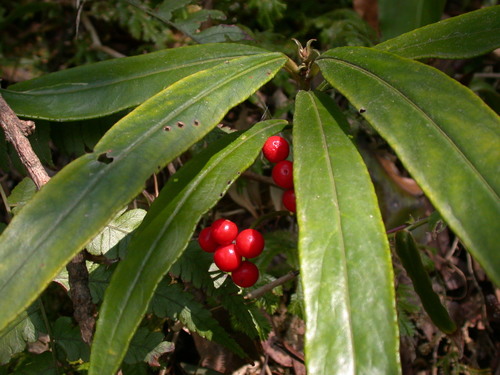
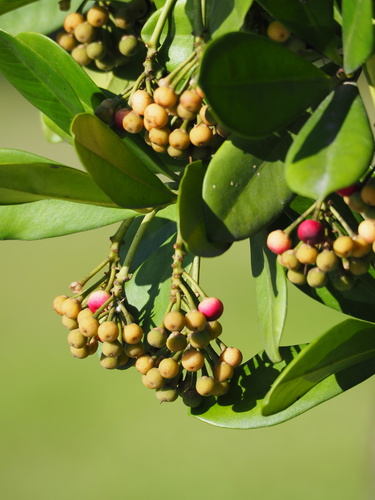
Aegiceras corniculatum
(Stickm.) Blanco
Horned mangrove, River Mangrove
iNaturalist· cc0
no rights reserved, uploaded by 葉子
iNaturalist· cc-by-sa
(c) Gary Williams, some rights reserved (CC BY-SA), uploaded by Gary Williams
iNaturalist· cc-by-sa
(c) Greg Tasney, some rights reserved (CC BY-SA), uploaded by Greg Tasney
Summary
Source: WikipediaAegiceras corniculatum, commonly known as black mangrove, river mangrove, goat's horn mangrove, or khalsi, is a species of shrub or tree mangrove in the primrose family, Primulaceae, with a distribution in coastal and estuarine areas ranging from India through South East Asia to southern China, New Guinea and Australia.
Description
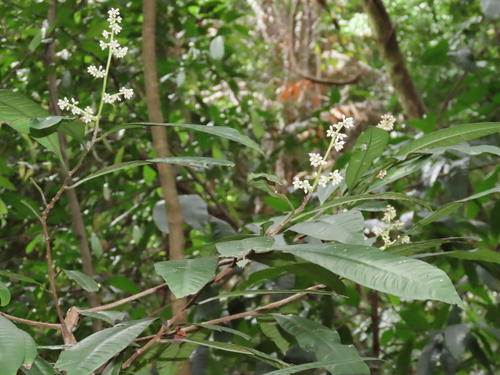
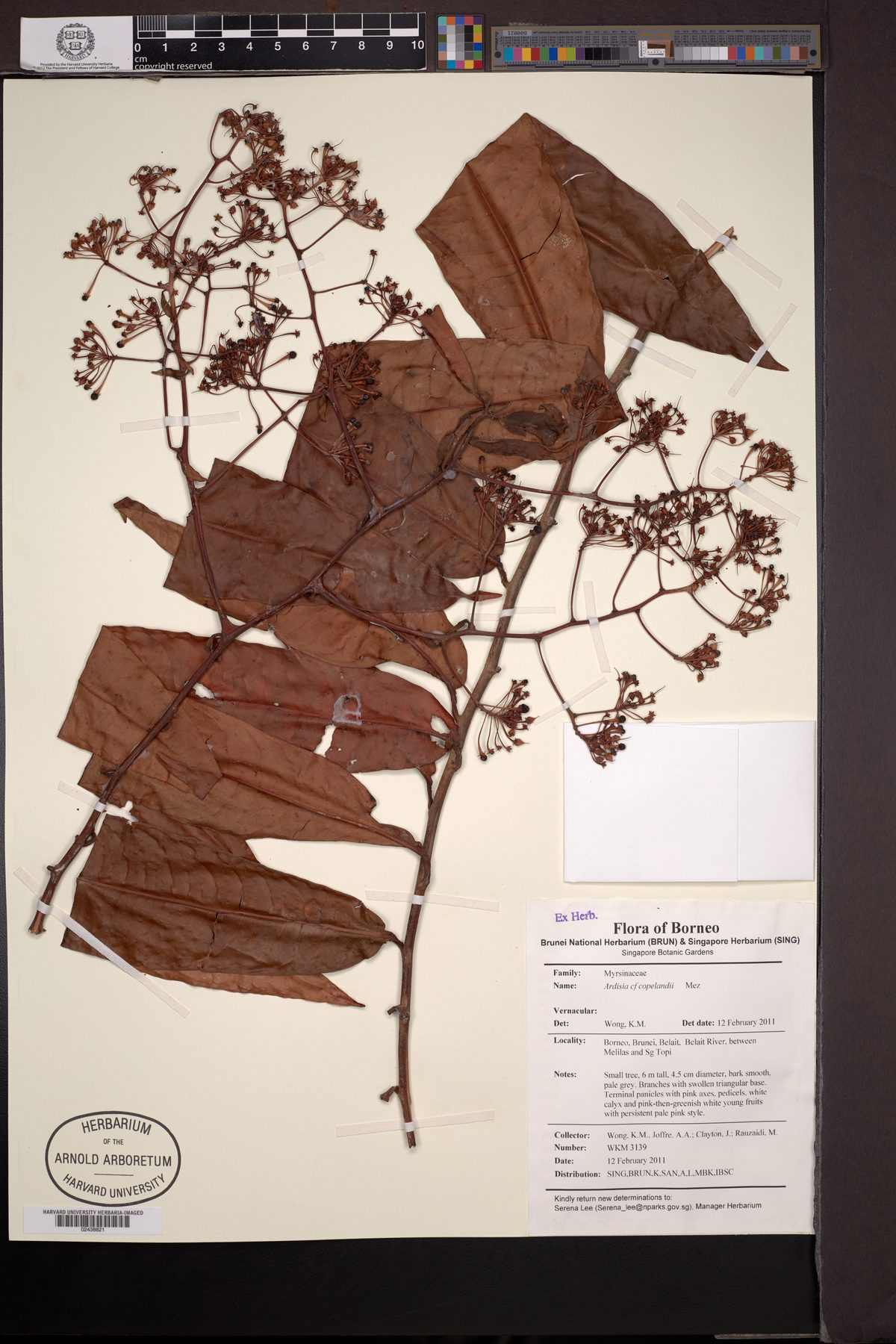
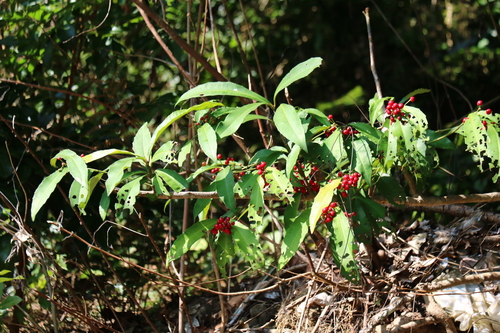
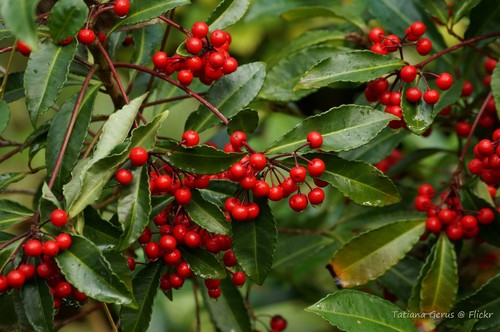
A small tree or shrub. It grows up to 1.5-7 m tall. It often has several stems. The young branches are reddish brown. The bark is smooth and grey to brown. The leaf stalk is 5-10 mm long. The leaves are oval. They are 2.5-8.5 cm long by 0.9-3.6 cm wide. They are leathery. There are 7-11 side veins on each side of the main vein. The midrib is easily seen under the leaf. The flower arrangement is made up of flowers from a common point arranged on stalks of equal length. They arise from a knob like point. The fruit are curved and like a cylinder up to 8 cm long by 5-6 mm across. They taper to a sharp point.
Edible Uses
The leaves are eaten raw or cooked. The fruit are cooked and eaten. Salt is collected from the leaves.
Traditional Uses
The leaves are eaten raw or cooked. The fruit are cooked and eaten. Salt is collected from the leaves.
This uses section is brief — help expand it
Medicinal Uses
Aegiceras corniculatum extract has analgesic properties which supports a fight against diabetes. The stems of the plant contain up to seven compounds, including: 2-methoxy-3-nonylresorcinol, 5-O-ethylembelin, 2-O-acetyl-5-O-methylembelin, 3,7-dihydroxy-2,5-diundecylnaphthoquinone, 2,7-dihydroxy-8-methoxy-3,6-diundecyldibenzofuran-1,4-dione, 2,8-dihydroxy-7-methoxy-3,9-diundecyldibenzofuran-1,4-dione (6), and 10-hydroxy-4-O-methyl-2,11-diundecylgomphilactone.
Known Hazards
The bark contains aegiceras-saponin and is used as a fish poison.
Distribution
A tropical plant. It grows in tropical and warm temperate areas. It occurs along banks of tidal creeks. It is also on the seaward edge of mangroves. It can grow in brackish and salty water. It likes light.
Where It Grows
Andamans, Asia, Australia, Bangladesh, China, East Timor, India, Indochina, Indonesia, Lord Howe Island, Malaysia, Myanmar, Pacific, Papua New Guinea, PNG, Philippines, SE Asia, Sri Lanka, Timor-Leste, Vietnam,
Cultivation
Plants can be grown from seed.
Other Uses
The wood is hard and heavy, ranging in colour from reddish-brown to almost black. It is used for knife handles. The wood is used for fuel.
Other Information
It is not known if it is used for food in Papua New Guinea.
Notes
There are 2 Aegiceras species. Also put in the family Myrsinaceae. Myrsinaceae are mainly in the tropics.
Nutrition
| Part | Moisture | kJ | kcal | Protein | Vit A | Vit C | Iron | Zinc |
|---|---|---|---|---|---|---|---|---|
| Leaves | — | — | — | — | — | — | — | — |
| Fruit | 42.5 | — | — | 8.3 | — | 87.7 | 8.5 | — |
Synonyms
Also Known As
Cat, Dudumara, Halsi, Kanjala, Khalshi, La zhu guo, Narikandam, Su, Teruntum, Tra, Truntung
References (36)
- Altschul, S.V.R., 1973, Drugs and Foods from Little-known Plants. Notes in Harvard University Herbaria. Harvard Univ. Press. Massachusetts. no. 3208
- Ambasta S.P. (Ed.), 2000, The Useful Plants of India. CSIR India. p 16
- Beasley, J., 2011, Plants of Tropical North Queensland - the compact guide. Footloose publications. p 16
- Bodkin, F., 1991, Encyclopedia Botanica. Cornstalk publishing, p 51
- Borrell, O.W., 1989, An Annotated Checklist of the Flora of Kairiru Island, New Guinea. Marcellin College, Victoria Australia. p 112
Show all 36 references Hide references
- Burkill, I.H., 1966, A Dictionary of the Economic Products of the Malay Peninsula. Ministry of Agriculture and Cooperatives, Kuala Lumpur, Malaysia. Vol 1 (A-H) p 54
- Cooper, W. and Cooper, W., 2004, Fruits of the Australian Tropical Rainforest. Nokomis Editions, Victoria, Australia. p 334
- Cowie, I, 2006, A Survey of Flora and vegetation of the proposed Jaco-Tutuala-Lore National Park. Timor-Lests (East Timor) www.territorystories.nt/gov.au p 51
- Cribb, A.B. & J.W., 1976, Wild Food in Australia, Fontana. p 188
- Cronin, L., 1989, The Concise Australian Flora. Reed. p 149
- Chen Jie, Pipoly 3, J.J., Myrsinaceae. Flora of China.
- Elliot, W.R., & Jones, D.L., 1982, Encyclopedia of Australian Plants suitable for cultivation. Vol 2. Lothian. p 161
- Fl. Filip. 78. 1837
- Flora of Australia Volume 49, Oceanic Islands 1, Australian Government Publishing Service, Canberra. (1994) p 150
- Flora of Pakistan. www.eFloras.org (As corniculatus)
- Floyd, A.G., 1977, Ecology of the Tidal Forests in the Kikori-Romilly Sound Area Gulf of Papua. Ecology Report No 4 Division of Botany, Lae, Papua New Guinea. p 24
- Frodin, D.G. & Leach, G.L., 1982, Mangroves of the Port Moresby Region. Biology Department Occasional Paper No 3 Revised edition. Papua New Guinea, p 14
- Haslam, S., 2004, Noosa's Native Plants. Noosa Integrated Catchment Assn. Inc. p 124
- Hosen, M. Z., et al, 2020, Comparison or Physicochemical and Antioxidant Properties of Edible Fruits in the Sundarbans' Mangrove Forest, Bangladesh. Bangladesh J. Bot. 49 (3): 671-678
- Jackes, B. R., 2010, Plants of Magnetic Island. 3rd Edition. James Cook University, Australia. p 23
- Kenneally, K.E., Edinger, D. C., and Willing T., 1996, Broome and Beyond, Plants and People of the Dampier Peninsula, Kimberley, Western Australia. Department of Conservation and Land Management. p 140
- Lazarides, M. & Hince, B., 1993, Handbook of Economic Plants of Australia, CSIRO. p 9
- Lovelock, C., & Clarke, S., 1999, Field Guide to the Mangroves of Queensland. Australian Institute of Marine Science. p 32
- Martin, F.W. & Ruberte, R.M., 1979, Edible Leaves of the Tropics. Antillian College Press, Mayaguez, Puerto Rico. p 206
- Melzer, R. & Plumb, J., 2011, Plants of Capricornia. Belgamba, Rockhampton. p 216
- Morley, B.D., & Toelken, H.R., (Eds), 1983, Flowering Plants in Australia. Rigby. p 118
- Paczkowska, G . & Chapman, A.R., 2000, The Western Australian Flora. A Descriptive Catalogue. Western Australian Herbarium. p 344
- Peekel, P.G., 1984, (Translation E.E.Henty), Flora of the Bismarck Archipelago for Naturalists, Division of Botany, Lae, PNG. p 427, 425
- Pham-Hoang Ho, 1999, An Illustrated Flora of Vietnam. Nha Xuat Ban Tre. p 710
- Reis, S. V. and Lipp, F. L., 1982, New Plant Sources for Drugs and Foods from the New York Botanical Garden herbarium. Harvard. p 230
- Roy, S. D., et al, 2009, Mangroves of Andaman and Nicobar Islands. ICAR p 28
- Sainty, G.R. & Jacobs, S.W.L., 1981, Waterplants of New South Wales. Water Resources Commission. NSW p 287
- Scarth-Johnson, V., 2000, National Treasures. Flowering Plants of Cooktown and Northern Australia. Vera Scarth-Johnson Gallery Association. Cooktown, Australia. p 19
- Siemonsma, J. S. & Kasem Piluek, eds. 1993. Vegetables. In: Plant Resources of South-East Asia (PROSEA) 8:311
- Wheeler, J.R.(ed.), 1992, Flora of the Kimberley Region. CALM, Western Australian Herbarium, p 275
- World Checklist of Useful Plant Species 2020. Royal Botanic Gardens, Kew