Entandrophragma utile
(Dawe & Sprague) Sprague
Sipo mahogany
Wikipedia· cc-by-sa
Wikimedia Commons - Expédition_Sangha_2010_fougères_épiphytes_1.jpg
wikimedia· cc0
Wikimedia Commons - Collector(s): Amarh, Amponsah Identifier: Gabriel Ameka
Summary
Source: WikipediaEntandrophragma utile, called the sipo or utile, is a species of large tree in the genus Entandrophragma, native to nearly all of tropical Africa facing the Atlantic, from Guinea to Angola, and as far east as Uganda. The timber is traded as a tropical hardwood. It is sometimes called sipo mahogany. It shares many of the characteristics of genuine mahogany and is used as an alternative. The timber provides high chatoyancy, with an average value above 21 PZC.
Description
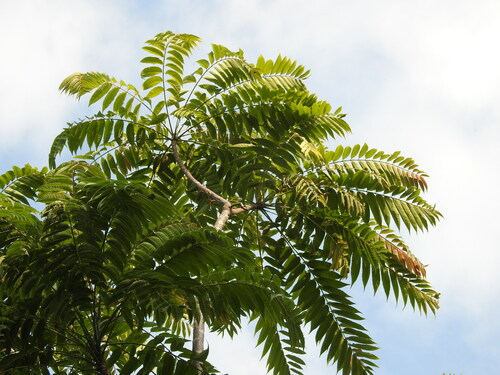
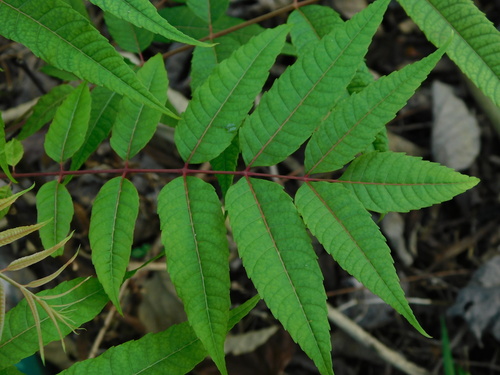
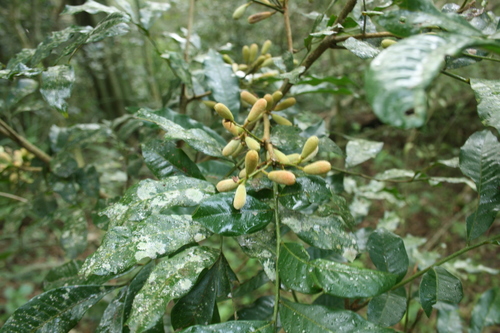
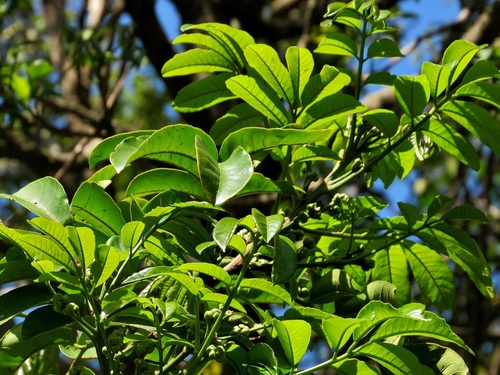
A large tree. It grows 70 m tall. The trunk is long and straight. The bark is grey-brown and have cracks along it. It has buttresses. The leaves are clustered at the ends of branches. The leaves are 50 cm long with 16-32 leaflets that are opposite. The leaflets are 14 cm long by 5 cm wide. The flowering shoots are 20 cm long and the flowers are white. The seeds are 9 cm long and 2 cm wide. They are dark brown.
Edible Uses
None known.
Medicinal Uses
The bark is used in traditional medicine to treat malaria and is claimed to heal peptic ulcers. Bark sap is taken internally or used as a wash for stomach-ache and kidney pain, massaged into affected joints for rheumatism, dropped into the eyes for eye inflammations, and into the ear for otitis. A bark maceration massage is considered a tonic and stimulant. Charred and pulverized bark mixed with salt and palm oil is rubbed into scarifications to treat headache. Research has identified active compounds in the bark including the lactone entandrophragmin, tetranortriterpenoids called utilins, heptanortriterpenoids called entilins, methyl angolensate, and an ergosterol derivative. Aqueous bark extract has shown significant protection against peptic ulcers in research, supporting its traditional use in Nigeria. Bark extracts have shown fungicidal activity against Pyricularia oryzae, and some entilins have shown moderate in-vitro antimalarial activity against chloroquine-resistant strains of Plasmodium falciparum.
Distribution
It is a tropical plant. It grows up to 1,350 m above sea level.
Where It Grows
Africa, Angola, Central Africa, Congo DR, Côte d'Ivoire, Guinea, Guinée, Ivory Coast, Uganda, West Africa,
Cultivation
A tree of low to medium elevations in the moist tropics, where it can be found at elevations up to 1,400 metres. It is found mainly in regions with an annual rainfall in the range 1,400 - 2,500 mm, where there is a dry period of 2 - 4 months and a mean annual temperature of 24 - 26°c. Prefers well-drained localities on deep soils. The species is characterized as a non-pioneer light demander and is generally noted to be more light-demanding and tolerant of dry conditions than other embers of the genus. Natural regeneration is often scarce in the forest, although it has also been reported as abundant. Regeneration in large forest gaps is reportedly poor, but seedlings perform well in small forest gaps. Saplings are more light-demanding than those of other members of the genus. Young seedlings grow slowly; root development takes considerable time. In Ghana, seedlings reached only up to 1 metre tall after 4 years, in silviculturally treated forest up to 1.5 metres. Under nursery conditions, however, seedlings can reach 40 cm tall in 6 months and 75 cm in one year. Fruit production starts when trees have reached bole diameters above 50 cm, and this has implications for forest management; minimum felling diameters should be well above 50 cm to allow natural regeneration. A dioecious species, both male and female forms need to be grown if fruit and seed are required.
Propagation
Pre-soaking seeds in warm water is reported to improve germination. Fresh seeds germinate at about 75%; 3-month-old seeds still achieve about 60%. Seeds are prone to rotting and should barely be covered with soil. Germination begins 13–19 days after sowing. Overhead shade promotes seedling survival, as seedlings are vulnerable to mite and insect attack in full sun and typically die under full light conditions. Seedlings grow well at 10–12% of full sunlight, with an irradiance of 25% of full sunlight recorded as optimal for young seedling growth. When raised in pots, account for the long taproot by cutting roots back several times during the 1–2-year nursery period. Seeds can be stored for about 3 months in sealed containers in a cool place, but must be protected from insect damage — adding ash is one method. Stumps and striplings have been used for propagation, though success rates with stumps were low.
Other Uses
Fruit valves have been used as spoons. Seeds contain 30–54% fat by weight; the fatty acid composition includes about 30% cis-vaccenic acid, a rare oleic acid isomer usable in industrial nylon-11 production, with linolenic acid as the main fatty acid at 46%. The heartwood is reddish brown to purplish brown with moiré shades, clearly demarcated from a 2–6cm band of pinkish white to pale brown sapwood. Grain is slightly interlocked and irregular, texture moderately fine, with a faint cedar-like smell when seasoned. The wood is moderately heavy, soft to moderately hard, and moderately durable with moderate resistance to powder-post beetle, pinhole borer, termite, and marine borer attack. It air-dries somewhat slowly and may split or distort, but is moderately stable once dry. It saws and works fairly easily with hand and machine tools with slight blunting of cutting edges, finishes well with a good polish (filler may be needed), holds nails and screws well, and glues, stains, and polishes satisfactorily, though steam bending properties are poor. The wood is used for exterior and interior joinery, interior trim, panelling, stairs, furniture, cabinet work, shipbuilding, veneer, plywood, construction, flooring, vehicle bodies, boxes, crates, carvings, and turnery. The bole is traditionally used for dug-out canoes. Timber offcuts are used as firewood and for charcoal production.
Notes
The bark is used fro medicine. Edible insects often occur on the plant.
Synonyms
References (1)
- World Checklist of Useful Plant Species 2020. Royal Botanic Gardens, Kew