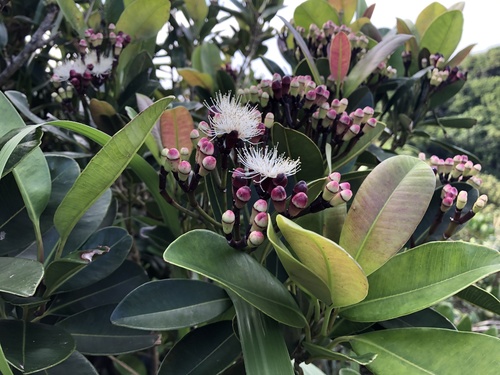
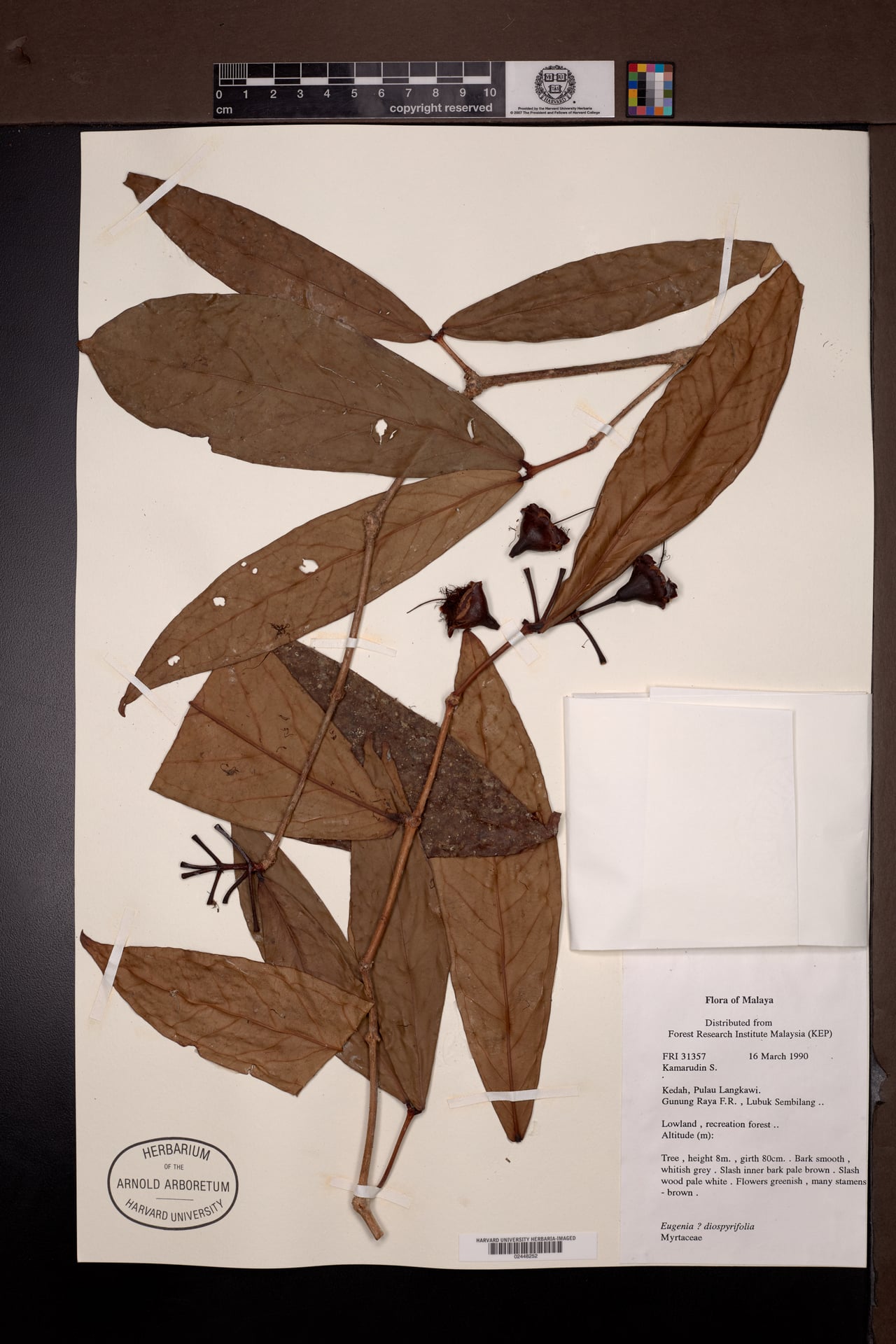
Eucalyptus grandis
W. Hill ex Maiden
Flooded gum
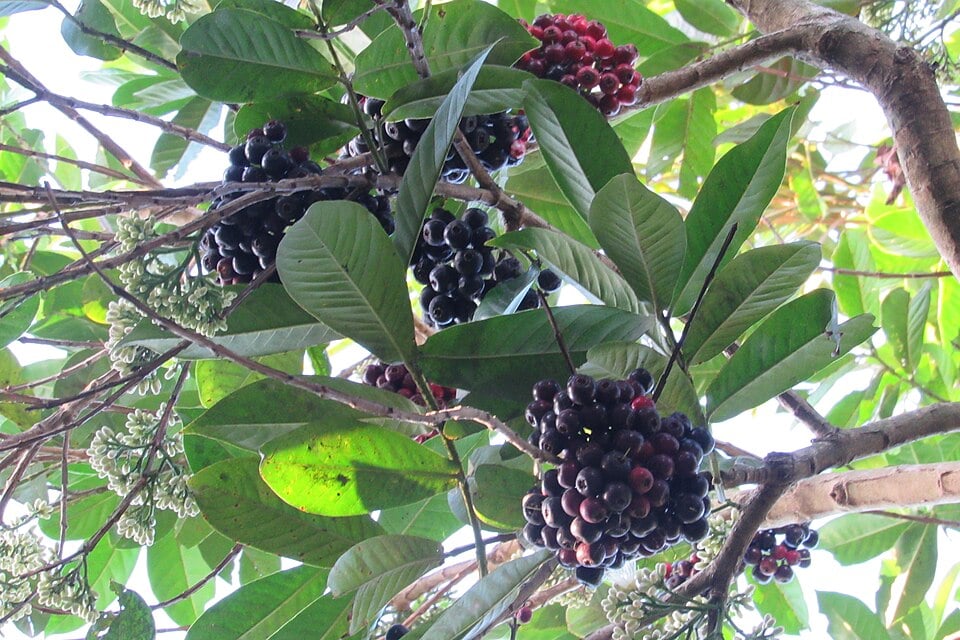
iNaturalist· cc-by-nc
(c) Dean Nicolle, some rights reserved (CC BY-NC), uploaded by Dean Nicolle
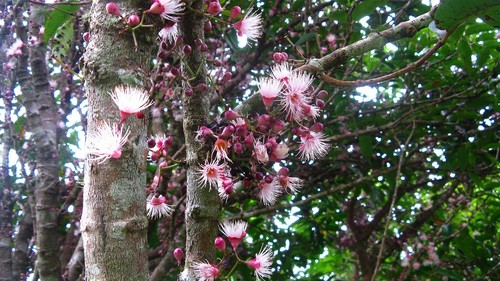
iNaturalist· cc-by-nc
(c) Tina Raveneau, some rights reserved (CC BY-NC)
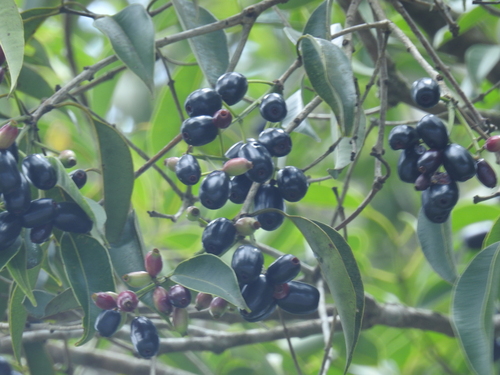
iNaturalist· cc-by-nc
(c) Tina Raveneau, some rights reserved (CC BY-NC)
Summary
Source: WikipediaEucalyptus grandis, commonly known as the flooded gum or rose gum, is a tall tree with smooth bark, rough at the base fibrous or flaky, grey to grey-brown. At maturity, it reaches 50 metres (160 feet) tall, though the largest specimens can exceed 80 metres (260 feet) tall. It is found on coastal areas and sub-coastal ranges from Newcastle in New South Wales northwards to west of Daintree in Queensland, mainly on flat land and lower slopes, where it is the dominant tree of wet forests and on the margins of rainforests.
Description
A tree. It grows 55 m tall. The leaves are sword shaped and 10-16 cm long by 2-3 cm wide. The fruit are 5-8 cm long by 4-7 cm wide.
This description is brief — help expand it
Edible Uses
None known.
Medicinal Uses
A decoction of ground branch tips is taken to treat constipation. Euglobals extracted from the leaves have shown anti-carcinogenic activity and inhibitory effects on Epstein-Barr virus activation.
Known Hazards
Citronellal, an essential oil found in most Eucalyptus species is reported to be mutagenic when used in isolation. In large doses, oil of eucalyptus, like so many essential oils has caused fatalities from intestinal irritation. Death is reported from ingestion of 4 - 24 ml of essential oils, but recoveries are also reported for the same amount. Symptoms include gastroenteric burning and irritation, nausea, vomiting, diarrhoea, oxygen deficiency, ,weakness, dizziness, stupor, difficult respiration, delirium, paralysis, convulsions, and death, usually due to respiratory failure.
Distribution
It is a subtropical plant.
Where It Grows
Africa, Australia*, South Africa,
Cultivation
Requires a sunny position and a deep, free-draining soil, growing best on fertile loam or clay-loam soils, but it will also perform well on lighter sandy soils, provided these are deep enough. A very fast-growing tree, height increase in young trees of 2m per year are common, with some trees averaging 4m for the first 10 years or more. Trees respond well to coppicing. When grown for pulpwood, fuel wood and timber for mining, a 6 - 10 year rotation is common. In most countries, no thinning is done on these short rotations. For saw logs, a rotation of 30 years is recommended with thinning at ages 7, 11 and 15 years, leaving a final stocking of 250 stems/ha. The use of boron to reduce die-back and improve the growth rate is essential. For most types of products, one seedling rotation, followed by at least two coppice rotations, is common practice. Trees normally produce a strong taproot, with few laterals. Trees can commence flowering when 4 - 5 years old. Under natural conditions, the tree bears heavy seed crops every 2 - 3 years. A fully mature tree can produce 2 kg of seed annually. This species often hybridizes with the closely related Eucalyptus saligna, from which it is distinguished most easily by the shape of the fruit valves. Eucalyptus species have not adopted a deciduous habit and continue to grow until it is too cold for them to do so. This makes them more susceptible to damage from sudden cold snaps. If temperature fluctuations are more gradual, as in a woodland for example, the plants have the opportunity to stop growing and become dormant, thus making them more cold resistant. A deep mulch around the roots to prevent the soil from freezing also helps the trees to survive cold conditions. The members of this genus are remarkably adaptable however, there can be a dramatic increase in the hardiness of subsequent generations from the seed of survivors growing in temperate zones. Eucalyptus monocultures are an environmental disaster, they are voracious, allelopathic and encourage the worst possible attitudes to land use and conservation. Flowering Time: Early summer, Early spring, Late summer, Late spring, Mid summer, Mid spring. Color Bloom: White.
Propagation
Surface sow seed in a sunny position, keeping the compost moist at all times. Species from high altitudes benefit from 6–8 weeks cold stratification at 2°C. Germination takes 7–14 days. Pot seedlings into individual containers as soon as the second set of true leaves develops. Seedlings are ready for field planting when 25–30 cm tall, typically after 3–5 months. Seed remains viable for a long time. Cuttings from very young seedlings root readily, but rooting ability is lost before seedlings reach 1 metre tall due to inhibitors produced by adult leaves. In mature trees, however, cuttings from epicormic shoots — induced at the tree base by felling or girdling — retain the ability to root. Coppice shoots from stumps have also been used successfully for propagation.
Other Uses
The tree is planted in windbreaks as an agroforestry measure. In southeastern Brazil, soya beans interplanted with this species suppressed weeds without harming tree survival or growth; maize and sorghum have also been found compatible. However, when planted next to avocado orchards, the tree reduces yields through shading and competition for light, nutrients and water. The leaves yield 0.3–4.7% essential oil, containing alpha-pinene (30.4–68.9%), beta-pinene (0.4–6.6%), p-cymene (up to 16.1%), terpinen-4-ol (up to 10.7%), 1,8-cineole (up to 4.8%), alpha-terpineol (0.5–8.0%), limonene (2.4–5.6%), and (E)-beta-ocimene (up to 9.4%). The oil has shown larvicidal activity against the mosquito Aedes aegypti, with alpha-pinene identified as the principal active component. The heartwood ranges from near-white to pink or dark red, clearly separated from 2–5 cm of paler sapwood; grain is straight or interlocked and texture medium to coarse; gum veins are common. The wood is moderately strong, moderately heavy and soft — softer and lighter than many other eucalypts. It is at best moderately durable: resistant to dry-wood borers, somewhat resistant to fungi, but susceptible to termites, making untreated wood unsuitable for ground contact. Sapwood is generally resistant to Lyctus borers. The wood can be difficult to dry but checking is avoidable with careful early-stage drying control. It is not especially stable in service. Machining and hand-tool working is good, though the surface can be woolly and prone to splintering. It saws cleanly, planes excellently, and takes all finishes well. Nail and screw holding is good, but pre-boring is recommended to prevent splitting. Gluing properties are good. Uses include fence posts, building timbers, transmission and telephone poles, boxes, hooks, boat building, flooring, plywood, panelling and general construction. The wood is also pulped for papermaking. Large quantities are used for charcoal — notably for iron smelting in Brazil — and as firewood for domestic use and tobacco curing. Energy value of the wood is 18,100–19,400 kJ/kg.
Also Known As
Flooded Gum, Gum, Rose Eucalyptus
References (1)
- World Checklist of Useful Plant Species 2020. Royal Botanic Gardens, Kew