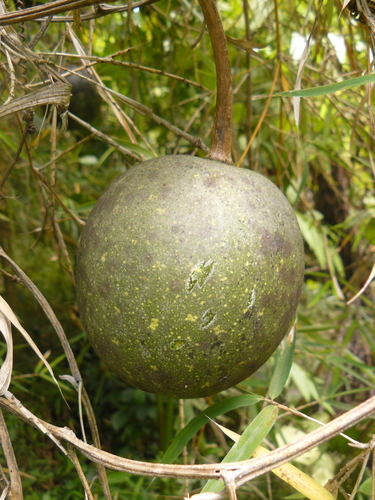
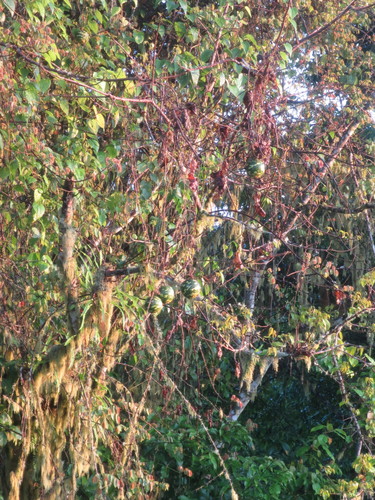
Cucumis trigonus
Roxb.
iNaturalist· cc-by
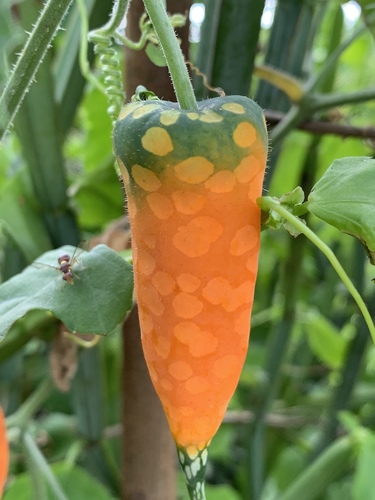
(c) Amar Bharathy, some rights reserved (CC BY), uploaded by Amar Bharathy
iNaturalist· cc-by-nc
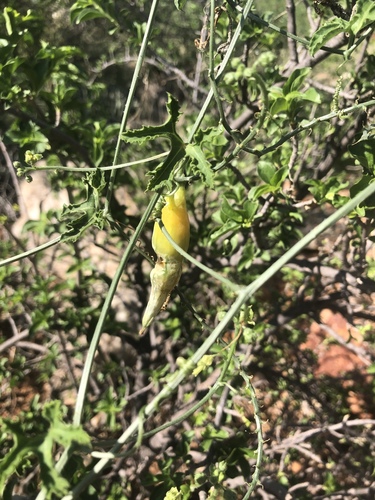
(c) GnanVi, some rights reserved (CC BY-NC)
iNaturalist· cc-by-nc
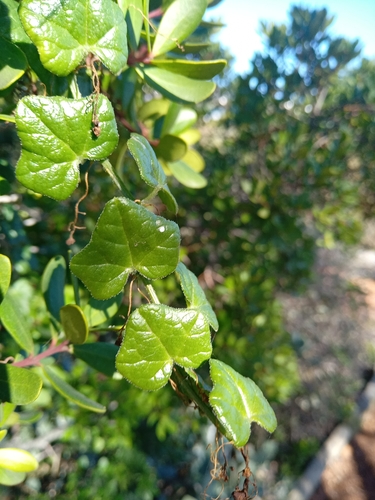
(c) GnanVi, some rights reserved (CC BY-NC)
Description
A pumpkin family plant. It is a perennial climber. It grows from a persistent root stock. The stems are 4 sided and hairy. The leaves have 5 lobes and teeth along the edge. The fruit are berries. These are slightly triangular. They are 4 cm across and green with white stripes.
Edible Uses
The ripe fruit are eaten raw, and the unripe fruit are boiled and eaten as a vegetable.
Traditional Uses
CAUTION: The fruit can cause serious diarrhoea. The fruit are eaten raw when ripe. The unripe fruit is boiled and eaten.
This uses section is brief — help expand it
Known Hazards
The fruit can cause serious diarrhoea.
Distribution
A tropical plant. It grows in open areas or low scrub.
Where It Grows
Asia, Australia, India, Indochina, Myanmar, Northeastern India, SE Asia, Vietnam,
Other Information
The ripe fruit are popular.
Notes
There are about 25 Cucumis species.
Nutrition
| Part | Moisture | kJ | kcal | Protein | Vit A | Vit C | Iron | Zinc |
|---|---|---|---|---|---|---|---|---|
| Fruit | 95.6 | — | — | 2 | — | — | — | — |
Also Known As
Adavipuchcha, Bhakura, Bislambhi, Boomarrah, Fangma tial, Ghimaru, Gomuk, Jangalindrayan, Karit, Karita, Kasit, Kattutumatti, Kodibudama, Mekke kayi, Nga-pyok-thakwa, Pahetula, Panch mahals, Thaisim, Vishala
References (12)
- Ambasta, S.P. (Ed.), 2000, The Useful Plants of India. CSIR India. p 149
- Cribb, A.B. & J.W., 1976, Wild Food in Australia, Fontana. p 64
- Fl. ind. ed. 1832, 3:722. 1832
- GAMMIE,
- IRVINE,
Show all 12 references Hide references
- Maiden, J. H., 1889, The Useful Native Plants of Australia (including Tasmania). The Technology Museum of NSW, Sydney. p 20
- Medhi, P. & Borthakur, S. K., 2012, Phytoresources from North Cachur Hills of Assam -3: Edible plants sold at Hflong market. Indian Journal or Natural Products and Resources. 3(1) pp 84-109
- Morley, B.D., & Toelken, H.R., (Eds), 1983, Flowering Plants in Australia. Rigby. p 100
- Patiri, B. & Borah, A., 2007, Wild Edible Plants of Assam. Geethaki Publishers. p 62
- Pham-Hoang Ho, 1999, An Illustrated Flora of Vietnam. Nha Xuat Ban Tre. p 570
- Rajasab, A. H. et al, 2004, Documentation of folk knowledge on edible wild plants of North Karnataka. Indian Journal of Traditional Knowledge. Vol 3(4) pp 419-429
- Sen, R., et al, 1985, Ethnobotanical Uses of Herbaria - 4 J. Econ. Tax. Bot. Vol 6. No.2 pp 331-335