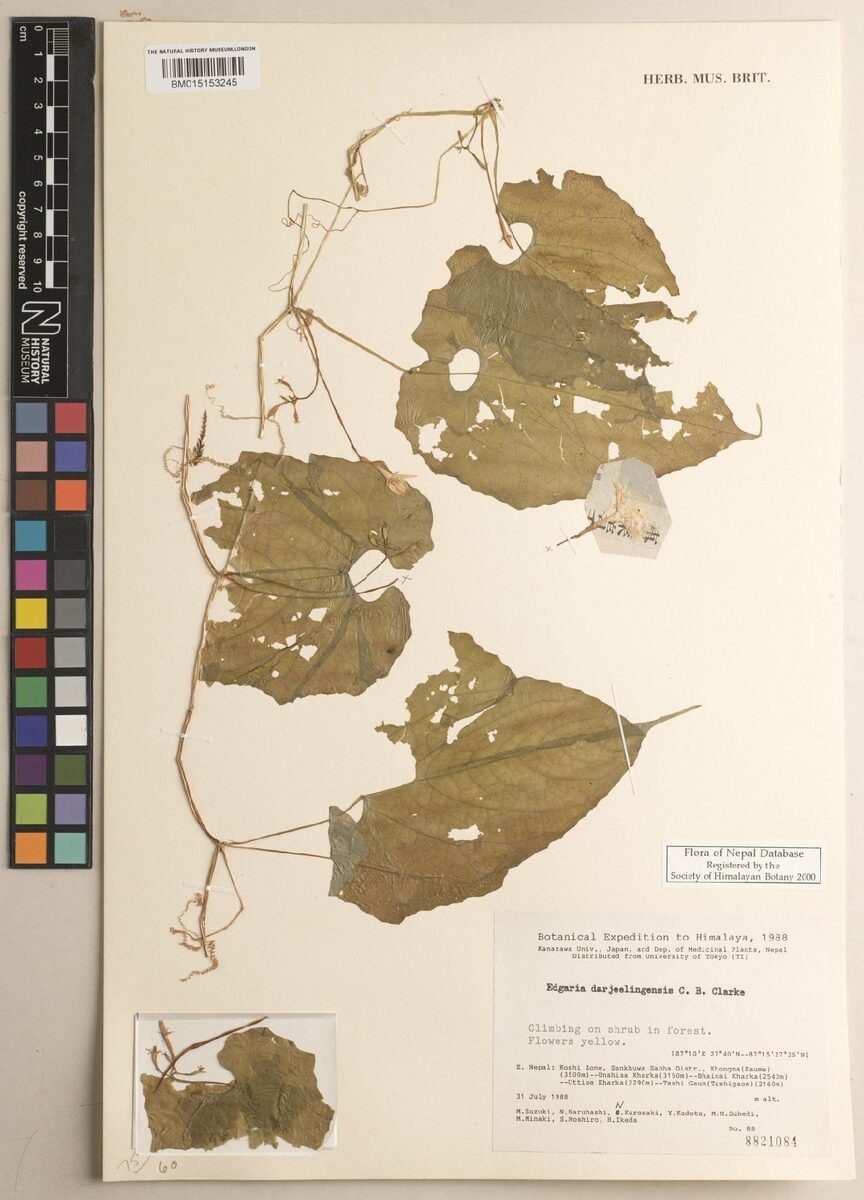
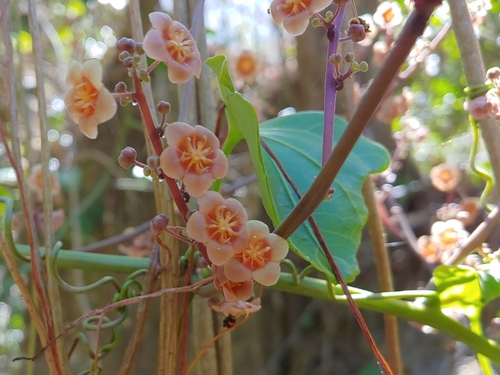
Kedrostis leloja
(Forssk. ex J. F. Gmel.) C. Jeffrey
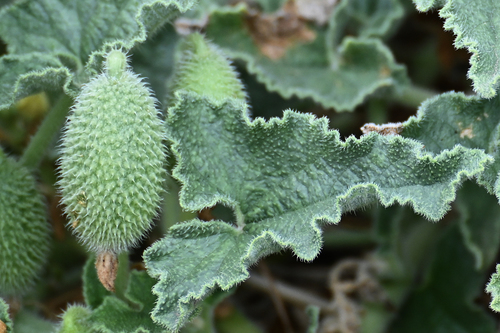
iNaturalist· cc-by-nc
(c) Troos van der Merwe, some rights reserved (CC BY-NC), uploaded by Troos van der Merwe
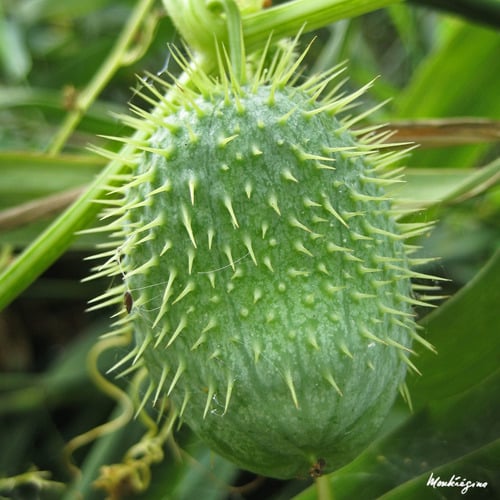
iNaturalist· cc-by-nc
(c) Will, some rights reserved (CC BY-NC), uploaded by Will
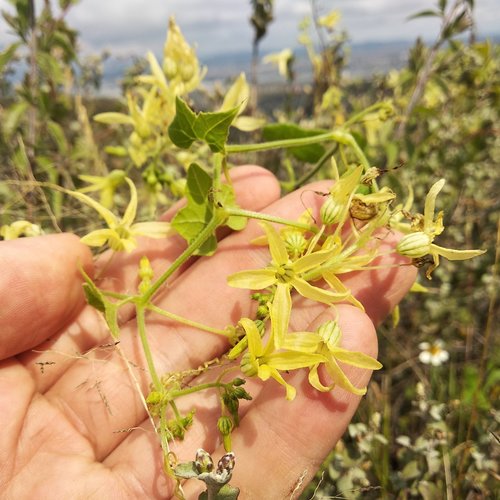
iNaturalist· cc-by-nc
(c) Will, some rights reserved (CC BY-NC), uploaded by Will
Description
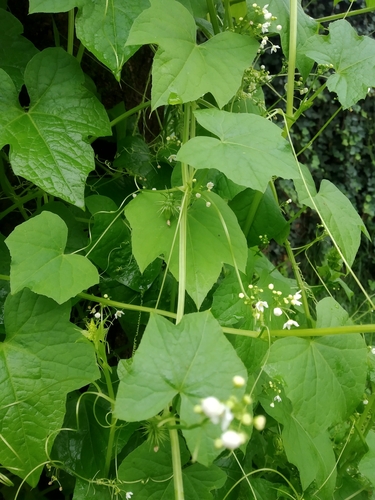
A herb. It is a pumpkin family plant. It can grow each year from seeds or keep growing from year to year. It is 1 m long. It is a climber. It has a taproot and puts up annual stems. It has simple tendrils. The leaves are simple with 5 shallow lobes. The leaves are 6 cm long by 10 cm across. The lobes widen at the tip. The male and female flowers are separate on the same plant. They are small and greenish-yellow. The male flowers are on a hanging stalk and the female flowers on a short stalk. The fruit are green and turn orange as they ripen. They are oblong.
Edible Uses
The leaves are chopped and cooked in coconut milk or pounded with peanuts and serve as a staple food. The fruit are eaten raw, particularly by children.
Traditional Uses
The leaves are eaten as a vegetable and used to flavour other foods. They are chopped and cooked in coconut milk or pounded with peanuts. It is a staple food. The fruit are eaten raw.
Medicinal Uses
The leaves are used to flavour other foods.
Distribution
It is a tropical plant. It grows in woodland and grassland. It grows from sea level to 1,700 m above sea level. It can grow in arid places.
Where It Grows
Africa, Angola, Benin, Botswana, Cameroon, Central Africa, Central African Republic, CAR, Chad, Côte d'Ivoire, Djibouti, East Africa, Eswatini, Ethiopia, Ghana, Guinea, Guinée, Guinea-Bissau, Ivory Coast, Kenya, Liberia, Malawi, Middle East, Mozambique, Namibia, Niger, Nigeria, Sahel, Senegal, Sierra Leone, Somalia, South Africa, Southern Africa, Sudan, Swaziland, Tanzania, Togo, Uganda, West Africa, Yemen, Zambia, Zimbabwe,
Cultivation
Plants can be grown from seeds.
Production
The leaves and fruit are collected during the rainy season.
Other Information
The fruit are eaten especially by children. It is a minor vegetable.
Synonyms
Also Known As
Durinbo, Garto, Nyandanga
References (9)
- Addis, G., et al, 2013, The Role of Wild and Semi-wild Edible Plants in Household Food Sovereignty in Hamer and Konso Communities, South Ethiopia. Ethnobotany Research & Applications. 11:251-271
- Grubben, G. J. H. and Denton, O. A. (eds), 2004, Plant Resources of Tropical Africa 2. Vegetables. PROTA, Wageningen, Netherlands. p 342
- Kidane, B., et al, 2014, Wild and semi-wild leafy vegetables used by the Maale and Ari ethnic communities in southern Ethiopia. Genetic Resour Crop Evol. Springer. p 8
- Lulekal, E., et al, 2011, Wild edible plants in Ethiopia: a review on their potential to combat food insecurity. Afrika Focus - Vol. 24, No 2. pp 71-121
- Royal Botanic Gardens, Kew (1999). Survey of Economic Plants for Arid and Semi-Arid Lands (SEPASAL) database. Published on the Internet; http://www.rbgkew.org.uk/ceb/sepasal/internet [Accessed 16th April 2011]
Show all 9 references Hide references
- Ruiters-Welcome, A. K., 2019, Food plants of southern Africa. Ph.D. thesis. Univ. of Johannesburg p 50
- Ruffo, C. K., Birnie, A. & Tengnas, B., 2002, Edible Wild Plants of Tanzania. RELMA p 406
- Welcome, A. K. & Van Wyk, B.-E., 2019, An inventory and analysis of the food plants of southern Africa. South African Journal of Botany 122 (2019) 136–179
- World Checklist of Useful Plant Species 2020. Royal Botanic Gardens, Kew