Cucumis sativus
L.
Cucumber
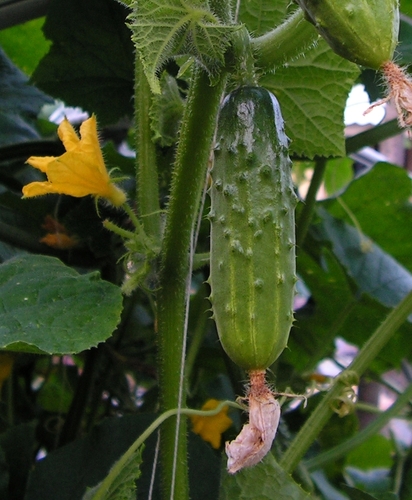
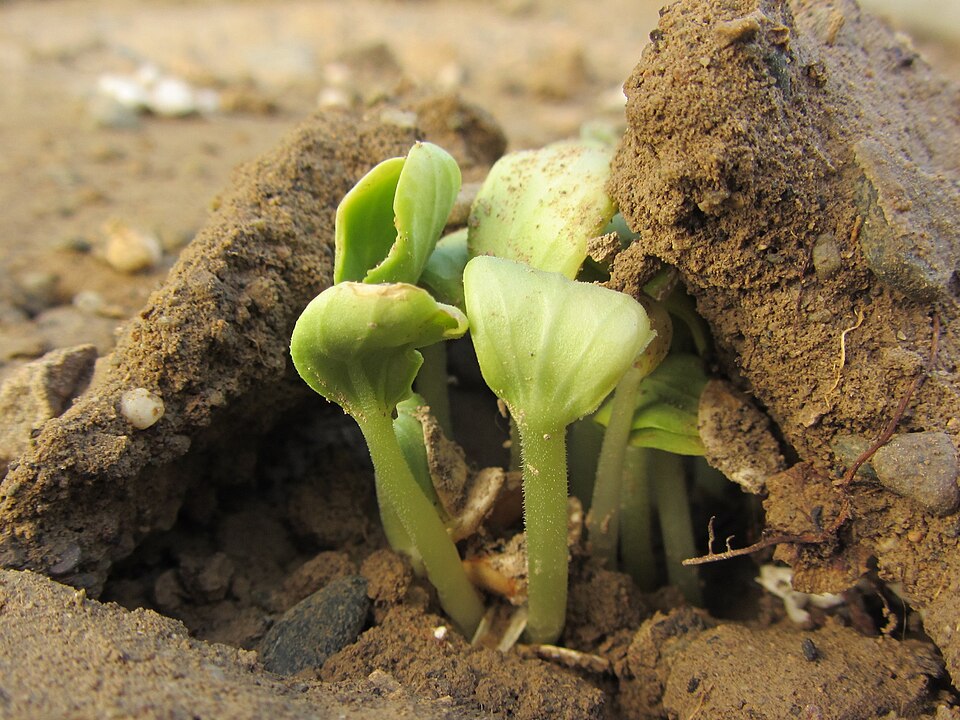
iNaturalist· cc-by-nc
(c) johana_shein, some rights reserved (CC BY-NC)
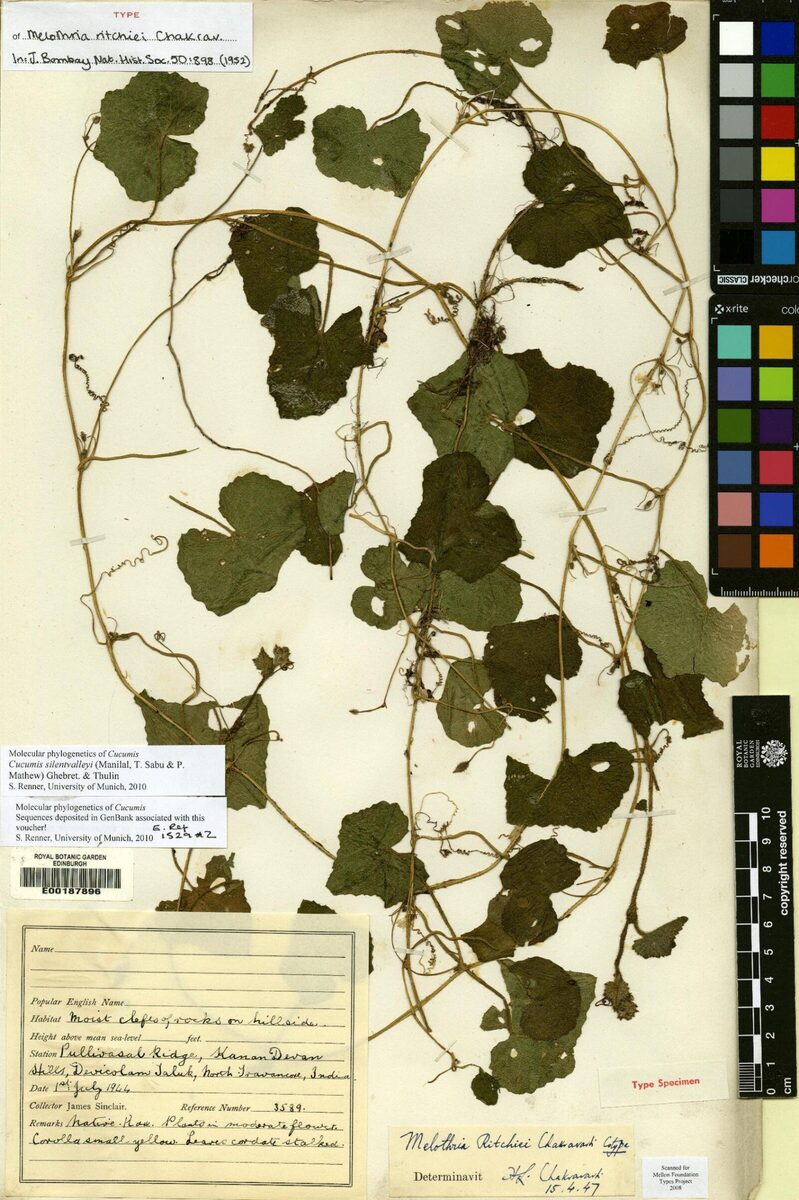
iNaturalist· cc-by-sa
(c) Bff, some rights reserved (CC BY-SA)
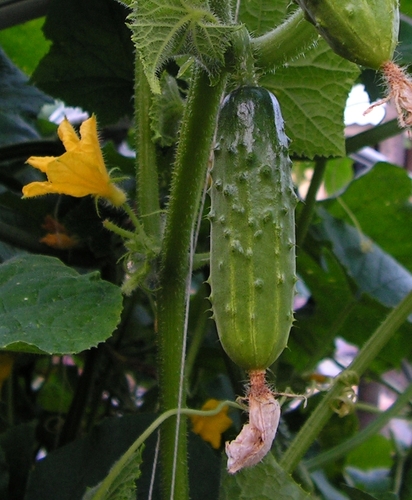
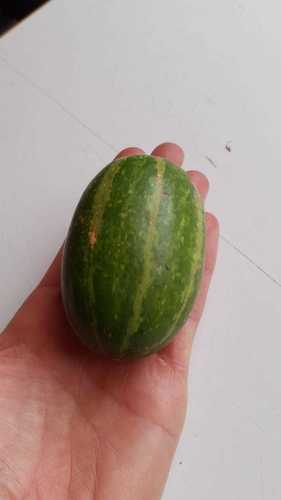
iNaturalist· cc-by-nc
(c) johana_shein, some rights reserved (CC BY-NC)
Summary
Source: WikipediaAnnual climbing vine growing to 2 m. Frost tender, hardy to UK zone 10. Flowers July to September with seeds ripening August to October. Monoecious with insect pollination and self-fertile. Tolerates sandy, loamy, or clay soils with good drainage and mildly acid to basic pH. Requires full sun and prefers moist soil.
Description
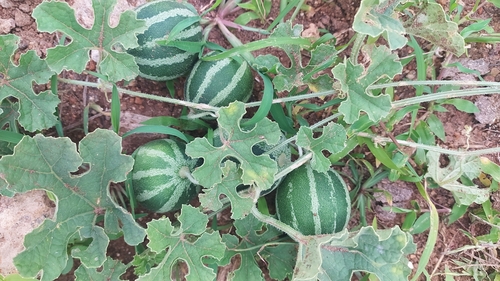
A pumpkin family plant. It is a hairy annual climber with tendrils and yellow flowers. It grows to 0.5 m high and spreads to 2 m wide. The stem is trailing and has bristles. The leaves are heart shaped and the lobes taper. Leaf shape varies with different varieties. The tendrils are not branched. The flowers are yellow and funnel shaped. They occur in clusters in the axils of leaves. Male and female flowers are separate but on the same plant. Male flowers are normally in groups of 2-3 and develop first and female flowers are borne singly and open later. Fruit are long and often with a slightly lumpy skin. The flesh inside is greenish white. The fruit are edible. The fruit contain many seeds. Fruit 20-100 cm long are called cucumbers and fruit which are much smaller and darker green are called gherkins.
Edible Uses
The fruit is eaten raw or cooked and is a common salad ingredient, valued mainly for its crisp texture and juiciness. It is very watery with little flavour and limited nutritional value; many people find it indigestible due to its high cellulose content. Fruit size varies widely between cultivars and can reach up to 1 metre long. Outdoor-grown plants typically produce from mid summer until early autumn. Seeds can be eaten raw; they are rich in oil with a nutty flavour, though small and covered with a fibrous coat, making them fiddly to prepare. Young leaves and stems can be cooked as a potherb. An oil extracted from the seed is said to resemble olive oil and is used in salad dressings and French cooking; it contains 22.3% linoleic acid, 58.5% oleic acid, 6.8% palmitic acid, and 3.7% stearic acid.
Traditional Uses
Usually unripe fruit are eaten raw. Young stem tops and leaves are edible. The kernels of the seeds are edible. They are also roasted. The seeds can be pounded and added to other dishes. The seeds can be pressed for oil. Cucumbers are normally eaten fresh while gherkins are pickled in vinegar.
Medicinal Uses
Leaf juice is emetic and is used to treat dyspepsia in children. The fruit is depurative, diuretic, emollient, purgative, and resolvent. Fresh fruit is used internally for blemished skin and heat rash, and externally as a poultice for burns and sores, as well as cosmetically to soften the skin. The seed is cooling, diuretic, tonic, and vermifuge; a standard vermifuge dose is 25–50 grams of thoroughly ground seeds including the seed coat, which usually needs to be followed by a purgative to expel worms. A decoction of the root is diuretic.
Known Hazards
The sprouting seed produces a toxic substance in its embryo.
Distribution
A subtropical plant. It occurs from sea level up to at least 2200 m in the tropics. It is a traditional vegetable in the highlands of Papua New Guinea. Protection from wind is needed. It is killed by frost. It needs a temperature above 10°C. In Nepal they grow to 1600 m altitude. It suits hardiness zones 9-11. In Yunnan.
Where It Grows
Africa, Albania, Amazon, Andorra, Angola, Asia, Australia, Austria, Azerbaijan, Balkans, Bangladesh, Barbados, Benin, Bolivia, Botswana, Bougainville, Brazil, Britain, Burkina Faso, Burundi, Cambodia, Cameroon, Cape Verde, Caucasus, Central Africa, Central African Republic, CAR, Central America, Central Asia, Chad, China, Colombia, Comoros, Congo, Costa Rica, Côte d'Ivoire, Cuba, Djibouti, Dominican Republic, East Africa, East Timor, Ecuador, Egypt, Equatorial-Guinea, Eritrea, Ethiopia, Europe, Fiji, Finland, FSM, Gabon, Gambia, Georgia, Ghana, Greece, Grenada, Guam, Guinea, Guinée, Guinea-Bissau, Guyana, Haiti, Hawaii, Himalayas, India, Indochina, Indonesia, Iran, Iraq, Italy, Ivory Coast, Jamaica, Japan, Kazakhstan, Kenya, Kiribati, Korea, Kyrgyzstan, Laos, Liberia, Macedonia, Madagascar, Malawi, Malaysia, Mali, Mauritania, Mauritius, Mediterranean, Mexico, Middle East, Moldova, Mozambique, Myanmar, Namibia, Nauru, Nepal, Netherlands, Niger, Nigeria, North Africa, North America, Northeastern India, Oman, Pacific, Pakistan, Papua New Guinea, PNG, Peru, Philippines, Pohnpei, Poland, Romania, Rotuma, Russia, Rwanda, Sahel, Sao Tome and Principe, Saudi Arabia, Scandinavia, SE Asia, Serbia, Seychelles, Senegal, Sierra Leone, Sikkim, Slovenia, Solomon Islands, Somalia, Southern Africa, South America, Spain, Sri Lanka, St. Vincent and Grenadines, Sudan, Switzerland, Syria, Taiwan, Tajikistan, Tanzania, Tasmania, Thailand, Timor-Leste, Togo, Tokelau, Tonga, Turkey, Türkiye, Tuvalu, Uganda, Ukraine, Uruguay, USA, Uzbekistan, Vanuatu, Vietnam, West Africa, West Indies, West Zambia, Zimbabwe,
Cultivation
Requires a rich, well-drained moisture retentive soil and a warm very sunny position. A frost-tender plant, the cucumber is commonly cultivated for its edible fruit, there are many named varieties. Many of these varieties are only suitable for protected cropping in Britain though there are a number that have been specifically bred for cool temperate areas and these succeed outdoors in most summers. Many of the cultivars, especially the greenhouse forms, should have their male flowers removed in order to prevent fertilization, since the fertilized fruits have a bitter taste. A number of cultivars have been developed that only produce female flowers. Cucumbers make good companion plants for sweet corn, beans and sunflowers, but they dislike growing with potatoes and aromatic herbs. The roots of cucumber plants secrete a substance that inhibits the growth of most weeds.
Propagation
Sow seed in early to mid spring in a greenhouse in rich soil; germination should occur within 2 weeks. Sow 2 or 3 seeds per pot and thin to the strongest plant. Grow on quickly and plant out after the last expected frosts, providing cloche or frame protection for at least the first few weeks if growing outdoors.
Other Uses
Cucumber skins have been shown to repel cockroaches in laboratory experiments. The fruit is applied to the skin as a cleansing cosmetic to soften and whiten it, and the juice is used in many beauty products. An oil is obtained from the seed.
Production
Harvesting can commence 6-8 weeks after sowing. Up to 10 fruit per plant can be produced.
Other Information
It is a commercially cultivated vegetable. A common and well liked vegetable throughout Papua New Guinea.
Notes
There are about 25 Cucumis species.
Nutrition
| Part | Moisture | kJ | kcal | Protein | Vit A | Vit C | Iron | Zinc |
|---|---|---|---|---|---|---|---|---|
| Fruit flesh raw | 96.4 | 43 | 10 | 0.6 | — | 8 | 0.3 | 0.1 |
Synonyms
Also Known As
Adai, Badrang, Bonteng, Dosakaya, Huang-kwa, Kakri, Kakrikai, Kankra, Kankro, Ketimun, Khira, Kikposi, K'it'ri, Kiuhri, Kokombra, Kokumba, Kuikaba, Kukaba, Kukama, Kukamba, Kyuuro, Meki, Mekkha, Melu, Morokyu, Mukku, Ogurec, Oi, Pepino, Pipinya, Setimun, Shosha, Sukasa, Taeng-kwa, Teng ran, Timun, Vellarikkai, Wasagu, Wong kwa
References (99)
- Ali, A. M. S., 2005, Homegardens in Smallholder Farming Systems: Examples from Bangladesh. Human Ecology, Vol. 33, No. 2 pp. 245-270
- Ambasta, S.P. (Ed.), 2000, The Useful Plants of India. CSIR India. p 149
- Anderson, E. F., 1993, Plants and people of the Golden Triangle. Dioscorides Press. p 208
- Ara, R. I. T., 2015, Leafy Vegetables in Bangladesh. Photon eBooks. p 164
- Barrau, J., 1976, Subsistence Agriculture in Melanesia. Bernice P. Bishop Museu, Bulletin 219 Honolulu Hawaii. Kraus reprint. p 55
Show all 99 references Hide references
- Beckstrom-Sternberg, Stephen M., and James A. Duke. "The Foodplant Database." http://probe.nalusda.gov:8300/cgi-bin/browse/foodplantdb.(ACEDB version 4.0 - data version July 1994)
- Bernholt, H. et al, 2009, Plant species richness and diversity in urban and peri-urban gardens of Niamey, Niger. Agroforestry Systems 77:159-179
- Baa-Poku, F. & Asante, I. K., 2020, Use of Neglected and Underutilized Crop Species (NUCS) in some farming communities in the Upper Afram and Upper Dayi River Basins in Ghana. International Journal of Technology and Management Research 5 (2): 48-63
- Balkrishna, A., et al, 2022, Indigenous Uses of Plants among Forest-dependent Communities of Seijosa, Arunachal Pradesh. International Journal of Economic Plants 2022, 9(1):064-080
- Bianchini, F., Corbetta, F., and Pistoia, M., 1975, Fruits of the Earth. Cassell. p 116
- Bodkin, F., 1991, Encyclopedia Botanica. Cornstalk publishing, p 306
- Bremness, L., 1994, Herbs. Collins Eyewitness Handbooks. Harper Collins. p 244
- Brown, D., 2002, The Royal Horticultural Society encyclopedia of Herbs and their uses. DK Books. p 184
- Burkill, H. M., 1985, The useful plants of west tropical Africa, Vol. 1. Kew.
- Burkill, I.H., 1966, A Dictionary of the Economic Products of the Malay Peninsula. Ministry of Agriculture and Cooperatives, Kuala Lumpur, Malaysia. Vol 1 (A-H) p 707
- Bussman, R. W., et al, 2016, A comparative ethnobotany of Khevsureti, Samtskhe-Javakheti, Tusheti, Svaneti, and Racha-Lechkhumi, Republic of Georgia (Sakartvelo), Caucasus. Journal of Ethnobiology and Ethnomedicine (2016) 12:4
- Bussman, R. W., et al, 2021, Unity in diversity—food plants and fungi of Sakartvelo (Republic of Georgia), Caucasus. Journal of Ethnobiology and Ethnomedicine (2021) 17:72 p 8
- Chin, H. F., 1999, Malaysian Vegetables in Colour. Tropical Press. p 44
- Cobley, L.S. (rev. Steele, W.M.) 2nd Ed., 1976, An Introduction to the Botany of Tropical Crops. Longmans. p 138
- Creasy, R., 2000, The Edible Asian Garden. Periplus p 38
- Cundall, P., (ed.), 2004, Gardening Australia: flora: the gardener's bible. ABC Books. p 441
- D'Ambrosio, U., & Puri, R. K., 2016, Foodways in transition: food plants, diet and local perceptions of change in a Costa Rican Ngäbe community. Journal of Ethnobiology and Ethnomedicine (2016) 12:3 p 22
- Duarte, M. C., et al, 2022, Diversity of Useful Plants in Cabo Verde Islands: A Biogeographic and Conservation Perspective. Plants 2022, 11, 1313 p 10
- Edwards. S., et al, (Eds), 1995, Flora of Ethiopia and Eritrea. Vol.2, Part 2 Canellaceae to Euphorbiaceae. Uppsala, Sweden. p 54
- Ekman Herbarium records Haiti
- Facciola, S., 1998, Cornucopia 2: a Source Book of Edible Plants. Kampong Publications, p 86
- Farooq, S., et al, 2012, Ethnobotanical Studies of the Flora of Tehsil Birmal in South Waziristan Agency, Pakistan. Pak. J. Weed Sci. Res. 18(3): 277-291
- Flowerdew, B., 2000, Complete Fruit Book. Kyle Cathie Ltd., London. p 118
- Foo, J.T.S.(ed), 1996, A Guide to Common Vegetables. Singapore Science Foundation. p 54
- Flora of Pakistan. www.eFloras.org
- Fowler, D. G., 2007, Zambian Plants: Their Vernacular Names and Uses. Kew. p 22
- French, B.R., 1986, Food Plants of Papua New Guinea, A Compendium. Asia Pacific Science Foundation p 101
- French, B.R., 2010, Food Plants of Solomon Islands. A Compendium. Food Plants International Inc. p 137
- Furusawa, T., et al, 2014, Interaction between forest biodiversity and people's used of forest resources in Roviana, Solomon Islands: implications for biocultural conservation under socioeconomic changes. Journal of Ethnobiology and Ethnomedicine, 10:10
- Grubben, G. J. H. and Denton, O. A. (eds), 2004, Plant Resources of Tropical Africa 2. Vegetables. PROTA, Wageningen, Netherlands. p 253
- Hani Medicine of Xishuangbanna, 1999, p 647
- Hedrick, U.P., 1919, (Ed.), Sturtevant's edible plants of the world. p 236
- Hu, Shiu-ying, 2005, Food Plants of China. The Chinese University Press. p 698
- Japanese International Research Centre for Agricultural Science www.jircas.affrc.go.jp/project/value_addition/Vegetables
- Jardin, C., 1970, List of Foods Used In Africa, FAO Nutrition Information Document Series No 2.p 72
- Jha, P. K., et al, 1996, Plant genetic resources of Nepal: A guide for plant breeders of agricultural, horticultural and forestry crops. Euphytica 87:189-210
- Kapelle, M., et al, 2000, Useful plants within a Campesino Community in a Costa Rican Montane Cloud Forest. Mountain Research and Development, 20(2): 162-171.
- Kays, S. J., and Dias, J. C. S., 1995, Common Names of Commercially Cultivated Vegetables of the World in 15 languages. Economic Botany, Vol. 49, No. 2, pp. 115-152
- Kiple, K.F. & Ornelas, K.C., (eds), 2000, The Cambridge World History of Food. CUP p 1765
- Kohila, A. & Kensa, V. M., 2019, Survey of Wild Edible Plants of Dhanakarkulam Panchayath, Tirunelveli District, Tamil Nadu, India. Kong. Res. J. 6(2): 20-27, 2019
- Kuvar, S. D. & Shinde, R. D., 2019, Wild Edible Plants used by Kokni Tribe of Nasik District, Maharashtra. Journal of Global Biosciences. Volume 8, Number 2, 2019, pp. 5936-5945 (As Cucumis setosus)
- Lazarides, M. & Hince, B., 1993, Handbook of Economic Plants of Australia, CSIRO. p 70
- Lembogi Biologi Nasional, 1980, Sayur-sayuran. Balai Pustaka, Jakarta. p 64
- Macmillan, H.F. (Revised Barlow, H.S., et al) 1991, Tropical Planting and Gardening. Sixth edition. Malayan Nature Society. Kuala Lumpur. p 332, 364
- Manandhar, N.P., 2002, Plants and People of Nepal. Timber Press. Portland, Oregon. p 179
- Martin, F.W. & Ruberte, R.M., 1979, Edible Leaves of the Tropics. Antillian College Press, Mayaguez, Puerto Rico. p 189
- Medhi, P. & Borthakur, S. K., 2012, Phytoresources from North Cachur Hills of Assam -3: Edible plants sold at Hflong market. Indian Journal or Natural Products and Resources. 3(1) pp 84-109
- Miller, A. G., Morris, M. & Stuart-Smith, S., 1988, Plants of Dhofar. The Southern Region of Oman, Traditional, Economic and Medicinal Uses. Sultanate of Oman. p 116
- Murtem, G. & Chaudhrey, P., 2016, An ethnobotanical note on wild edible plants of Upper Eastern Himalaya, India. Brazilian Journal of Biological Sciences, 2016, v. 3, no. 5, p. 63-81
- Norrington, L., & Campbell, C., 2001, Tropical Food Gardens. Bloomings Books. p 46
- Ochse, J.J. et al, 1931, Vegetables of the Dutch East Indies. Asher reprint. p 191
- Omawale, 1973, Guyana's edible plants. Guyana University, Georgetown p 93
- Owen, S., 1993, Indonesian Food and Cookery, INDIRA reprints. p 69
- Patil, M. V. & Patil, D. A., 2000, Some More Wild Edible Plants of Nasik District (Maharashtra). Ancient Science of Life Vol. X1X (3&4): 102-104 (As Cucumis setosus)
- Peekel, P.G., 1984, (Translation E.E.Henty), Flora of the Bismarck Archipelago for Naturalists, Division of Botany, Lae, PNG. p 545,
- Pham-Hoang Ho, 1999, An Illustrated Flora of Vietnam. Nha Xuat Ban Tre. p 570
- Phon, P., 2000, Plants used in Cambodia. © Pauline Dy Phon, Phnom Penh, Cambodia. p 183
- Pieroni, A., 2008, Local plant resources in the ethnobotany of Theth, a village in the Northern Albanian Alps. Genet Resour Crop Evol (2008) 55:1197–1214
- Pieroni, A. et al, 2013, One century later: the folk botanical knowledge of the last remaining Albanians of the upper Reka Valley, Mount Korab, Western Macedonia. Journal of Ethnobiology and Ethnomedicine. 9:22
- Plants for a Future database, The Field, Penpol, Lostwithiel, Cornwall, PL22 0NG, UK. http://www.scs.leeds.ac.uk/pfaf/
- Plants of Haiti Smithsonian Institute http://botany.si.edu/antilles/West Indies
- Polunin, O., & Stainton, A., 2006, Flowers of the Himalaya, Oxford India Paperbacks. p 151
- Purseglove, J.W., 1968, Tropical Crops Dicotyledons, Longmans. p 114
- Rajapaksha, U., 1998, Traditional Food Plants in Sri Lanka. HARTI, Sri Lanka. p 146
- Rashid, H. E., 1977, Geography of Bangladesh. Westview. p 263
- Roa, J. A. G. & Boada, D. S. G., 2018, Fundación para el Fortalecimiento de la Fruticultura y Plantas Alimenticias no Convencionales en Colombia.
- Schneider, E., 2001, Vegetables from Amaranth to Zucchini: The essential reference. HarperCollins. p 239
- Sen, R., et al, 1985, Ethnobotanical Uses of Herbaria - 4 J. Econ. Tax. Bot. Vol 6. No.2 pp 331-335 (As Cucumis setosus)
- Sharma, B.B., 2005, Growing fruits and vegetables. Publications Division. Ministry of Information and broadcasting. India. p 170
- Siemonsma, J. S. and Piluek, K. (Eds), 1994, Plant Resources of South-East Asia No. 8 Vegetables. Prosea Foundation, Bogor, Indonesia, p 157
- Sillitoe, P. 1995, An Ethnobotanical Account of the Plant Resources of the Wola Region, Southern Highlands Province, Papua New Guinea. J. Ethnobiol. 15(2): 201-235
- Small, E., 2009, Top 100 Food Plants. The world's most important culinary crops. NRC Research Press. p 239
- Solomon, C., 2001, Encyclopedia of Asian Food. New Holland. p 111
- Sp. pl. 2:1012. 1753
- Stanley, T. D. & Ross, E. M., 1986, Flora of south-eastern Queensland Volume 2. Queensland Government p 111
- Staples, G.W. and Herbst, D.R., 2005, A tropical Garden Flora. Bishop Museum Press, Honolulu, Hawaii. p 265
- Sukenti, K., et al, 2016, Ethnobotanical study on local cuisine of the Sasak tribe in Lombok Island, Indonesia. Journal of Ethnic Foods. 3 (2016) 189-200 p 198
- Terra, G.J.A., 1973, Tropical Vegetables. Communication 54e Royal Tropical Institute, Amsterdam, p 42
- Thaman, R.R., 1976, The Tongan Agricultural System, University of the South Pacific, Suva, Fiji. p 393
- Thaman, R. R., 1987, Plants of Kiribati: A listing and analysis of vernacular names. Atoll Research Bulletin No. 296
- Thaman, R. R, 2016, The flora of Tuvalu. Atoll Research Bulletin No. 611. Smithsonian Institute p 81
- Tindall, H.D., & Williams, J.T., 1977, Tropical Vegetables and their Genetic Resources, International Board for Plant Genetic Resources, Rome, p 45
- Tindall, H.D., 1983, Vegetables in the tropics. Macmillan p. 159
- Torre, de la, L., et al, 2008, Enciclopedia de las Plantas Útiles del Ecuador. Herbario QCA. Pontificia Universidad Católica del Ecuador. p 298
- USDA, ARS, National Genetic Resources Program. Germplasm Resources Information Network - (GRIN). [Online Database] National Germplasm Resources Laboratory, Beltsville, Maryland. Available: www.ars-grin.gov/cgi-bin/npgs/html/econ.pl (10 April 2000)
- Vael, L., 2015, Ethnobotanical study of the plant use in the natural landscape of two mestizo communities in the Ucayali region of the Peruvian Amazon. Universiteit Gent.
- van Wyk, B., 2005, Food Plants of the World. An illustrated guide. Timber press. p 159
- Walter, A. & Lebot, V., 2007, Gardens of Oceania. ACIAR Monograph No. 122. p 185
- Walters, T. W., 1989, Historical Overview on Domesticated Plants in China with Special Emphasis on the Cucurbitaceae. Economic Botany 43(3): 297-313
- Whitaker,T.W., & Bemis,W.P., 1979, Cucurbits, in Simmonds N.W.,(ed), Crop Plant Evolution. Longmans. London. p 64
- Wiersema, J. H. & Leon, B., 2013, World Economic Plants. A Standard Reference CRC Press. 2nd Ed. p 216
- Williamson, J., 2005, Useful Plants of Malawi. 3rd. Edition. Mdadzi Book Trust. p 86
- World Checklist of Useful Plant Species 2020. Royal Botanic Gardens, Kew
- Zeven, A. C. & de West, J. M. J., 1982, Dictionary of cultivated plants and their regions of diversity. Wageningen. p 35, 73, 89