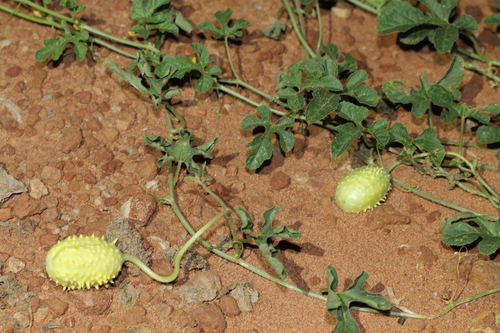
Cucumis melo subsp. agrestis
L., (Naudin) Pangalo
Early melon, Native gooseberry, People's melon
iNaturalist· cc-by-nc
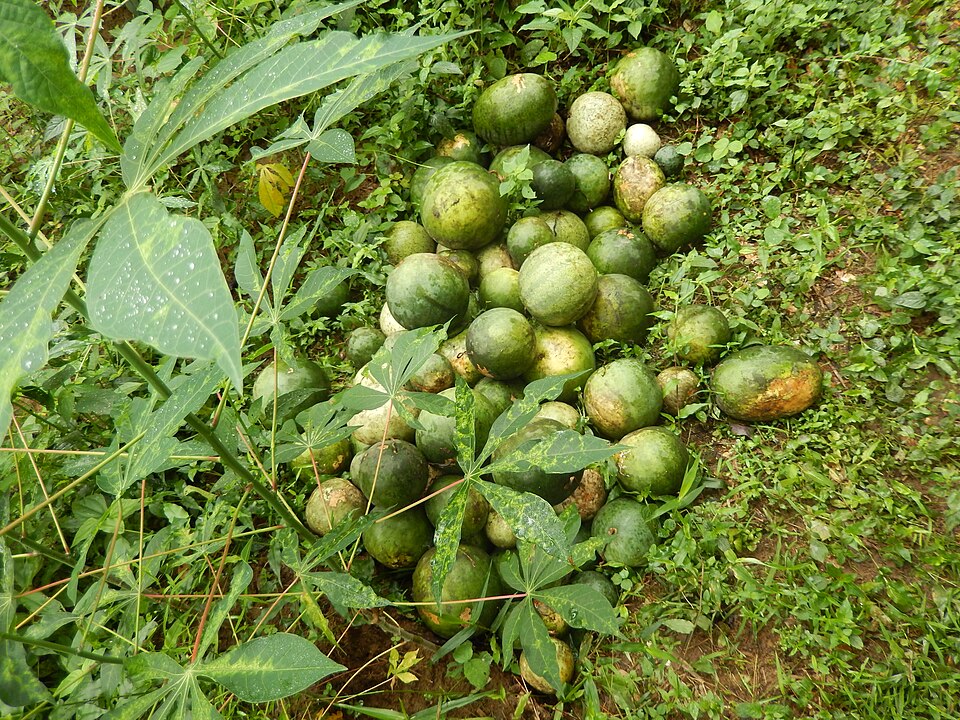
(c) Thinley Dema, some rights reserved (CC BY-NC), uploaded by Thinley Dema
iNaturalist· cc-by-nc
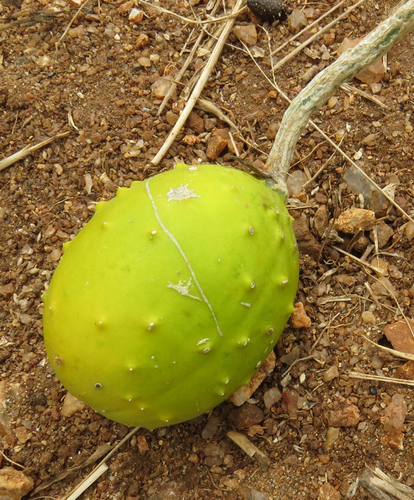
(c) Kelly Kines Crawford, some rights reserved (CC BY-NC), uploaded by Kelly Kines Crawford
iNaturalist· cc-by-nc
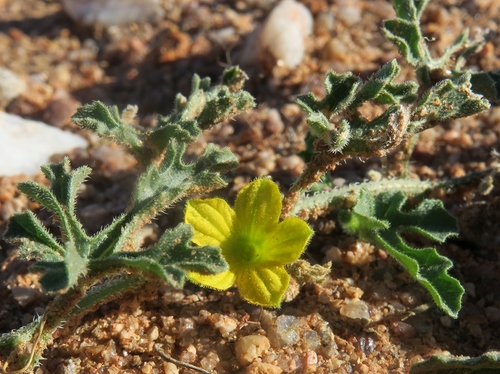
(c) Jon McIntyre, some rights reserved (CC BY-NC), uploaded by Jon McIntyre
Summary
Source: WikipediaCucumis melo, also known as melon, is a species of Cucumis that has been developed into many cultivated varieties. The fruit is a pepo. The flesh is either sweet or bland, with or without an aroma, and the rind can be smooth (such as honeydew), ribbed (such as European cantaloupe), wrinkled (such as Casaba melon), or netted (such as American cantaloupe). The species is sometimes referred to as muskmelon. However, there is no consensus about the usage of this term, as it can also be used as a specific name for the musky netted-rind American cantaloupe, or as a generic name for any sweet-flesh variety such the inodorous smooth-rind honeydew melon. The origin of melons is not known. Research has revealed that seeds and rootstocks were among the goods traded along the caravan routes of the Ancient World. Some botanists consider melons native to the Levant and Egypt, while others place their origin in Iran, India or Central Asia. Still others support an African origin; in modern times, wild melons can still be found in some African countries.
Description
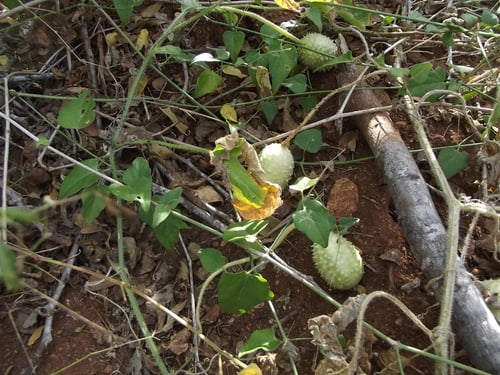
A pumpkin family plant. It is a twining annual herb. The stems are angular and coarsely hairy. They are brittle. The leaves can be almost round or kidney shaped. They can be 3-6 lobed and with teeth. The leaves are 0.3-0.8 cm long by 0.2-0.4 cm wide. The texture is somewhat rough. The flowers are yellow. The male flowers are in clusters and the female flowers occur singly. The fruit are green and oval. They are 2-5 cm long.
Edible Uses
The ripe fruit are eaten raw, though the skin can be bitter. Immature fruit are cooked as a vegetable. The leaves and seeds are also edible.
Traditional Uses
The ripe fruit are eaten raw. The skin can be bitter. The immature fruit are cooked as a vegetable.
This uses section is brief — help expand it
Distribution
A tropical plant. They grow in Nepal up to 800 m altitude. They grow in sandy places. In Australia they grow along stream banks and flood plains in inland areas. Plants are very frost tender. It can grow in arid places.
Where It Grows
Afghanistan, Africa, Asia, Australia, Benin, Central Africa, Chad, China, Cook Islands, Côte d'Ivoire, East Africa, Ethiopia, Ghana, Guam, Himalayas, India, Indochina, Indonesia, Iran, Iraq, Ivory Coast, Japan, Korea, Malawi, Malaysia, Maldives, Marquesas, Middle East, Mozambique, Nepal, Niger, Pacific, Pakistan, Papua New Guinea, PNG, Philippines, Sahel, Samoa, Saudi Arabia, SE Asia, Senegal, Seychelles, Solomon Islands, Somalia, South Africa, Sri Lanka, Sudan, Tanzania, Thailand, Tonga, Uganda, West Africa, Yemen, Zimbabwe,
Cultivation
Plants are grown from seed. Seeds grow easily under warm, moist conditions.
Other Information
In India they are eaten especially by children.
Notes
There are about 25 Cucumis species.
Synonyms
Also Known As
Dimbu beli, Fagus an nas, Kachri, Meki, Ulcardo melon, Ulkukta, Urmi, Wild melon
References (25)
- Arora, R. K., 2014, Diversity in Underutilized Plant Species - An Asia-Pacific Perspective. Bioversity International. p 48
- Bindon, P., 1996, Useful Bush Plants. Western Australian Museum. p 93
- Cherikoff V. & Isaacs, J., The Bush Food Handbook. How to gather, grow, process and cook Australian Wild Foods. Ti Tree Press, Australia p 189
- Chowdery, T., et al, 2014, Wild edible plants of Uttar Dinajpur District, West Bengal. Life Science Leaflets. 47:pp 20-36 http://lifesciencesleaflets.ning.com
- CRÉAC'H,
Show all 25 references Hide references
- Elliot, W.R., & Jones, D.L., 1984, Encyclopedia of Australian Plants suitable for cultivation. Vol 3. Lothian. p 130
- Facciola, S., 1998, Cornucopia 2: a Source Book of Edible Plants. Kampong Publications, p 85
- Flora of Australia, Volume 8, Lecythidales to Batales, Australian Government Publishing Service, Canberra (1982) p 189
- Flora of Pakistan. www.eFloras.org
- Jardin, C., 1970, List of Foods Used In Africa, FAO Nutrition Information Document Series No 2.p 72
- Latz, P.K., 1996, Bushfires and Bushtucker: Aboriginal plant use in Central Australia. IAD Press Alice Springs p 155
- Latz, P & Wightman, G., 1995, Desert Bush Tucker Identikit. Common Native Food Plants of Central Australia. Parks & Wild Commission Northern territory. p 40
- Lazarides, M. & Hince, B., 1993, Handbook of Economic Plants of Australia, CSIRO. p 70
- Low, T., 1992, Bush Tucker. Australia’s Wild Food Harvest. Angus & Robertson. p 41
- Manandhar, N.P., 2002, Plants and People of Nepal. Timber Press. Portland, Oregon. p 178
- Paczkowska, G. & Chapman, A.R., 2000, The Western Australian Flora. A Descriptive Catalogue. Western Australian Herbarium. p 221
- Peters, C. R., O'Brien, E. M., and Drummond, R.B., 1992, Edible Wild plants of Sub-saharan Africa. Kew. p 100
- Robins, J., 1996, Wild Lime. Cooking from the Bush food garden. Allen & Unwin p 25
- Sadhale, A., et al, 1991, Ethnobotanical studies of sacred grove at Ajiwali, Pune district. J. Econ. Tax. Bot. Vol. 15 No. 1 pp 167-172
- Stanley, T. D. & Ross, E. M., 1986, Flora of south-eastern Queensland Volume 2. Queensland Government p 110
- Tanaka,
- Wheeler, J.R.(ed.), 1992, Flora of the Kimberley Region. CALM, Western Australian Herbarium, p 247
- Wiersema, J. H. & Leon, B., 2013, World Economic Plants. A Standard Reference CRC Press. 2nd Ed. p 215
- Wightman, Glenn et al. 1994, Gurindji Ethnobotany: Aboriginal Plant Use from Daguragu Northern Australia. Northern Territory Botanical Bulletin No 18. Parks and Wildlife Commission of the Northern Territory. p 18
- Zhukovsky, La Turquie Agricole 534. 1933