Cucumis aculeatus
Cogn.
iNaturalist· cc-by-nc-nd
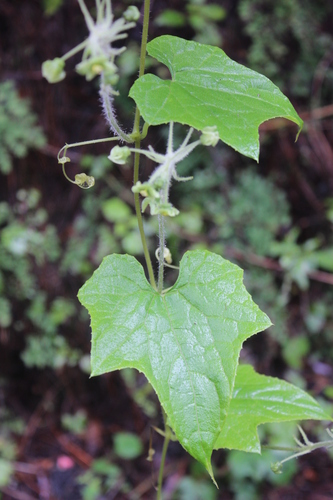
(c) Joachim Louis, some rights reserved (CC BY-NC-ND), uploaded by Joachim Louis
iNaturalist· cc-by-nc-nd
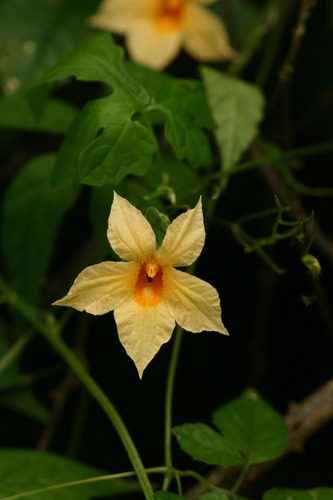
(c) Joachim Louis, some rights reserved (CC BY-NC-ND), uploaded by Joachim Louis
Description
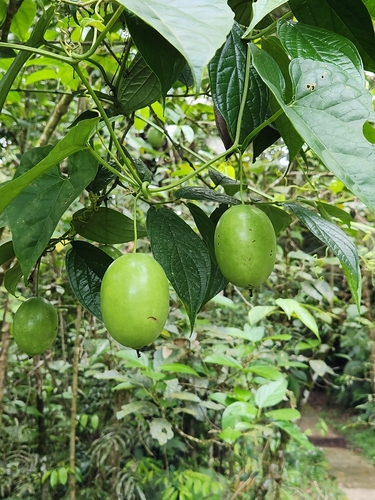
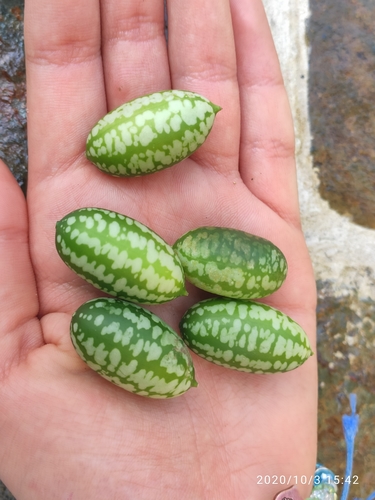
A climbing pumpkin family herb. It grows 3 m long. The stems are prickly. It has a fleshy rootstock that produces stems each year. The stems have tendrils and attach to other plants. The fruit is oval and yellow and 5-7 cm long by 3-5 cm wide.
Edible Uses
Young fruit are eaten raw, while ripe fruit are cooked and eaten or processed into a paste to serve with vegetables, though they have a bitter taste. The leaves are cooked as a vegetable or dried for storage.
Traditional Uses
The young fruit are eaten raw. Ripe fruit are cooked and eaten or sliced into a paste used with vegetables. They are bitter. The leaves are cooked as a vegetable and also dried and stored.
Distribution
It is a tropical plant. It grows in grassland and on the edges of forests between 1,000-2,400m above sea level.
Where It Grows
Africa, Burundi, Central Africa, Congo DR, East Africa, Ethiopia, Kenya, Rwanda, Tanzania, Uganda,
Other Information
It is cultivated.
Nutrition
| Part | Moisture | kJ | kcal | Protein | Vit A | Vit C | Iron | Zinc |
|---|---|---|---|---|---|---|---|---|
| Fruit | 85.7 | 384 | 92 | 24 | — | — | — | — |
Also Known As
Akobokobo, Kasasalya, Kishasae, Mtango mwitu, Nyambede, Okwer
References (7)
- Ferns, Useful Tropical Plants.
- Malaisse, F., 1997, Se nourrir en floret claire africaine. Approche ecologique et nutritionnelle. CTA., p 77
- Masters, T., 2021, Traditional food plants of the upper Aswa River catchment of northern Uganda—a cultural crossroads. Journal of Ethnobiology and Ethnomedicine (2021) 17:24
- Mutie, F. M., et al, 2023, Important Medicinal and Food Taxa (Orders and Families) in Kenya, Based on Three Quantitative Approaches. Plants 2023, 12, 1145
- Njoroge, G. & Newton, L. E. 1994, Edible and Poisonous Species of Cucurbitaceaea in the Central Highlands of Kenya. Journal of East African Natural History. 83:101-115
Show all 7 references Hide references
- Ruffo, C. K., Birnie, A. & Tengnas, B., 2002, Edible Wild Plants of Tanzania. RELMA p 244
- Zeven, A. C. & de West, J. M. J., 1982, Dictionary of cultivated plants and their regions of diversity. Wageningen. p 124