Cucumis africanus
L. f.
Horned cucumber, Jelly melon
iNaturalist· cc-by
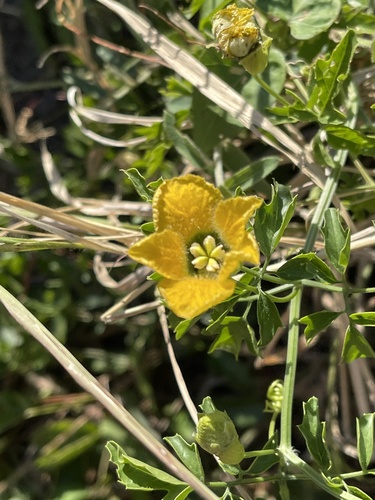
(c) Kevin Murray, some rights reserved (CC BY), uploaded by Kevin Murray
iNaturalist· cc-by-sa
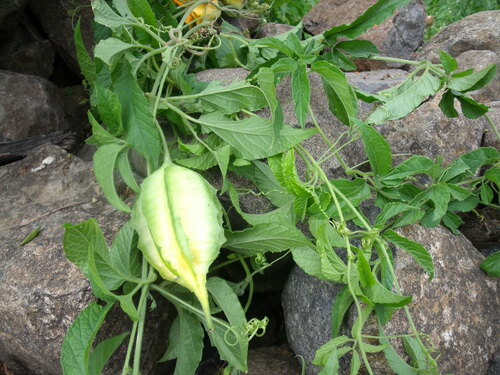
(c) Tony Rebelo, some rights reserved (CC BY-SA)
iNaturalist· cc-by-sa
(c) Tony Rebelo, some rights reserved (CC BY-SA)
Summary
Source: WikipediaCucumis africanus, the wild cucumber or wild gherkin, is a species of cucumber belonging to the genus Cucumis. It was first described by Carl Linnaeus the Younger. The species is native to Southern Africa.
Description
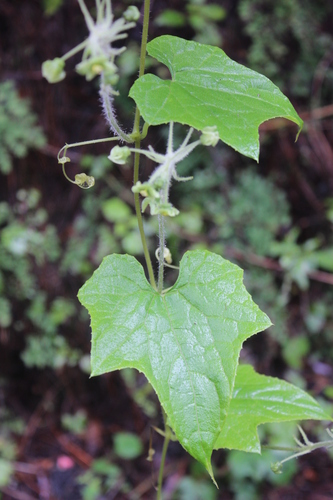
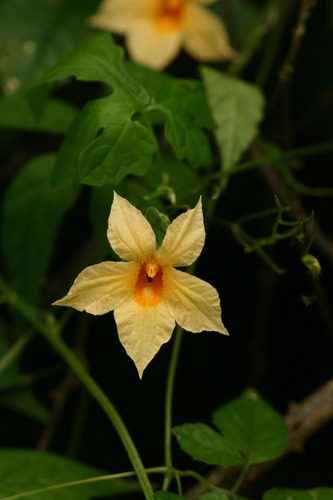
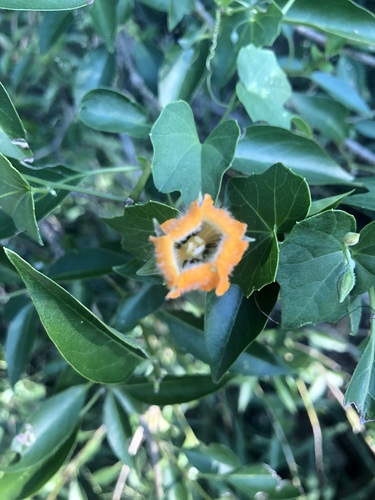
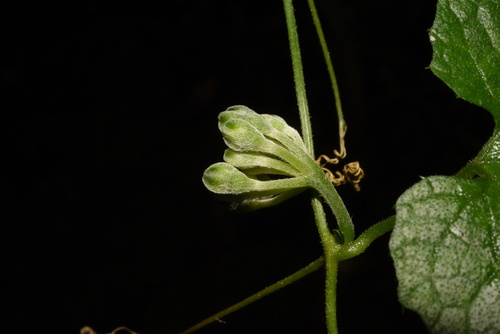
A pumpkin family herb. It keeps growing from year to year. It is a straggling plant with a rough surface. The leaves have 3-5 lobes. The middle lobe is largest. The tendrils are short and weak. The leaves are 8 cm long on stalks 7 cm long. The female flowers are yellow and 2 cm long. The male flowers are smaller and in clusters. The fruit are oval and 8 cm long by 4 cm across. They are yellow when ripe. The fruit are covered with stiff spines. Some fruit are bitter. Non bitter kinds have to be chosen.
Edible Uses
Young leaves are eaten as a potherb. The fruit can be eaten raw (non-bitter varieties preferred) or cooked and strained. Seeds are also edible.
Traditional Uses
Young leaves are eaten as a potherb. The bitter fruit are occasionally eaten raw. They are also cooked and strained.
This uses section is brief — help expand it
Medicinal Uses
In South African traditional medicine the fruit, leaf or root is used as an emetic, purgative or enema in the treatment of various ailments. The boiled leaf is used as a poultice.
Known Hazards
Some fruit are bitter and should be avoided; only non-bitter varieties should be selected for consumption.
Distribution
A tropical plant. It grows in deep dry sandy soils. It grows in hot arid areas with a marked dry season. It grows between 150-2,115 m above sea level. It is not common in Swaziland. It can grow in arid places.
Where It Grows
Africa, Angola, Botswana, Central Africa, East Africa, Eswatini, Lesotho, Mozambique, Namibia, South Africa, Southern Africa, Swaziland, Zambia, Zimbabwe,
Cultivation
A plant of drier areas in the tropics - in S. Africa it grows in areas where the mean annual rainfall is within the range 100 - 800mm. Succeeds in full sun and also grows well in partial shade in very sunny areas. Leaves are larger and less hairy when the plant is given some shade. There are three basic forms of this species:- Plants with non-bitter, large and oblong fruits are found growing wild in Angola, Namibia and South Africa. A form with smaller, ellipsoid fruits is also - these fruits are bitter, possibly poisonous and unsuitable for consumption. A third type, intermediate in taste and shape between the first two, seems to exist as well.
Other Information
It is an important crop in South Africa. It is cultivated.
Notes
There are about 25-30 Cucumis species.
Nutrition
| Part | Moisture | kJ | kcal | Protein | Vit A | Vit C | Iron | Zinc |
|---|---|---|---|---|---|---|---|---|
| Fruit | 88.2 | 163 | 39 | 2.8 | — | 13 | 1.1 | 0.4 |
| Leaves | 92.2 | 90 | 22 | 1.3 | — | 81 | 12.1 | 0.3 |
Synonyms
Also Known As
Duno, Etanga, Huhaqn, Konkomba, Lekatane, Magabala, Mapukupuka, Mogabala, Monyaki, Monyaku, Moshishiwau, Mugaika, Mukake, Mutete, Nku, Toa, Tshinyagu, Uhufafa, Isendlenja, Umaselwane, Uthangazana, Wildeagurkie
References (30)
- Akinola, R., et al, 2020, A Review of Indigenous Food Crops in Africa and the Implications for more Sustainable and Healthy Food Systems. Sustainability 2020, 12, 3493; (
- Arnold, T.H., Wells, M.J. & Wehmeyer, A.S., Khoisan food plants: taxa with potential for future economic exploitation, in Wickens, G.E., Goodin, J.R., and Field, D.V.,(Eds.) 1985, Plants for Arid Lands. Unwin Hyman, London, p 73
- Facciola, S., 1998, Cornucopia 2: a Source Book of Edible Plants. Kampong Publications, p 85
- Fowler, D. G., 2007, Zambian Plants: Their Vernacular Names and Uses. Kew. p 79
- Fox, F. W. & Young, M. E. N., 1982, Food from the Veld. Delta Books. p 171
Show all 30 references Hide references
- Gard. Chron. 1870:1503. 1870 (As Cucumis hookeri)
- Grivetti, L. E., 1980, Agricultural development: present and potential role of edible wild plants. Part 2: Sub-Saharan Africa, Report to the Department of State Agency for International Development. p 75
- Grubben, G. J. H. and Denton, O. A. (eds), 2004, Plant Resources of Tropical Africa 2. Vegetables. PROTA, Wageningen, Netherlands. p 237
- INFOODS:FAO/INFOODS Databases
- Jardin, C., 1970, List of Foods Used In Africa, FAO Nutrition Information Document Series No 2.p 72 (As Cucumis hookeri)
- Long, C., 2005, Swaziland's Flora - siSwati names and Uses http://www.sntc.org.sz/flora/
- Magwede, K., van Wyk, B.-E., & van Wyk, A. E., 2019, An inventory of Vhavenḓa useful plants. South African Journal of Botany 122 (2019) 57–89
- Martin, F.W. & Ruberte, R.M., 1979, Edible Leaves of the Tropics. Antillian College Press, Mayaguez, Puerto Rico. p 189
- Matlhare, T., et al, Vegetables in Botswana. p 21 Bioversity website.
- Peters, C. R., O'Brien, E. M., and Drummond, R.B., 1992, Edible Wild plants of Sub-saharan Africa. Kew. p 100
- Plowes, N. J. & Taylor, F. W., 1997, The Processing of Indigenous Fruits and other Wildfoods of Southern Africa. in Smartt, L. & Haq. (Eds) Domestication, Production and Utilization of New Crops. ICUC p 189
- Quin, 1959,
- Royal Botanic Gardens, Kew (1999). Survey of Economic Plants for Arid and Semi-Arid Lands (SEPASAL) database. Published on the Internet; http://www.rbgkew.org.uk/ceb/sepasal/internet [Accessed 15th April 2011]
- Ruiters-Welcome, A. K., 2019, Food plants of southern Africa. Ph.D. thesis. Univ. of Johannesburg p 49
- Silberbauer, 1965, 1972, 1981,
- Story, 1958,
- Suppl. pl. 423. 1782 ("1781")
- Swaziland's Flora Database http://www.sntc.org.sz/flora
- Terra, G.J.A., 1973, Tropical Vegetables. Communication 54e Royal Tropical Institute, Amsterdam, p 42
- van Wyk, B., 2005, Food Plants of the World. An illustrated guide. Timber press. p 156
- van Wyk, Be, & Gericke, N., 2007, People's plants. A Guide to Useful Plants of Southern Africa. Briza. p 40
- Wehmeyer, A. S, 1986, Edible Wild Plants of Southern Africa. Data on the Nutrient Contents of over 300 species
- Welcome, A. K. & Van Wyk, B.-E., 2019, An inventory and analysis of the food plants of southern Africa. South African Journal of Botany 122 (2019) 136–179
- World Checklist of Useful Plant Species 2020. Royal Botanic Gardens, Kew
- Zeven, A. C. & de West, J. M. J., 1982, Dictionary of cultivated plants and their regions of diversity. Wageningen. p 124