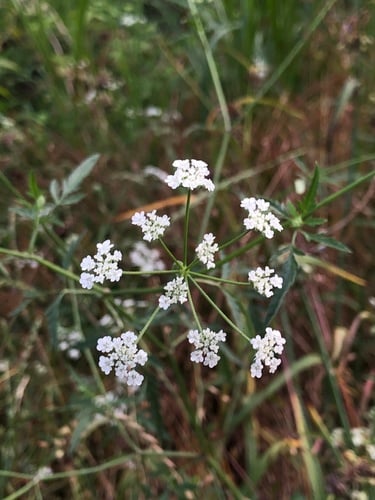
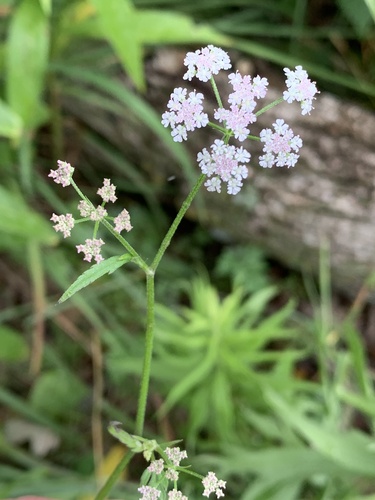
Cryptotaenia japonica
Hasskarl
Japanese parsley
iNaturalist· cc0
no rights reserved, uploaded by 葉子
iNaturalist· cc-by-nc
(c) Chuangzao, some rights reserved (CC BY-NC), uploaded by Chuangzao
iNaturalist· cc-by
(c) Cheng-Tao Lin, some rights reserved (CC BY), uploaded by Cheng-Tao Lin
Summary
Source: WikipediaCryptotaenia japonica, commonly called mitsuba, Japanese wild parsley and Japanese honewort among other names, is a herbaceous perennial plant in the celery family native to Japan, Korea and China. The plant is edible and is commonly used as a garnish and root vegetable in Japan, and other Asian countries. It is sometimes considered a subspecies of Cryptotaenia canadensis as Cryptotaenia canadensis subsp. japonica.
Description
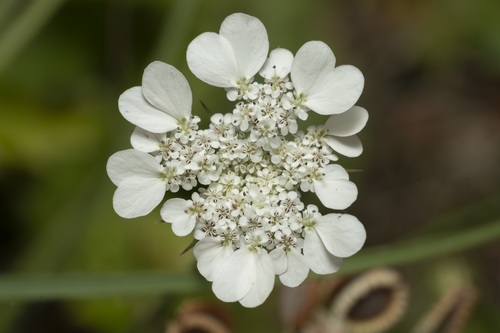
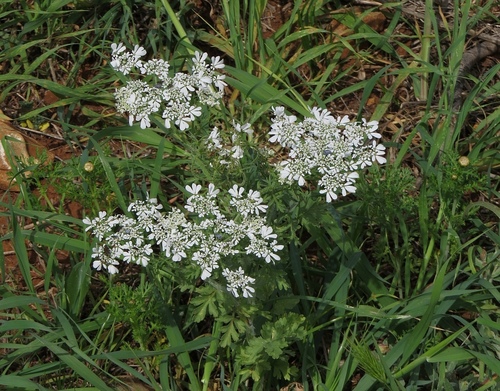
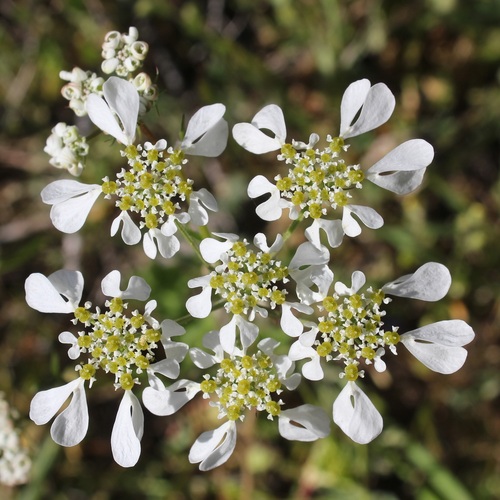
A perennial normally grown as an annual. It grows 1 m tall. The leaves have leaflets along the stalk. These are broader than C. canadensis. They are also more closely spaced. The leaves near the base and lower on the stalks have leaves with 3 leaflets. They are triangle shaped. The flowers are small and white in loose groups.
Edible Uses
Leaves and stems can be eaten raw or cooked, offering a parsley-like flavour that works well as a seasoning. Seedlings and young leaves make a useful addition to salads. When cooking leaves, limit them to no more than a couple of minutes or the flavour is lost. The leaves contain roughly 2.3% protein, 0.23% fat, 4.4% carbohydrate, and 2.1% ash. The root can be eaten raw or cooked, and blanched stems make a reasonable celery substitute. Seeds are used as a seasoning.
Traditional Uses
The leaves are boiled than eaten with oil and salt. The roots are cooked and eaten The seeds are used for seasoning. Young seedlings or sprouts are eaten. The leaves and leaf stalks are blanched and eaten raw in salads.
Medicinal Uses
Used to treat haemorrhages, colds, and fevers, and is considered a tonic for strengthening the body. It has applications for women's complaints and acts as a febrifuge.
Distribution
It is a temperate plant. It suits cooler places. It withstands frosts well. It can grow in shade. In China it grows in damp places between 200-2,400 m. It suits hardiness zones 4-10. Melbourne Botanical Gardens. In Sichuan and Yunnan.
Where It Grows
Asia, Australia, China, Hawaii, Indonesia, Japan, Korea, North America, Russia, SE Asia, Taiwan, Tasmania, USA,
Cultivation
Succeeds in most soils, preferring a moist shady position under trees where it often self-sows. The leaves tend to turn yellow when plants are grown in full sun. This species is not winter-hardy in all areas of Britain, though plants can tolerate short periods at temperatures down to -10°c. Mitsuba is commonly cultivated as a vegetable in Japan, there are some named varieties. It is usually grown as an annual. It is closely allied to C. canadensis, and is considered to be no more than a synonym of that species by some botanists. This plant is adored by slugs and snails and must be protected when small or when new growth is emerging in the spring.
Propagation
Sow seed in April in a greenhouse; germination is usually rapid. Prick seedlings into individual pots when large enough to handle and plant out in early summer. The ideal germination temperature is around 25°C, though seed will germinate at higher and lower temperatures. Seed can also be sown in early autumn. The plant can also be divided in spring or autumn.
Other Uses
No other uses are known. The plant is suited to food forest settings.
Production
Either the whole plant can be pulled out or leaves can be cut and allowed to grow again.
Other Information
It is a commercially cultivated vegetable. It is used as a vegetable in Japan.
Notes
Chemical composition: Protein = 2.3%. Fat = 0.23%. Carbohydrate = 4.4%. Ash = 2.1%. Contains a small amount of fragrant oil.
Nutrition
| Part | Moisture | kJ | kcal | Protein | Vit A | Vit C | Iron | Zinc |
|---|---|---|---|---|---|---|---|---|
| Leaves | 93.5 | 75 | 18 | 2 | 48 | — | 1.8 | — |
Synonyms
Also Known As
Honewort, Japanese honewort, Japanese cryptotaenia, Mitsuba, Padudugnamul, San ip, San ye qin, Trefoil, Yajiuban
References (34)
- Arora, R. K., 2014, Diversity in Underutilized Plant Species - An Asia-Pacific Perspective. Bioversity International. p 39
- AVRDC files
- Brown, D., 2002, The Royal Horticultural Society encyclopedia of Herbs and their uses. DK Books. p 184
- Crawford, M., 2012, How to grow Perennial Vegetables. Green Books. p 134
- Creasy, R., 2000, The Edible Asian Garden. Periplus p 47
Show all 34 references Hide references
- Cundall, P., (ed.), 2004, Gardening Australia: flora: the gardener's bible. ABC Books. p 440
- Duke, J.A., 1992, Handbook of Edible Weeds. CRC Press. p 80
- Eisenberg et al, 2009, Kam Local Indigenous Knowledge and Sustainable Resource Management in Ghuizhou and Guangxi Provinces, China. Ethnobotany Research and Applicatons 7:067-113
- Facciola, S., 1998, Cornucopia 2: a Source Book of Edible Plants. Kampong Publications, 17
- Food Composition Tables for use in East Asia FAO http://www.fao.org/infoods/directory No. 543
- Fujime, Y., 2012, Introduction to Some Indigenous Vegetables in Japan. HortScience Vol. 47(7) July 2012. p 831
- Hibbert, M., 2002, The Aussie Plant Finder 2002, Florilegium. p 77
- Hu, Shiu-ying, 2005, Food Plants of China. The Chinese University Press. p 594
- Jackes, D. A., Edible Forest Gardens
- Kang, Y., et al, 2012, Wild food plants and wild edible fungi in two valleys on the Qinling Mountains (Shaanxi, central China) Journal of Ethnobiology and Ethnomedicine; 9:26
- Kays, S. J., and Dias, J. C. S., 1995, Common Names of Commercially Cultivated Vegetables of the World in 15 languages. Economic Botany, Vol. 49, No. 2, pp. 115-152
- Kiple, K.F. & Ornelas, K.C., (eds), 2000, The Cambridge World History of Food. CUP p 1786
- Larkcom, J., 1991, Oriental Vegetables, John Murray, London, p 98, 137
- Lim, T. K., 2015, Edible Medicinal and Non Medicinal Plants. Volume 9, Modified Stems, Roots, Bulbs. Springer p 29
- Pemberton, R. W. & Lee, N. S., 1996, Wild Food Plants in South Korea: Market Presence, New Crops, and Exports to the United States. Economic Botany, Vol. 50, No. 1, pp. 57-70
- Plants for a Future database, The Field, Penpol, Lostwithiel, Cornwall, PL22 0NG, UK. http://www.scs.leeds.ac.uk/pfaf/
- READ,
- Retzia 1:113. 1855
- Rodriguez-Amaya, D. B., 1999, Carotenoides y Prepracion de Alimentos. University Estadual de Campinas, Brasil, Ph.D. thesis. p 23
- Ryan, S., 2008, Dicksonia. Rare Plants Manual. Hyland House. p 99
- Seidemann J., 2005, World Spice Plants. Economic Usage, Botany, Taxonomy. Springer. p 124
- Smith, K., 1998. Growing Uncommon Fruits and Vegetables. New Holland. p 52
- Solomon, C., 2001, Encyclopedia of Asian Food. New Holland. p 235
- Staples, G.W. and Herbst, D.R., 2005, A tropical Garden Flora. Bishop Museum Press, Honolulu, Hawaii. p 114
- Thomson, G. & Morgan, W., (Ed.) 2003, Access to Asian Foods Newsletter, Vic Govt., Australia Issue 64
- USDA, ARS, National Genetic Resources Program. Germplasm Resources Information Network - (GRIN). [Online Database] National Germplasm Resources Laboratory, Beltsville, Maryland. Available: www.ars-grin.gov/cgi-bin/npgs/html/econ.pl (10 April 2000)
- Waters, C T, Morgan, W C, McGeary, D J, 1992, Oriental Vegetables. AgMedia, Victoria, Australia p 71
- Wiersema, J. H. & Leon, B., 2013, World Economic Plants. A Standard Reference CRC Press. 2nd Ed. p 215
- World Checklist of Useful Plant Species 2020. Royal Botanic Gardens, Kew