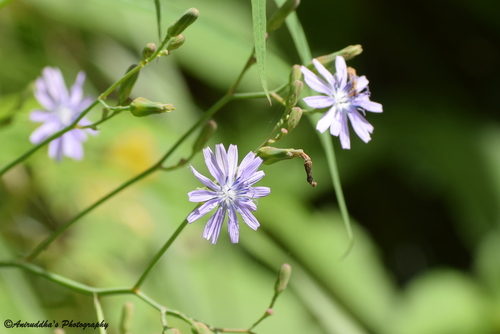
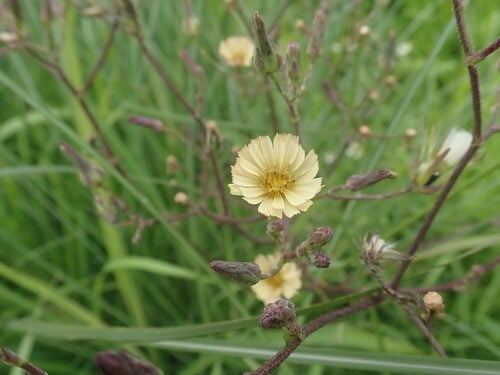
Crepis vesicaria
L.
Beaked Hawksbeard, Dandelion crepis
iNaturalist· cc-by-nc-sa
(c) Maria Emília Martins, some rights reserved (CC BY-NC-SA)
iNaturalist· cc-by-nc-sa
(c) José María Escolano, some rights reserved (CC BY-NC-SA)
Summary
Source: WikipediaCrepis vesicaria is a European species of flowering plant in the family Asteraceae with the common name beaked hawk's-beard. It is native to the Western and Southern Europe from Ireland and Portugal east as far as Germany, Austria, and Greece. It became naturalized in scattered locations in North America. Crepis vesicaria is an annual, biennial, or perennial herb up to 120 cm (48 inches or 4 feet) tall, producing a large underground caudex. Each plant can have as many as 20 flower heads, each with up to 70 ray florets but no disc florets. It grows on hillsides and in sandy clearings. A prominent plant, Crepis vesicaria stands erect, with many branches, each ending in its own dandelion-like flower. The underside of the flower has two layers of leaf-like phyllaries. The inner layer is longer and pointed, and often curls back away from the rest of the flower head. The outer layer is substantially shorter. The plant is a source of helenynolic acid, a rare fatty acid.
Description
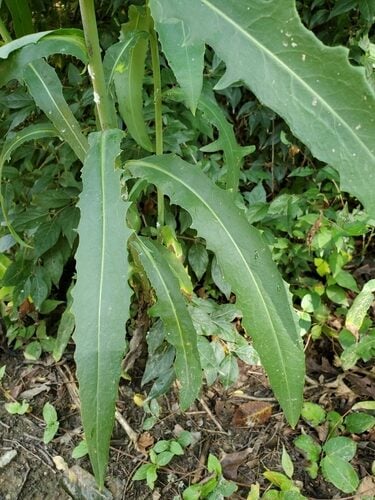
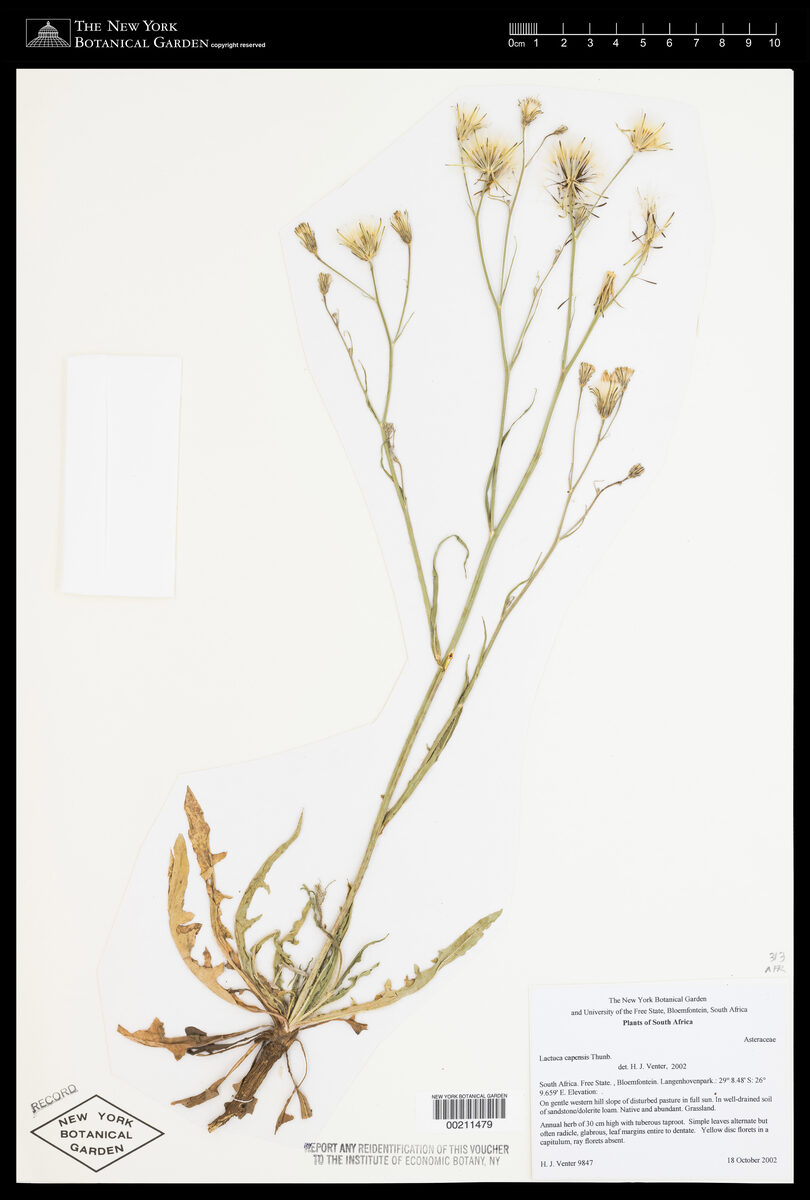
A herb. It can grow each year from seed or take 2 years to complete its life-cycle. It grows 70 cm to 1.5 m high. The stems are branched. The leaves at the base are lyre shaped and softly hairy. They are fleshy and have wavy edges. Later leaves near flowering become lobed. The flowers are yellow. They are 2.5 cm across.
Edible Uses
The leaves are eaten raw in salads, though they have a bitter taste.
Traditional Uses
The lower leaves that form a ring are boiled and seasoned with oil and lemon. They are eaten in salads or stews.
This uses section is brief — help expand it
Medicinal Uses
None known
Distribution
It grows in temperate places. It grows in lawns and pastures.
Where It Grows
Australia, Britain, Crete, Europe, France, Greece, Ireland, Italy, Mediterranean, Sicily, Spain,
Cultivation
See the plants native habitat for ideas on its needs. C. vesicaria is a large aggregate species that it sometimes divided into various sub-species. Plants are usually biennial, but they can be perennial or even annual.
Propagation
Sow seed in situ either as soon as it is ripe in late summer or in spring.
Other Uses
None known
Synonyms
Also Known As
Achicoria, Camarroja, Cicuriune, Kokkinogoulia, Pikrouses, Zicoria burda
References (18)
- Biscotti, N. & Pieroni, A., 2015, The hidden Mediterranean diet: wild vegetables traditionally gathered and consumed in the Gargano area, Apulia, SE Italy. Acta Societatis Botanicorum Poloniae 84 (3): 327-338
- Biscotti, N. et al, 2018, The traditional food use of wild vegetables in Apulia (Italy) in the light of Italian ethnobotanical literature. Italian Botanist 5:1-24
- Dretakis, M. et al, 2012, Flora and Fauna Biodiversity in an ancient olive grove in Crete (Greece) in Calabrese G. (Ed.) Study on Biodiversity in Century-Old Olive Groves. CIHEAM - Mediterranean Agronomic Institute of Bari. p 94
- Geraci, A., et al, 2018, The wild taxa utilized as vegetables in Sicily (Italy): a traditional component of the Mediterranean diet. Journal of Ethnobiology and Ethnomedicine (2018) 14:14
- Hussey, B.M.J., Keighery, G.J., Cousens, R.D., Dodd, J., Lloyd, S.G., 1997, Western Weeds. A guide to the weeds of Western Australia. Plant Protection Society of Western Australia. p 96
Show all 18 references Hide references
- Irving, M., 2009, The Forager Handbook, A Guide to the Edible Plants of Britain. Ebury Press p 150
- Lentini, F. and Venza, F., 2007, Wild food plants of popular use in Sicily. J Ethnobiol Ethnomedicine. 3: 15
- Licata, M., et al, 2016, A survey of wild plant species for food use in Sicily (Italy) – results of a 3-year study in four Regional Parks. Journal of Ethnobiology and Ethnomedicine 12:12
- Paczkowska, G. & Chapman, A.R., 2000, The Western Australian Flora. A Descriptive Catalogue. Western Australian Herbarium. p 161
- Pasta, S., et al, 2020, An Updated Checklist of the Sicilian Native Edible Plants: Preserving the Traditional Ecological Knowledge of Century-Old Agro-Pastoral Landscapes. Frontiers in Plant Science. Volume 11|Article 388
- Pieroni, A., et al, 2005, Food for two seasons: Culinary uses of non-cultivated local vegetables and mushrooms in a south Italian village. International Journal of Food Sciences and Nutrition, 56(4): 245-272
- Plants for a Future database, The Field, Penpol, Lostwithiel, Cornwall, PL22 0NG, UK. http://www.scs.leeds.ac.uk/pfaf/
- Rivera, D. et al, 2006, Gathered Mediterranean Food Plants - Ethnobotanical Investigations and Historical Development, in Heinrich M, Müller WE, Galli C (eds): Local Mediterranean Food Plants and Nutraceuticals. Forum Nutr. Basel, Karger, 2006, vol 59, pp 18–74
- Signorini, M. A., et al, 2009, Plants and traditional knowledge: An ethnobotanical investigation on Monte Ortobene (Nuoro, Sardinia). Journal or Ethnobiology and Ethnomedicine, 5:6
- Skoula, M & Sarpaki, A., 2005, Traditional knowledge on the uses of wild plants in Crete, Greece.
- Sp. pl. 2:805. 1753
- Tardio, J., et al, Ethnobotanical review of wild edible plants in Spain. Botanical J. Linnean Soc. 152 (2006), 27-71
- Vardavas, C. I., et al, 2006, Lipid concentrations of wild greens in Crete. Food Chemistry 99: 822-834