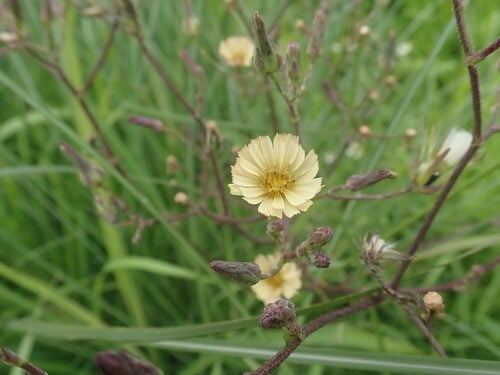
Dittrichia graveolens
(L.) Greuter
iNaturalist· cc-by-sa
(c) Fabien Piednoir, some rights reserved (CC BY-SA), uploaded by Fabien Piednoir
iNaturalist· cc-by-nc
(c) Linda Pardy, some rights reserved (CC BY-NC), uploaded by Linda Pardy
iNaturalist· cc-by-nc
(c) madge, some rights reserved (CC BY-NC), uploaded by madge
Summary
Source: WikipediaDittrichia graveolens, commonly known as stinkwort or stinking fleabane, is a plant species in the sunflower family, native to southern Europe, North Africa, and western Asia as far east as Pakistan. It has become naturalized in California, Asia, Africa, Australia, and other places and is regarded as a noxious weed in some regions. It is a classified as an invasive species in California, and a potential threat to wine production in the state. The plant is a branching subshrub growing up to 130 centimetres (51 inches) tall, with an aromatic, camphor smell. Leaves are long and narrow, pointed at each end, with small teeth along the edges, glandular hairs on the surfaces, and a sticky resin. One plant can produce numerous yellow flower heads with as many as 16 ray florets and 40 disc florets. Barbs on the fluffy-tipped seeds, which help it spread, can fatally damage the digestive systems of grazing animals. Oils in the plant also taint the flavor of meat and milk of animals that have consumed them. The sticky resin has been known to cause allergic reactions and severe dermatitis in humans. For this reasons, it is advisable to wear protective gloves when handling the plant.
Description
A herb. It has a strong smell. It grows 20-130 cm tall. The leaves are narrow and 3-7 cm long by 1-3 mm wide. There can be teeth along the edge. They taper to the tip.
Edible Uses
The leaves are used as a drink, traditionally to preserve grapes.
Traditional Uses
The leaves are used as a drink to preserve grapes.
This uses section is brief — help expand it
Distribution
It is a Mediterranean climate plant.
Where It Grows
Africa, Australia, Europe, Italy, Mediterranean, South Africa, Southern Africa, Spain, Tasmania,
Also Known As
Herba matapulgas, Herba pansera
References (2)
- Blanco-Salas, J., et al, 2019, Wild Plants Potentially Used in Human Food in the Protected Area “Sierra Grande de Hornachos” of Extremadura (Spain). Sustainability 2019, 11, 456
- Bonet, M. A. & Valles, J., 2002, Use of non-crop food vascular plants in Montseny biosphere reserve (Catalonia, Iberian Peninsula). International Journal of Food Sciences and Nutrition (2002) 53, 225–248 (As Inula graveolens)