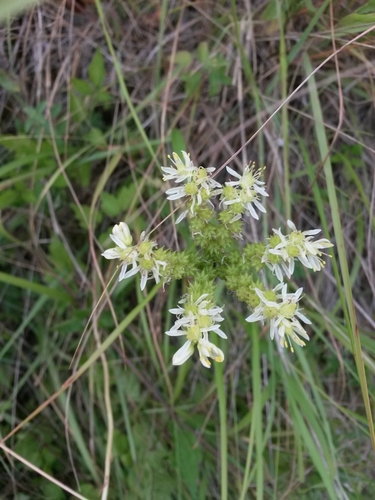
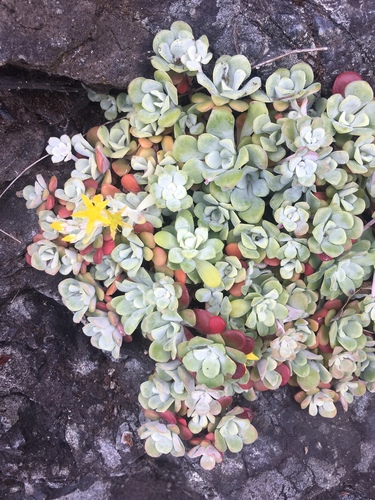
Kalanchoe lanceolata
(Forssk.) Pers.
Narrow-leaved kalanchoe
iNaturalist· cc0
no rights reserved, uploaded by Simon Tonge
iNaturalist· cc-by-nc
(c) Elizabeth Odendaal, some rights reserved (CC BY-NC)
Description
A succulent herb. It grows up to 150 cm tall. It has a ring of dark green leaves. They do not have stalks. The stems have 4 angles.
This description is brief — help expand it
Edible Uses
The plant is used medicinally.
Medicinal Uses
In traditional medicine, Kalanchoe species have been used to treat ailments such as infections, rheumatism and inflammation. Kalanchoe extracts also have immunosuppressive effects. Kalanchoe pinnata has been recorded in Trinidad and Tobago as being used as a traditional treatment for hypertension. A variety of bufadienolide compounds have been isolated from various Kalanchoe species. Five different bufadienolides have been isolated from Kalanchoe daigremontiana. Two of these, daigremontianin and bersaldegenin 1,3,5-orthoacetate, have been shown to have a pronounced sedative effect. They also have the strong positive inotropic effect associated with cardiac glycosides, and with greater doses an increasing effect on the central nervous system. Bufadienolide compounds isolated from Kalanchoe pinnata include bryophillin A which showed strong anti-tumor promoting activity, and bersaldegenin-3-acetate and bryophillin C which were less active. Bryophillin C also showed insecticidal properties.
Distribution
It is a tropical plant. It grows in drier areas. It grows between 900-2,100 m in Africa.
Where It Grows
Africa, Asia, Botswana, Cameroon, East Africa, Egypt, Eswatini, Ghana, India, Kenya, Madagascar, Mali, Namibia, Nigeria, North Africa, North America, South Africa, Southern Africa, Sudan, Swaziland, USA, West Africa, Zimbabwe,
Cultivation
It can be grown from one leaf.
Propagation
Seed - Easy to propagate vegetatively - just one leaf with part of its stem, when set on the soil, will produce roots and grow into a new plant.
Synonyms
Also Known As
Intelezi, Moithimodiso
References (4)
- Beckstrom-Sternberg, Stephen M., and James A. Duke. "The Foodplant Database." http://probe.nalusda.gov:8300/cgi-bin/browse/foodplantdb.(ACEDB version 4.0 - data version July 1994) (As Cotyledon lanceolata)
- Fl. aegypt.-arab. 89. 1775 (As Cotyledon lanceolata)
- Mutie, F. M., et al, 2023, Important Medicinal and Food Taxa (Orders and Families) in Kenya, Based on Three Quantitative Approaches. Plants 2023, 12, 1145
- World Checklist of Useful Plant Species 2020. Royal Botanic Gardens, Kew