Bryophyllum pinnatum
(Lam.) Oken
Resurrection plant, Air plant, Never die
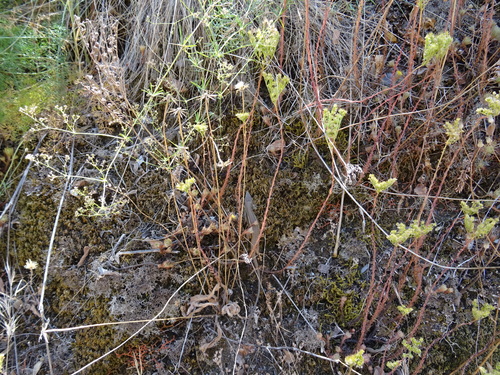
iNaturalist· cc-by-nc
(c) Rahaingoson Fabien, some rights reserved (CC BY-NC)
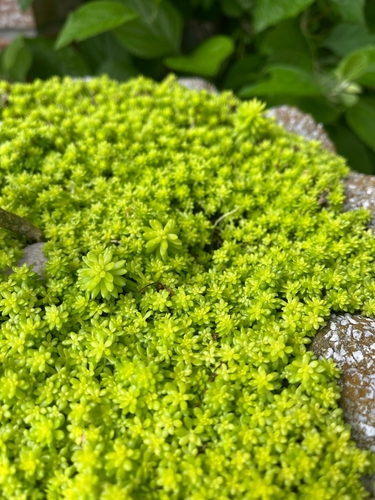
iNaturalist· cc-by-nc
(c) Rahaingoson Fabien, some rights reserved (CC BY-NC)
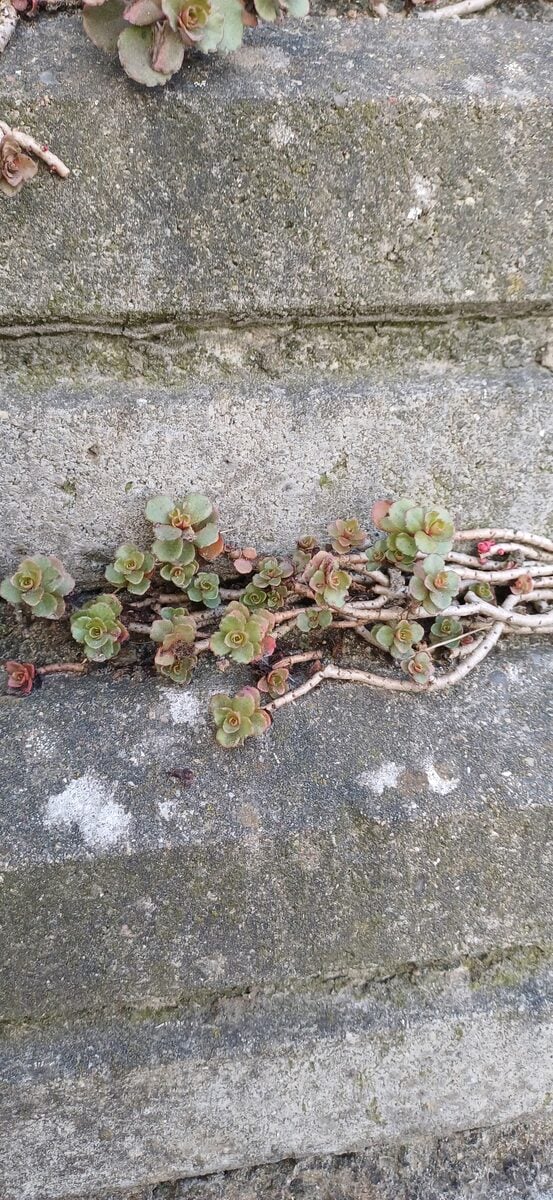
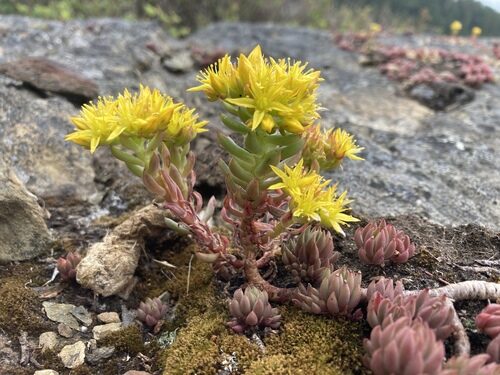
iNaturalist· cc-by-nc
(c) scottchen642, some rights reserved (CC BY-NC)
Description
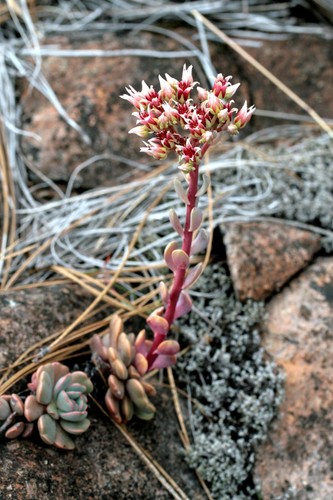
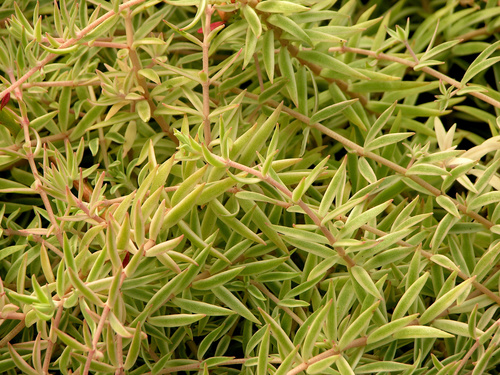
An evergreen succulent herb or shrub. The stems are 0.3-2 m high. They can be woody at the base. It grows to 1 m high and spreads to 1 m wide. The stems are erect, stout and purplish green. The leaves can be simple or upper leaves have 3-5 leaflets. The leaves are large and fleshy. They have teeth around the edge. They are succulent. The leaves are 5-20 cm long by 3-12 cm wide. Small plants can grow from the edges of the leaves. The flowers hang down in clusters at the ends of branches. The flowers are like tubes and are green with purple tips. They are large and have red and purple stripes. The fruit follicles are 10-14 mm long. There are several seed in each fruit.
Edible Uses
The leaves are eaten as a vegetable, used in curries and sauces, and mixed with other vegetables; they are acidic but become less so later in the day and at certain times of year. Nectar is sucked directly from the flowers, particularly by children.
Traditional Uses
The leaves are sometimes eaten as a vegetable. They are acidic. They are less acidic later in the day and at some times of the year. The leaves are used in curry. The leaves are used to prepare a sauce. The fleshy leaves are mixed with other vegetables. The nectar can be sucked from the flowers.
Medicinal Uses
The leaves have traditional medicinal uses.
Distribution
A tropical plant. It does best in well drained, well-composted soils. It needs an open sunny position. It is damaged by drought and frost. It needs a temperature above 12°C. It grows to 1,000 m above sea level. It grows in dry sunny places. In XTBG Yunnan. At MARDI.
Where It Grows
Africa*, Angola, Asia, Australia, Brunei, Cambodia, Caroline Islands, Central America, China, Congo DR, East Africa, East Timor, Eswatini, Fiji, Guiana, Guianas, Guyana, Haiti, India, Indochina, Indonesia, Kiribati, Laos, Madagascar, Malawi, Malaysia, Mauritius, Mozambique, Myanmar, Nepal, New Zealand, Niue, North America, Northeastern India, Pacific, Pakistan, Panama, Papua New Guinea, PNG, Philippines, Sao Tome and Principe, SE Asia, Sierra Leone, South Africa, Southern Africa, South America, Sudan, Suriname, Swaziland, Taiwan, Thailand, Timor-Leste, Tokelau, Tuvalu, USA, Venezuela, Vietnam, West Africa, West Indies, West Timor, Zimbabwe,
Cultivation
Plants can be grown from seed or cuttings. Leaf buds root easily.
Other Information
Leaves are sold in local markets. The nectar is eaten especially by children. It is cultivated.
Notes
There are about 30 Bryophyllum species. It is considered a weed in Australia.
Nutrition
| Part | Moisture | kJ | kcal | Protein | Vit A | Vit C | Iron | Zinc |
|---|---|---|---|---|---|---|---|---|
| Leaves | 89.7 | 130 | 31 | 1.9 | — | 44 | — | — |
Synonyms
Also Known As
Ajambari, Anhelika, Anheliko, Chandelier plant, Cocor bebek, Dupar tenga, Dupor tenga, Ghavpala, Lamalam, Luna, Maikhri lai, Mchu prek, Mgbidingbi, Miracle plant, Miru heu, Pagi, Panphuti, Pategaja, Pategoja, Ranakalli, Te ang, Tenga patta, Thuoc Bong, Truongsanh long-chim
References (31)
- Arinathan, V., et al, 2007, Wild edibles used by Palliyars of the western Ghats, Tamil Nadu. Indian Journal of Traditional Knowledge. 6(1) pp 163-168 (As Kalanchoe pinnata)
- Bodkin, F., 1991, Encyclopedia Botanica. Cornstalk publishing, p 601 (As Kalanchoe pinnata)
- Borrell, O.W., 1989, An Annotated Checklist of the Flora of Kairiru Island, New Guinea. Marcellin College, Victoria Australia. p 65 (As Kalanchoe pinnata)
- Brickell, C. (Ed.), 1999, The Royal Horticultural Society A-Z Encyclopedia of Garden Plants. Convent Garden Books. p 578 (As Kalanchoe pinnata)
- Chandrakumar, P., et al, 2015, Ethnobotanical studies of wild edible plants of Gond, Halba and Kawar tribes of Salekasa Taluka, Gondia District, Maharashtra State, India. International Research Journal of Pharmacy 6(8) (As Kalanchoe pinnata)
Show all 31 references Hide references
- Cowie, I, 2006, A Survey of Flora and vegetation of the proposed Jaco-Tutuala-Lore National Park. Timor-Lests (East Timor) www.territorystories.nt/gov.au p 46
- Flora of China @ efloras.org Volume 8
- Flora of Pakistan. www.eFloras.org
- Hibbert, M., 2002, The Aussie Plant Finder 2002, Florilegium. p 176 (As Kalanchoe pinnata)
- Kuhnlein, H. V., et al, 2009, Indigenous Peoples' food systems. FAO Rome p 262
- Kuo, W. H. J., (Ed.) Taiwan's Ethnobotanical Database (1900-2000), http://tk.agron.ntu.edu.tw/ethnobot/DB1.htm
- Latham, P., 2004, Useful Plants of Bas-Congo province. Latham & DFID p 62
- Lazarides, M. & Hince, B., 1993, Handbook of Economic Plants of Australia, CSIRO. p 142 (As Kalanchoe pinnata)
- Lacuna-Richman, C., 2006, The use of non-wood forest products by migrants in a new settlement: experiences of a Visayan community in Palawan, Philippines. Journal of Ethnobiology and Ethnomedicine. 2:36 (As Kalanchoe pinnata)
- Medhi, P. & Borthakur, S. K., 2012, Phytoresources from North Cachur Hills of Assam -3: Edible plants sold at Hflong market. Indian Journal or Natural Products and Resources. 3(1) pp 84-109
- Medhi, P., Sarma, A and Borthakur, S. K., 2014, Wild edible plants from the Dima Hasao district of Assam, India. Pleione 8(1): 133-148
- Mot So Rau Dai an Duoc O Vietnam. Wild edible Vegetables. Ha Noi 1994, p 218 (As Kalanchoe pinnata)
- Patiri, B. & Borah, A., 2007, Wild Edible Plants of Assam. Geethaki Publishers. p 51 (As Kalanchoe pinnata)
- Pegu, R., et al, 2013, Ethnobotanical study of Wild Edible Plants in Poba Reserved Forest, Assam, India. Research Journal of Agriculture and Forestry Sciences 1(3):1-10 (As Kalanchoe pinnatum)
- Phon, P., 2000, Plants used in Cambodia. © Pauline Dy Phon, Phnom Penh, Cambodia. p 386 (As Kalanchoe pinnata)
- Plants of Haiti Smithsonian Institute http://botany.si.edu/antilles/West Indies (As Kalanchoe pinnata)
- PROSEA (Plant Resources of South East Asia) handbook, Volume 12 (1), 1999, Medicinal and poisonous
- Rajasab, A. H. et al, 2004, Documentation of folk knowledge on edible wild plants of North Karnataka. Indian Journal of Traditional Knowledge. Vol 3(4) pp 419-429 (As Kalanchoe pinnata)
- Rajkalkshmi, P. et al, 2001, Total carotenoid and beta-carotene contents of forest green leafy vegetables consumed by tribals of south India. Plant Foods for Human Nutrition 56:225-238
- Sarma, H., et al, 2010, Updated Estimates of Wild Edible and Threatened Plants of Assam: A Meta-analysis. International Journal of Botany 6(4): 414-423
- Smith, A.C., 1985, Flora Vitiensis Nova, Lawaii, Kuai, Hawaii, Volume 3 p 27 (As Kalanchoe pinnata)
- Swaziland's Flora Database http://www.sntc.org.sz/flora (As Kalanchoe pinnata)
- Thaman, R. R., 1987, Plants of Kiribati: A listing and analysis of vernacular names. Atoll Research Bulletin No. 296 (As Kalanchoe pinnata)
- Whistler, W. A., 1988, Ethnobotany of Tokelau: The Plants, Their Tokelau Names, and Their Uses. Economic Botany 42(2): 155-176 (As Kalanchoe pinnata)
- Wild edible plants of Himachal Pradesh (As Bryophyllum calycinum)
- Zeven, A. C. & de West, J. M. J., 1982, Dictionary of cultivated plants and their regions of diversity. Wageningen. p 123