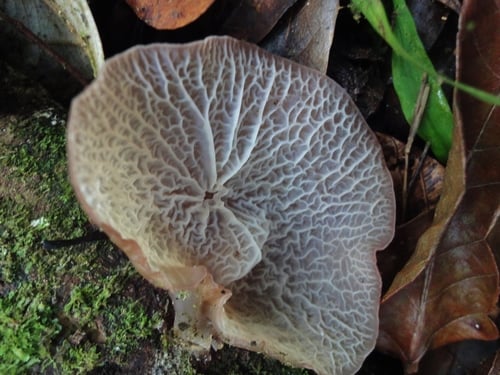
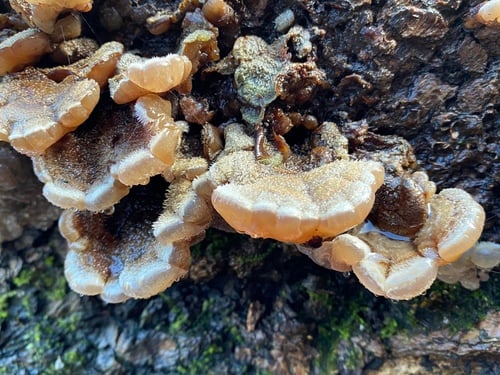
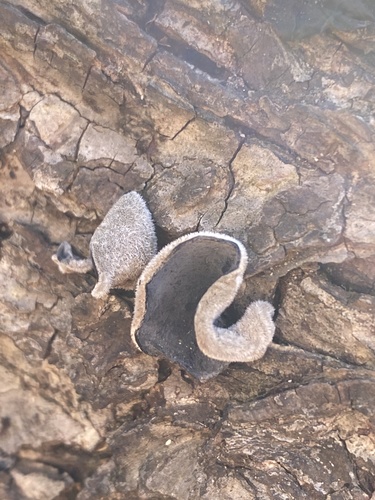
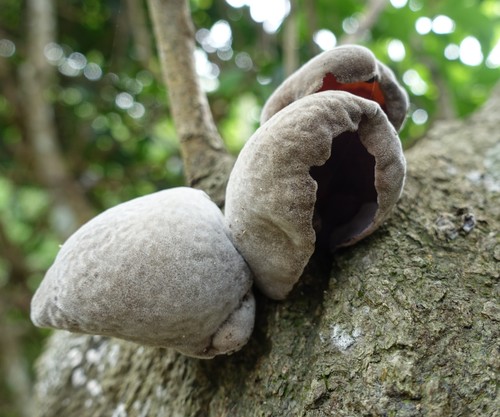
Auricularia heimuer
F. Wu, B. K. Cui, & Y. C. Dai
iNaturalist· cc-by-sa
(c) Dinesh Valke, some rights reserved (CC BY-SA)
iNaturalist· cc-by-sa
(c) Dinesh Valke, some rights reserved (CC BY-SA)
iNaturalist· cc-by-sa
(c) Dinesh Valke, some rights reserved (CC BY-SA)
Summary
Source: WikipediaAuricularia heimuer, also known as heimuer (Chinese: 黑木耳; pinyin: hēimù'ěr) or black wood ear, is a species of fungus in the order Auriculariales. It is commercially cultivated for food in China at a value exceeding $4 billion (USD) per year. The species was previously referred to as the European Auricularia auricula-judae, but the latter is not known to occur in East Asia. Auricularia heimuer is a popular ingredient in many Chinese dishes, such as hot and sour soup, and it is also used in traditional Chinese medicine.
Description
A mushroom.
This description is brief — help expand it
Edible Uses
In China, the use of an Auricularia species, probably A. heimuer, as a food and a medicine was recorded in the 3rd-century Chinese medicinal book Shennong Ben Cao Jing. Species were being cultivated in China as early as the Tang dynasty (618–907). Li Shizhen, in his Pen Tsao Kang Mu, quotes Tang Ying-chuan from that period as saying "put the steamed bran on logs, cover with straw, Wood Ear will grow". The fungus is widely used as an ingredient in savoury dishes and is also cooked and served as a salad with vegetables and flavourings. A soup containing the species is used medicinally for dealing with colds and fevers in the belief that it reduces the heat of the body. According to a 2010 publication, the annual production of Auricularia species worldwide is the fourth highest among all industrially cultivated culinary and medicinal mushrooms. The estimated annual output in China in 2013 was 4.75 billion kg in fresh weight, with a value of about four billion US dollars. In Japan, the fungus is known as kikurage (キクラゲ; lit. "wood jellyfish") and is commonly shredded and used as a topping in ramen. A 2018 Japanese study surveyed 26 local specimens originally determined as A. auricula-judae. The molecular identification was as follows: 4 samples of A. heimuer, 7 of A. minutissima, 10 of A. villosula, and 5 of A. thailandica. In Korea, the mushroom is called heuk-mogi (Korean: 흑목이; Hanja: 黑木耳). It is commercially cultivated and commonly used in japchae.
Distribution
It is a temperate plant.
Where It Grows
Asia, China,
Other Information
It is cultivated. It is an important mushroom.
References (1)
- forests-366202-SI