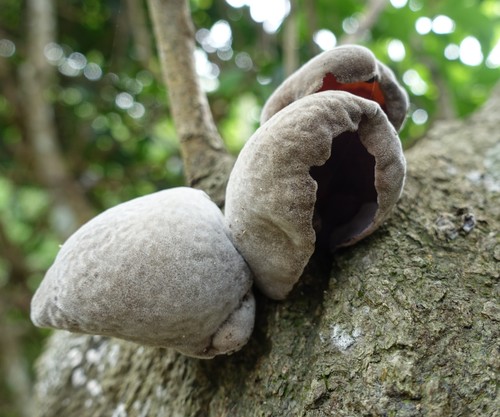
Auricularia delicata
(Mont. ex Fr.) Hennings
Jew’s ear, mushroom, Brown wood ear
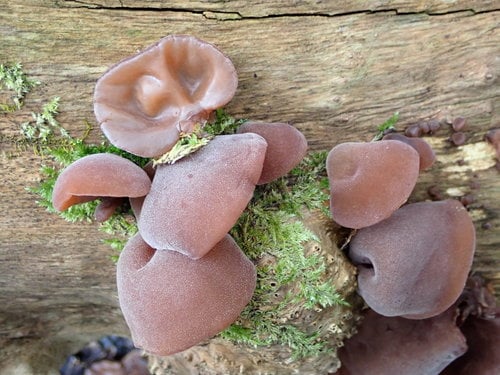
iNaturalist· cc-by-nc
(c) Eric van den Berghe, some rights reserved (CC BY-NC), uploaded by Eric van den Berghe
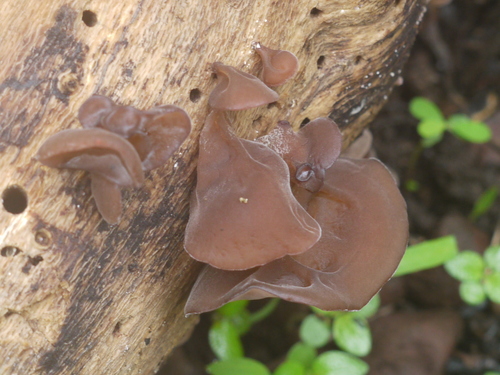
iNaturalist· cc-by
(c) Daniel Mesa, some rights reserved (CC BY), uploaded by Daniel Mesa
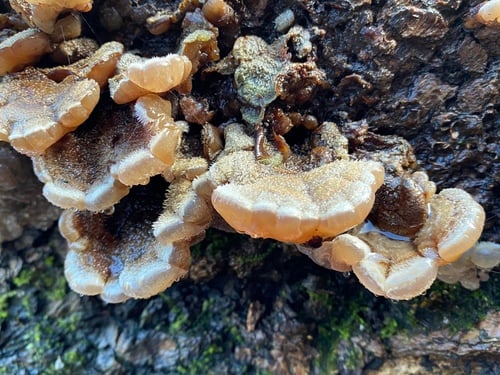
iNaturalist· cc-by-nc
(c) balawu, some rights reserved (CC BY-NC), uploaded by balawu
Description
A tropical mushroom in the family Auriculariaceae that is sold in local markets.
This description is brief — help expand it
Edible Uses
The mushroom is cooked in stews.
Traditional Uses
The mushroom is cooked in stew.
This uses section is brief — help expand it
Medicinal Uses
At least three species are commercially cultivated for food on a large scale in China and East Asia. They include Auricularia heimuer (black wood ear), formerly misdetermined as Auricularia auricula-judae; Auricularia cornea (wood ear or cloud ear), also called A. polytricha; and Auricularia villosula. Other species are eaten locally around the world. A study on the use of fungi by the Bini people of southern Nigeria found that the local inhabitants collected and ate a species similar to A. auricula-judae, but that it was not one of the fungi they used medicinally. Collection of Auricularia species has also been documented in Nepal. However, the Nepalese do not consider them all that good for eating; of the three grades given to edible fungi, they were given the worst. Additional places where Auricularia species have been recorded as locally gathered and consumed include Benin, Chile, Fiji, Ghana, Guatemala, India, Indonesia, Madagascar, Mexico, Mozambique, and Poland. Several species, including the Asian cultivated species and the European A. auricula-judae (jelly ear or jew's ear), have been used in traditional medicine. They have also been investigated for potential pharmaceutical use.
Distribution
A tropical plant.
Where It Grows
Africa, Asia, Australia, Benin, Burundi, Central Africa, Central America, China, Congo DR, East Africa, Guatemala, Guyana, Himalayas, Hong Kong, India, Indonesia, Laos, Malawi, Malaysia, Mexico, Nepal, Northeastern India, North America, Peru, Rwanda, SE Asia, South America, Tanzania, West Africa, Zambia,
Other Information
It is sold in local markets.
Synonyms
Also Known As
Barati-jike, Choch e wakax lo'ro, Het hou nou, Koroch, Mukhum, Oreja de chango, Oreja de cochi, Ozenabi, Pachop, Tinunger becuk, Yaonupa
References (20)
- Andel T. van, 2000, Non-timber forest products of the North-West District of Guyana. Part 2. A Field Guide. Tropenbos-Guyana Programme. p 252
- Bhaben, T., et al, 2010, Wild edible fungal resources by ethnic tribes of nagaland, India. Indian Journal of Traditional Knowledge. Vol 10(3) p 513
- Boa, E. R., 2004, Wild edible fungi and their importance to people. FAO Non Wood Forest Products Booklet 17
- Burkill, I.H., 1966, A Dictionary of the Economic Products of the Malay Peninsula. Ministry of Agriculture and Cooperatives, Kuala Lumpur, Malaysia. Vol 1 (A-H) p 270
- Cribb, A.B. & J.W., 1976, Wild Food in Australia, Fontana. p 201
Show all 20 references Hide references
- Degreef, J., et al, 2016, Wild edible mushrooms, a valuable resource for food security and rural development in Burundi and Rwanda. Biotechnol. Agron. Soc. Environ. 2016 20(4), 441-452
- efta-online.org, Edible Fungi of Tropical Africa, Jardin botanique Meise
- Hoare, A., 2003, Food use of the Lundayeh SW Sabah. Borneo Research Council.
- Kamalebo, H. M., et al, 2018, Uses and importance of wild fungi: traditional knowledge from the Tshopo province in the Democratic Republic of the Congo. Journal of Ethnobiology and Ethnomedicine (2018) 14:13
- Kiple, K.F. & Ornelas, K.C., (eds), 2000, The Cambridge World History of Food. CUP p 318
- Luczaj, L., et al, 2021, Wild food plants and fungi sold in the markets of Luang Prabang, Lao PDR. Journal of Ethnobiology and Ethnomedicine (2021) 17:6
- Medhi, P., Sarma, A and Borthakur, S. K., 2014, Wild edible plants from the Dima Hasao district of Assam, India. Pleione 8(1): 133-148
- Msuya, T. S., et al, 2010, Availability, Preference and Consumption of Indigenous Foods in the Eastern Arc Mountains, Tanzania, Ecology of Food and Nutrition, 49:3, 208-227
- Ochse, J.J. et al, 1931, Vegetables of the Dutch East Indies. Asher reprint. p 72
- Pfoze, N. L., et al, 2012, Assessment of Local Dependency on Selected Wild Edible Plants and fruits from Senapati district, Manipur, Northeast India. Ethnobotany Research & Applications 10:357-367
- Pfoze, N. L., et al, 2012, Survey and assessment of floral diversity on wild edible plants from Senapati district of Manipur, Northeast India. Journal or Biodiversity and Environmental Sciences. 1(6):50-52
- Ruan-Soto, F. et al, 2006, Process and dynamics of traditional selling wild edible mushrooms in tropical Mexico. Journal or Ethnobiology and Ethnomedicine. 2:3
- Ruan-Soto, F. et al, 2009, Use and handling of wild fungi in two communities of the Lacandona Rainforest, Chiapas, Mexico. Revista Mexicana de Micologia. 29, 2009
- Tibuhwa, 2013, Wild Mushroom - an underutilized healthy food resource and income generator: experience from Tanzania rural areas. Journal of Ethnobiology and Ethnomedicine 9:49
- Verma and Singh, 1981,