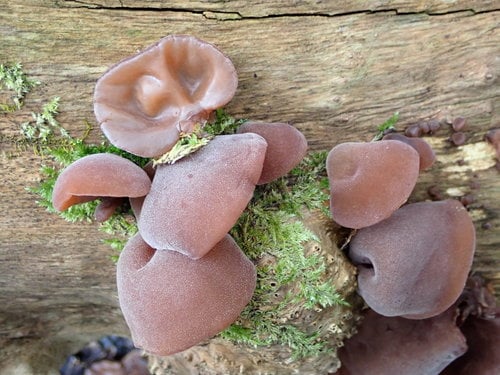
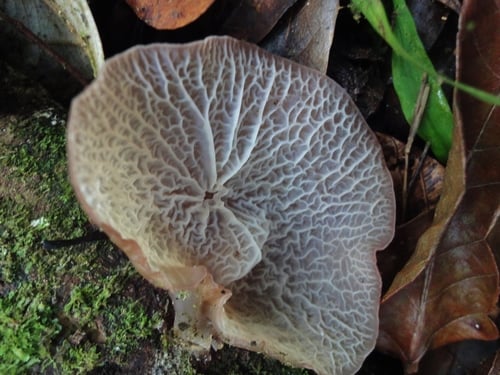
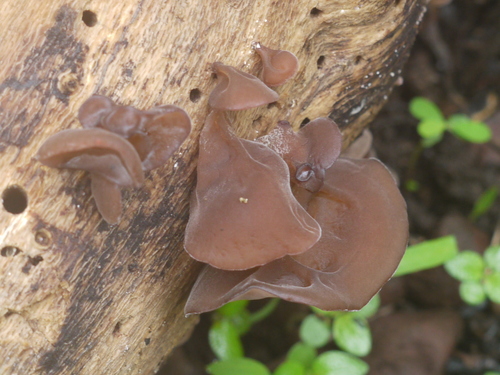
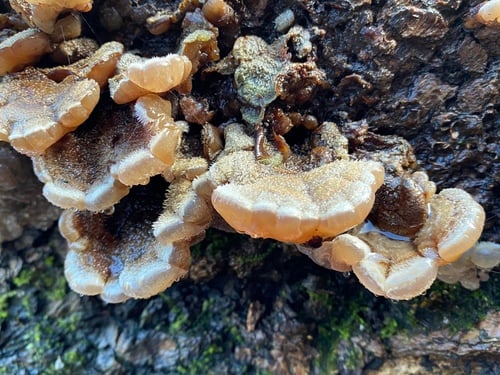
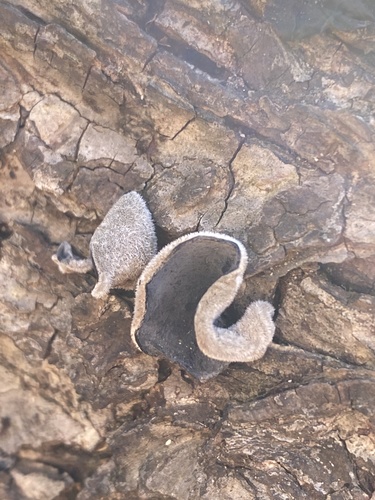
Auricularia polytricha
(Montagne) Saccardo
Black fungus, Wood ear, Hairy Jew’s ear
iNaturalist· cc-by-nc
(c) jjjohnston, some rights reserved (CC BY-NC)
iNaturalist· cc-by
(c) Wes Gapp, some rights reserved (CC BY), uploaded by Wes Gapp
iNaturalist· cc-by-nc
(c) Yukki Qiu, some rights reserved (CC BY-NC), uploaded by Yukki Qiu
Description
A mushroom. This jelly fungus or mushroom grows on logs. The cap is ear-shaped. It is leathery and 8 cm across. The stalk is short. It has frilly, brownish clumps of translucent tissue.
Edible Uses
The mushroom is used fresh or dried in sour salads, soups, and fried with chicken. It maintains a crunchy texture when added near the end of cooking.
Traditional Uses
The mushroom is used both fresh and dried. It is used in sour salads and in soups. It can also be fried with chicken. It keeps its crunchy texture if only added to dishes in the last few minutes of cooking.
Medicinal Uses
At least three species are commercially cultivated for food on a large scale in China and East Asia. They include Auricularia heimuer (black wood ear), formerly misdetermined as Auricularia auricula-judae; Auricularia cornea (wood ear or cloud ear), also called A. polytricha; and Auricularia villosula. Other species are eaten locally around the world. A study on the use of fungi by the Bini people of southern Nigeria found that the local inhabitants collected and ate a species similar to A. auricula-judae, but that it was not one of the fungi they used medicinally. Collection of Auricularia species has also been documented in Nepal. However, the Nepalese do not consider them all that good for eating; of the three grades given to edible fungi, they were given the worst. Additional places where Auricularia species have been recorded as locally gathered and consumed include Benin, Chile, Fiji, Ghana, Guatemala, India, Indonesia, Madagascar, Mexico, Mozambique, and Poland. Several species, including the Asian cultivated species and the European A. auricula-judae (jelly ear or jew's ear), have been used in traditional medicine. They have also been investigated for potential pharmaceutical use.
Distribution
A tropical and subtropical plant. In Thailand it grows on logs of Sesbania, Kapok, or mango. In China and the USA it is often near melting snow.
Where It Grows
Africa, Asia, Australia, Cambodia, Cameroon, Central Africa, Chile, China, Congo, East Africa, Fiji, Hawaii, Himalayas, Hong Kong, India, Indochina, Indonesia, Japan, Malaysia, Mexico, Myanmar, Nepal, New Zealand, North America, Northeastern India, Pacific, Russia, Samoa, SE Asia, South Africa, South America, Southern Africa, Taiwan, Tanzania, Thailand, Tonga, USA, Vietnam,
Other Information
It is sold in markets. It is cultivated in China. It is sold in Asian shops in Australia.
Nutrition
| Part | Moisture | kJ | kcal | Protein | Vit A | Vit C | Iron | Zinc |
|---|---|---|---|---|---|---|---|---|
| Mushroom dried | 14.8 | 1188 | 284 | 9.3 | 0 | 0 | 5.9 | 1.3 |
| Mushroom | 87.1 | 176 | 42 | 1 | 0 | 0 | 6.1 | — |
Also Known As
Arage-kikurage, Biyae, Black shelf fungus, Cendawan telinga kera, Chiple, Cloud ear, Daliga, Hakeka, Hed hoo noo, Hed hunu, Hunu, Jelly mushroom, Kikurage, Kuping jamu, Kuping tikus, Kyet neywet, Majiamdzum, Maomuer, Nam meo long, Mo-er, Mook yee, Mu-er, Pachei, Phset chheu, Psoet tratchik kandai, Silver ear, Tree ear, Wood fungus, Wun yee, Xer-bla-ble
References (36)
- Boa, E. R., 2004, Wild edible fungi and their importance to people. FAO Non Wood Forest Products Booklet 17
- Cengel, D. J. & Dany. C., (Eds), 2016, Integrating Forest Biodiversity Resource Management and Sustainable Community Livelihood Development in the Preah Vihear Protected Forest. International Tropical Timber Organization p 109
- Cribb, A.B. & J.W., 1976, Wild Food in Australia, Fontana. p 200
- Crowe, A., 1997, A Field Guide to the Native Edible Plants of New Zealand. Penguin. p 126
- Dongol, et al, 1995, Edible Mushrooms in Nepal (Also as Auricularia temperata)
Show all 36 references Hide references
- Facciola, S., 1998, Cornucopia 2: a Source Book of Edible Plants. Kampong Publications, p 250
- Food Composition Tables for use in East Asia FAO http://www.fao.org/infoods/directory No. 557
- Gryzenhout, M., 2010, Mushrooms of South Africa. Pocket Guide. Struik. p 118
- Hall, I. R., et al, 2003, Edible and Poisonous Mushrooms of the World. Timber Press. p 261
- Hu, Shiu-ying, 2005, Food Plants of China. The Chinese University Press. p 266
- Jacquat, C., 1990, Plants from the Markets of Thailand. D.K. Book House p 31
- Jansen, A. A. J., et al, (Eds), 1990, Food and Nutrition in Fiji. Volume One. p 52
- Jardin, C., 1970, List of Foods Used In Africa, FAO Nutrition Information Document Series No 2.p 113
- Kiple, K.F. & Ornelas, K.C., (eds), 2000, The Cambridge World History of Food. CUP p 317, 1758, 1819
- Low, T., 1992, Bush Tucker. Australia’s Wild Food Harvest. Angus & Robertson. p 168
- Medhi, P. & Borthakur, S. K., 2012, Phytoresources from North Cachur Hills of Assam -3: Edible plants sold at Hflong market. Indian Journal of Natural Products and Resources. 3(1) pp 84-109 (As polysticha)
- Medhi, P. & Borthakur, S. K., 2013, Wild edible plants sold by the Zeme Nagas at the makeshift market of Mahur, Dima Hasao district of Assam. Pleione 7(1): 84 - 93. 2013 (As polysticha)
- Medhi, P., Sarma, A and Borthakur, S. K., 2014, Wild edible plants from the Dima Hasao district of Assam, India. Pleione 8(1): 133-148 (As polysticha)
- Mulherin, J., 1994, Spices and natural flavourings. Tiger Books, London. p 61
- Ochse, J.J. et al, 1931, Vegetables of the Dutch East Indies. Asher reprint. p 72
- Ogle, B. M., et al, 2003, Food, Feed or Medicine: The Multiple Functions of Edible Wild Plants in Vietnam. Economic Botany 57(1): 103-117
- Parham, B. E. V., 1972, Plants of Samoa. New Zealand Department of Scientific and Industrial Research. Information Series. No. 85 p 118
- Quinonez-Martinez, M., et al, 2014, Knowledge and use of edible mushrooms in two municipalities of the Sierra Tarahumara, Chihuahua, Mexico. Journal of Ethniobiology and Ethnomedicine 10:6
- Ruan-Soto, F. et al, 2006, Process and dynamics of traditional selling wild edible mushrooms in tropical Mexico. Journal or Ethnobiology and Ethnomedicine. 2:3
- Sang, D. T., & Mizoue, K. O. N., 2012, Use of Edible Forest Plants among Indigenous Ethnic Minorities in Cat Tien Biosphere Reserve, Vietnam. Asian Journal of Biodiversity Vol. 3 (1), p 23-49
- Schneider, E., 2001, Vegetables from Amaranth to Zucchini: The essential reference. HarperCollins. p 698
- Semwal, K. C., et al, 2014, Edible mushrooms of the Northwestern Himalaya, India: a study of indigenous knowledge, distribution and diversity. Mycosphere 5(3): 440–461
- Solomon, C., 2001, Encyclopedia of Asian Food. New Holland. p 237
- Staples, G.W. and Herbst, D.R., 2005, A tropical Garden Flora. Bishop Museum Press, Honolulu, Hawaii. p 281
- Sunrinrut, P. et al, 1987, Protein, amino acids and some major and trace elements in Thai and Norwegian mushrooms. Plant Foods for Human Nutrition. 37:117-125
- Thaman, R.R., 1976, The Tongan Agricultural System, University of the South Pacific, Suva, Fiji. p 382
- Thatoi, H. & Singdevsachan, S. K., 2014, Diversity, nutritional composition and medicinal potential of Indian mushrooms: A review. African Journal of Biotechnology 13(4): 523-545
- Tibuhwa, 2013, Wild Mushroom - an underutilized healthy food resource and income generator: experience from Tanzania rural areas. Journal of Ethnobiology and Ethnomedicine 9:49
- Uphof,
- van Dijk, H., et al, 2003, Knowledge and Utilization of Edible Mushrooms by Local Populations of the Rain Forest of South Cameroon. Ambio Vol. 32, No. 1.pp 19-23
- Wikipedia